Last visit was: 23 Apr 2026, 23:09 It is currently 23 Apr 2026, 23:09
Close
GMAT Club Daily Prep
Thank you for using the timer - this advanced tool can estimate your performance and suggest more practice questions. We have subscribed you to Daily Prep Questions via email.

Customized
for You

we will pick new questions that match your level based on your Timer History

Track
Your Progress

every week, we’ll send you an estimated GMAT score based on your performance

Practice
Pays

we will pick new questions that match your level based on your Timer History
Not interested in getting valuable practice questions and articles delivered to your email? No problem, unsubscribe here.
Close
Request Expert Reply
Confirm Cancel
User avatar
EgmatQuantExpert
User avatar
e-GMAT Representative
Joined: 04 Jan 2015
Last visit: 02 Apr 2024
Posts: 3,657
Own Kudos:
20,872
 [39]
Given Kudos: 165
Expert
Expert reply
Posts: 3,657
Kudos: 20,872
 [39]
3
Kudos
Add Kudos
36
Bookmarks
Bookmark this Post
User avatar
EgmatQuantExpert
User avatar
e-GMAT Representative
Joined: 04 Jan 2015
Last visit: 02 Apr 2024
Posts: 3,657
Own Kudos:
20,872
 [3]
Given Kudos: 165
Expert
Expert reply
Posts: 3,657
Kudos: 20,872
 [3]
2
Kudos
Add Kudos
1
Bookmarks
Bookmark this Post
avatar
kapilsingal27
Joined: 30 Dec 2013
Last visit: 06 Sep 2024
Posts: 11
Own Kudos:
26
 [1]
Given Kudos: 891
Location: India
Posts: 11
Kudos: 26
 [1]
1
Kudos
Add Kudos
Bookmarks
Bookmark this Post
User avatar
rohit8865
Joined: 05 Mar 2015
Last visit: 19 Apr 2026
Posts: 815
Own Kudos:
1,008
 [2]
Given Kudos: 45
Products:
Posts: 815
Kudos: 1,008
 [2]
2
Kudos
Add Kudos
Bookmarks
Bookmark this Post
EgmatQuantExpert
Mastering Important Concept on Triangles – III - Question #2


In the given figure, BD = 6 and DC =4. If angle BAD = \(30^o\) and angle ADC = \(120^o\), find the area of the triangle ADC.
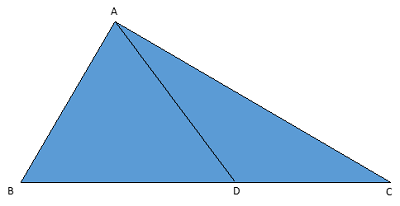


Answer Choices

    a. \(6√3 cm^2\)
    b. \(8√3 cm^2\)
    c. \(10√3 cm^2\)
    d. \(12√3 cm^2\)
    e. \(18√3 cm^2\)


[size=110]Key concepts on Triangles are explained in detail in the following posts:


since ADC=120 and BAD=30 we can find all angles in triangle ABD with ext. angle property.
thus ABD is 90-60-30 triangle with BD=6
thus we find other sides too as 2:√3:1 ratio as shown in fig as AB=6√3,BD=6 & AD=12

area of triangle ABC- ABD =area ADC

1/2*10*6√3 - 1/2*6√3*6 ==30√3 - 18√3 ==12√3

Ans D
Attachments

Q2.png
Q2.png [ 17.09 KiB | Viewed 11602 times ]

User avatar
EgmatQuantExpert
User avatar
e-GMAT Representative
Joined: 04 Jan 2015
Last visit: 02 Apr 2024
Posts: 3,657
Own Kudos:
Given Kudos: 165
Expert
Expert reply
Posts: 3,657
Kudos: 20,872
Kudos
Add Kudos
Bookmarks
Bookmark this Post
Hey Everyone,

The official solution has been posted. Please go through the solution once. In case of any doubts please feel to ask :)

Thanks,
Saquib
Quant Expert
e-GMAT
User avatar
BlueBook
Joined: 17 Oct 2019
Last visit: 10 Jul 2020
Posts: 51
Own Kudos:
Given Kudos: 109
Location: Kenya
Concentration: Leadership, Strategy
GMAT 1: 510 Q26 V34
WE:Science (Energy)
GMAT 1: 510 Q26 V34
Posts: 51
Kudos: 52
Kudos
Add Kudos
Bookmarks
Bookmark this Post
EgmatQuantExpert
Hey,

PFB the official solution.

It is given that angle \(BAD = 30^o\) and angle \(ADC = 120^o\)

Since we know that
    The External Angle = Sum of Opposite Internal Angles

We can write
    angle ADC =angle ABD + angle BAD
    • \(120^0 = ABD + 30^0\)
    • \(ABD = 90^0\)

Thus, we can conclude that triangle \(ABD\) is a right angle triangle!

To find the area of triangle \(ADC\), we need the value of the base \(DC\), which is given as 4 and we need the value of the height \(AB\).

The triangle \(ABD\) is a \(30^o-60^o-90^o\) triangle,therefore the sides \(BD : AB : AD\) are in the ratio - \(1 : √3 : 2\)

As we know the value of \(BD = 6\), we can easily find the value of \(AB\).
    • \(BD/AB = 1/√3\)
    • \(AB = 6√3\)

Thus the area of triangle \(ADC\)
    \(= 1/2 * DC * AB\)
    \(= 1/2 * 4 * 6√3\)
    \(= 12√3\)

And the correct answer option is D

How is AB the height of triangle ADC?

Thanks :please
User avatar
rohit8865
Joined: 05 Mar 2015
Last visit: 19 Apr 2026
Posts: 815
Own Kudos:
1,008
 [1]
Given Kudos: 45
Products:
Posts: 815
Kudos: 1,008
 [1]
1
Kudos
Add Kudos
Bookmarks
Bookmark this Post
GMATJock
EgmatQuantExpert
Hey,

PFB the official solution.

It is given that angle \(BAD = 30^o\) and angle \(ADC = 120^o\)

Since we know that
    The External Angle = Sum of Opposite Internal Angles

We can write
    angle ADC =angle ABD + angle BAD
    • \(120^0 = ABD + 30^0\)
    • \(ABD = 90^0\)

Thus, we can conclude that triangle \(ABD\) is a right angle triangle!

To find the area of triangle \(ADC\), we need the value of the base \(DC\), which is given as 4 and we need the value of the height \(AB\).

The triangle \(ABD\) is a \(30^o-60^o-90^o\) triangle,therefore the sides \(BD : AB : AD\) are in the ratio - \(1 : √3 : 2\)

As we know the value of \(BD = 6\), we can easily find the value of \(AB\).
    • \(BD/AB = 1/√3\)
    • \(AB = 6√3\)

Thus the area of triangle \(ADC\)
    \(= 1/2 * DC * AB\)
    \(= 1/2 * 4 * 6√3\)
    \(= 12√3\)

And the correct answer option is D

How is AB the height of triangle ADC?

Thanks :please


since we find angle abc is 90deg. ab is not only height of ADC but also height of ABC triangle
height is always measured in 90 deg.
if u want your height to be measured ,u have to stand right of 90 deg. otherwise measurement would not be correct.
hope it clears ur doubt
User avatar
lstudentd
Joined: 08 Feb 2017
Last visit: 27 Jan 2022
Posts: 22
Own Kudos:
Given Kudos: 35
Location: United States
Posts: 22
Kudos: 6
Kudos
Add Kudos
Bookmarks
Bookmark this Post
rohit8865
GMATJock
EgmatQuantExpert
Hey,

PFB the official solution.

It is given that angle \(BAD = 30^o\) and angle \(ADC = 120^o\)

Since we know that
    The External Angle = Sum of Opposite Internal Angles

We can write
    angle ADC =angle ABD + angle BAD
    • \(120^0 = ABD + 30^0\)
    • \(ABD = 90^0\)

Thus, we can conclude that triangle \(ABD\) is a right angle triangle!

To find the area of triangle \(ADC\), we need the value of the base \(DC\), which is given as 4 and we need the value of the height \(AB\).

The triangle \(ABD\) is a \(30^o-60^o-90^o\) triangle,therefore the sides \(BD : AB : AD\) are in the ratio - \(1 : √3 : 2\)

As we know the value of \(BD = 6\), we can easily find the value of \(AB\).
    • \(BD/AB = 1/√3\)
    • \(AB = 6√3\)

Thus the area of triangle \(ADC\)
    \(= 1/2 * DC * AB\)
    \(= 1/2 * 4 * 6√3\)
    \(= 12√3\)

And the correct answer option is D

How is AB the height of triangle ADC?

Thanks :please


since we find angle abc is 90deg. ab is not only height of ADC but also height of ABC triangle
height is always measured in 90 deg.
if u want your height to be measured ,u have to stand right of 90 deg. otherwise measurement would not be correct.
hope it clears ur doubt


I am still unclear how we know that AB is height of ADC. If it's because of the 90 deg angle, what about BD? Doesn't that also touch the 90 deg angle? I'm a bit confused on how to identify height for these types of problems, where it doesn't seem obvious.
User avatar
Nups1324
Joined: 05 Jan 2020
Last visit: 12 Sep 2023
Posts: 104
Own Kudos:
Given Kudos: 353
Posts: 104
Kudos: 65
Kudos
Add Kudos
Bookmarks
Bookmark this Post
EgmatQuantExpert
Mastering Important Concept on Triangles – III - Question #2


In the given figure, BD = 6 and DC =4. If angle BAD = \(30^o\) and angle ADC = \(120^o\), find the area of the triangle ADC.


Answer Choices

    a. \(6√3 cm^2\)
    b. \(8√3 cm^2\)
    c. \(10√3 cm^2\)
    d. \(12√3 cm^2\)
    e. \(18√3 cm^2\)


Key concepts on Triangles are explained in detail in the following posts:

1. Mastering Important Concepts Tested By GMAT in Triangle - I

2. Mastering Important Concepts Tested By GMAT in Triangle - II

3.Mastering Important Concepts Tested By GMAT in Triangle - III


Detailed solution will be posted soon.
:)

Thanks,
Saquib
Quant Expert
e-GMAT


Hi EgmatQuantExpert ,

I have a doubt.

Why can't we draw a perpendicular bisector from D to AC (example DE) and thus split △ADC into 2 30-60-90 triangles.?

If we do so then, we get AE as 2√3 and EC as 2√3. DE as 2.
Therefore, AC = 4√3 becomes our base and DE = 2 becomes our height. Thus giving us area of 4√3.

What is wrong in this approach?

I don't see anything wrong.. please let me know if I'm missing anything.

Tagging others just in case
Bunuel chetan2u GMATinsight IanStewart ScottTargetTestPrep yashikaaggarwal VeritasKarishma egmat EMPOWERgmatRichC

Thank you :)

Posted from my mobile device
User avatar
IanStewart
User avatar
GMAT Tutor
Joined: 24 Jun 2008
Last visit: 17 Apr 2026
Posts: 4,143
Own Kudos:
11,276
 [1]
Given Kudos: 99
Expert
Expert reply
Posts: 4,143
Kudos: 11,276
 [1]
1
Kudos
Add Kudos
Bookmarks
Bookmark this Post
Nups1324

I have a doubt.

Why can't we draw a perpendicular bisector from D to AC (example DE) and thus split △ADC into 2 30-60-90 triangles.?

When you draw a height in a triangle (which is what you're doing, when you draw your line DE), you're only ever dividing the triangle perfectly in half if your triangle is isosceles (or equilateral), and you're drawing the height between the two equal sides. In this question, AD and DC are not the same length, so the line DE you're trying to draw will not be a bisector -- you won't get two 30-60-90 triangles when you draw that line. Rounding off to integers, it turns out you'll actually get one 14-76-90 triangle, and one 46-44-90 triangle when you draw the line DE (I used trigonometry to work that out, which you'd never need to know for a GMAT question).
User avatar
lstudentd
Joined: 08 Feb 2017
Last visit: 27 Jan 2022
Posts: 22
Own Kudos:
Given Kudos: 35
Location: United States
Posts: 22
Kudos: 6
Kudos
Add Kudos
Bookmarks
Bookmark this Post
IanStewart
Nups1324

I have a doubt.

Why can't we draw a perpendicular bisector from D to AC (example DE) and thus split △ADC into 2 30-60-90 triangles.?

When you draw a height in a triangle (which is what you're doing, when you draw your line DE), you're only ever dividing the triangle perfectly in half if your triangle is isosceles (or equilateral), and you're drawing the height between the two equal sides. In this question, AD and DC are not the same length, so the line DE you're trying to draw will not be a bisector -- you won't get two 30-60-90 triangles when you draw that line. Rounding off to integers, it turns out you'll actually get one 14-76-90 triangle, and one 46-44-90 triangle when you draw the line DE (I used trigonometry to work that out, which you'd never need to know for a GMAT question).

Hi! Could you help explain how we know that AB is height of ADC. If it's because of the 90 deg angle, what about BD? Doesn't that also touch the 90 deg angle? I'm a bit confused on how to identify height for these types of problems, where it doesn't seem obvious.
User avatar
Nups1324
Joined: 05 Jan 2020
Last visit: 12 Sep 2023
Posts: 104
Own Kudos:
Given Kudos: 353
Posts: 104
Kudos: 65
Kudos
Add Kudos
Bookmarks
Bookmark this Post
IanStewart
Nups1324

I have a doubt.

Why can't we draw a perpendicular bisector from D to AC (example DE) and thus split △ADC into 2 30-60-90 triangles.?

When you draw a height in a triangle (which is what you're doing, when you draw your line DE), you're only ever dividing the triangle perfectly in half if your triangle is isosceles (or equilateral), and you're drawing the height between the two equal sides. In this question, AD and DC are not the same length, so the line DE you're trying to draw will not be a bisector -- you won't get two 30-60-90 triangles when you draw that line. Rounding off to integers, it turns out you'll actually get one 14-76-90 triangle, and one 46-44-90 triangle when you draw the line DE (I used trigonometry to work that out, which you'd never need to know for a GMAT question).

Oh yes. I overlooked the fact that AD and DC are not equal.

Thank you so much :)

Posted from my mobile device
User avatar
Nups1324
Joined: 05 Jan 2020
Last visit: 12 Sep 2023
Posts: 104
Own Kudos:
Given Kudos: 353
Posts: 104
Kudos: 65
Kudos
Add Kudos
Bookmarks
Bookmark this Post
lstudentd
IanStewart
Nups1324

I have a doubt.

Why can't we draw a perpendicular bisector from D to AC (example DE) and thus split △ADC into 2 30-60-90 triangles.?

When you draw a height in a triangle (which is what you're doing, when you draw your line DE), you're only ever dividing the triangle perfectly in half if your triangle is isosceles (or equilateral), and you're drawing the height between the two equal sides. In this question, AD and DC are not the same length, so the line DE you're trying to draw will not be a bisector -- you won't get two 30-60-90 triangles when you draw that line. Rounding off to integers, it turns out you'll actually get one 14-76-90 triangle, and one 46-44-90 triangle when you draw the line DE (I used trigonometry to work that out, which you'd never need to know for a GMAT question).

Hi! Could you help explain how we know that AB is height of ADC. If it's because of the 90 deg angle, what about BD? Doesn't that also touch the 90 deg angle? I'm a bit confused on how to identify height for these types of problems, where it doesn't seem obvious.

Hi,

If we take BD as the height then we must take AB as the base, since the height must be perpendicular to the base. Taking BD and AB will give us the area of triangle ABD.

Hope it's clear.

Posted from my mobile device
User avatar
lstudentd
Joined: 08 Feb 2017
Last visit: 27 Jan 2022
Posts: 22
Own Kudos:
Given Kudos: 35
Location: United States
Posts: 22
Kudos: 6
Kudos
Add Kudos
Bookmarks
Bookmark this Post
Quote:
Hi! Could you help explain how we know that AB is height of ADC. If it's because of the 90 deg angle, what about BD? Doesn't that also touch the 90 deg angle? I'm a bit confused on how to identify height for these types of problems, where it doesn't seem obvious.

Quote:
Hi,

If we take BD as the height then we must take AB as the base, since the height must be perpendicular to the base. Taking BD and AB will give us the area of triangle ABD.

Hope it's clear.

Posted from my mobile device

Thank you for your response! My confusion is that EgmatQuantExpert said:
"To find the area of triangle ADC, we need the value of the base DC, which is given as 4 and we need the value of the height AB."

I don't see how AB is the height of triangle ADC. As far as I can tell, I don't see the connection between AB and triangle ADC. Am I missing something really obvious here?
User avatar
lstudentd
Joined: 08 Feb 2017
Last visit: 27 Jan 2022
Posts: 22
Own Kudos:
Given Kudos: 35
Location: United States
Posts: 22
Kudos: 6
Kudos
Add Kudos
Bookmarks
Bookmark this Post
EgmatQuantExpert
Hey,

PFB the official solution.

It is given that angle \(BAD = 30^o\) and angle \(ADC = 120^o\)

Since we know that
    The External Angle = Sum of Opposite Internal Angles

We can write
    angle ADC =angle ABD + angle BAD
    • \(120^0 = ABD + 30^0\)
    • \(ABD = 90^0\)

Thus, we can conclude that triangle \(ABD\) is a right angle triangle!

To find the area of triangle \(ADC\), we need the value of the base \(DC\), which is given as 4 and we need the value of the height \(AB\).

The triangle \(ABD\) is a \(30^o-60^o-90^o\) triangle,therefore the sides \(BD : AB : AD\) are in the ratio - \(1 : √3 : 2\)

As we know the value of \(BD = 6\), we can easily find the value of \(AB\).
    • \(BD/AB = 1/√3\)
    • \(AB = 6√3\)

Thus the area of triangle \(ADC\)
    \(= 1/2 * DC * AB\)
    \(= 1/2 * 4 * 6√3\)
    \(= 12√3\)

And the correct answer option is D


Hi EgmatQuantExpert! I have a question on this part: "To find the area of triangle ADC, we need the value of the base DC, which is given as 4 and we need the value of the height AB."

I don't see how AB is the height of triangle ADC. As far as I can tell, I don't see the connection between AB and triangle ADC. Am I missing something really obvious here?
User avatar
KarishmaB
Joined: 16 Oct 2010
Last visit: 23 Apr 2026
Posts: 16,441
Own Kudos:
79,397
 [1]
Given Kudos: 484
Location: Pune, India
Expert
Expert reply
Active GMAT Club Expert! Tag them with @ followed by their username for a faster response.
Posts: 16,441
Kudos: 79,397
 [1]
1
Kudos
Add Kudos
Bookmarks
Bookmark this Post
lstudentd
Quote:
Hi! Could you help explain how we know that AB is height of ADC. If it's because of the 90 deg angle, what about BD? Doesn't that also touch the 90 deg angle? I'm a bit confused on how to identify height for these types of problems, where it doesn't seem obvious.

Quote:
Hi,

If we take BD as the height then we must take AB as the base, since the height must be perpendicular to the base. Taking BD and AB will give us the area of triangle ABD.

Hope it's clear.

Posted from my mobile device

Thank you for your response! My confusion is that EgmatQuantExpert said:
"To find the area of triangle ADC, we need the value of the base DC, which is given as 4 and we need the value of the height AB."

I don't see how AB is the height of triangle ADC. As far as I can tell, I don't see the connection between AB and triangle ADC. Am I missing something really obvious here?

Triangle ADC is an obtuse triangle.
Think about how you get the area of an obtuse triangle:
Attachment:
drawingobtusetriangleheight.png
drawingobtusetriangleheight.png [ 2.74 KiB | Viewed 6658 times ]

The altitude may not fall on the base because of the obtuse angle but nevertheless, the altitude has to be the perpendicular as shown in the diagram above.

Area = (1/2)*base*altitude
We have found that AB is perpendicular so it is the altitude (you can redraw the diagram according to given values and see that angle ABD is a right triangle).
User avatar
lstudentd
Joined: 08 Feb 2017
Last visit: 27 Jan 2022
Posts: 22
Own Kudos:
Given Kudos: 35
Location: United States
Posts: 22
Kudos: 6
Kudos
Add Kudos
Bookmarks
Bookmark this Post
Quote:
Thank you for your response! My confusion is that EgmatQuantExpert said:
"To find the area of triangle ADC, we need the value of the base DC, which is given as 4 and we need the value of the height AB."

I don't see how AB is the height of triangle ADC. As far as I can tell, I don't see the connection between AB and triangle ADC. Am I missing something really obvious here?

Quote:
Triangle ADC is an obtuse triangle.
Think about how you get the area of an obtuse triangle:
Attachment:
The attachment drawingobtusetriangleheight.png is no longer available

The altitude may not fall on the base because of the obtuse angle but nevertheless, the altitude has to be the perpendicular as shown in the diagram above.

Area = (1/2)*base*altitude
We have found that AB is perpendicular so it is the altitude (you can redraw the diagram according to given values and see that angle ABD is a right triangle).

Thank you VeritasKarishma! What if triangle ABD looked like the following where angle BAD is 90 degree instead? Which segment would then be the height of obtuse triangle ADC? Apologies for the rough drawing - I don't have the proper tools to make it look better.
Attachments

unnamed.png
unnamed.png [ 24.28 KiB | Viewed 6548 times ]

User avatar
lstudentd
Joined: 08 Feb 2017
Last visit: 27 Jan 2022
Posts: 22
Own Kudos:
Given Kudos: 35
Location: United States
Posts: 22
Kudos: 6
Kudos
Add Kudos
Bookmarks
Bookmark this Post
lstudentd
Quote:
Thank you for your response! My confusion is that EgmatQuantExpert said:
"To find the area of triangle ADC, we need the value of the base DC, which is given as 4 and we need the value of the height AB."

I don't see how AB is the height of triangle ADC. As far as I can tell, I don't see the connection between AB and triangle ADC. Am I missing something really obvious here?

Quote:
Triangle ADC is an obtuse triangle.
Think about how you get the area of an obtuse triangle:
Attachment:
The attachment drawingobtusetriangleheight.png is no longer available

The altitude may not fall on the base because of the obtuse angle but nevertheless, the altitude has to be the perpendicular as shown in the diagram above.

Area = (1/2)*base*altitude
We have found that AB is perpendicular so it is the altitude (you can redraw the diagram according to given values and see that angle ABD is a right triangle).

Thank you VeritasKarishma! What if triangle ABD looked like the following where angle BAD is 90 degree instead? Which segment would then be the height of obtuse triangle ADC? Apologies for the rough drawing - I don't have the proper tools to make it look better.

Hi VeritasKarishma, wanted to follow up on this one. What if triangle ABD looked like the following where angle BAD is 90 degree instead? Which segment would then be the height of obtuse triangle ADC? Apologies again for the rough drawing.
Attachments

unnamed.png
unnamed.png [ 24.28 KiB | Viewed 6405 times ]

User avatar
KarishmaB
Joined: 16 Oct 2010
Last visit: 23 Apr 2026
Posts: 16,441
Own Kudos:
Given Kudos: 484
Location: Pune, India
Expert
Expert reply
Active GMAT Club Expert! Tag them with @ followed by their username for a faster response.
Posts: 16,441
Kudos: 79,397
Kudos
Add Kudos
Bookmarks
Bookmark this Post
lstudentd
lstudentd
Quote:
Thank you for your response! My confusion is that EgmatQuantExpert said:
"To find the area of triangle ADC, we need the value of the base DC, which is given as 4 and we need the value of the height AB."

I don't see how AB is the height of triangle ADC. As far as I can tell, I don't see the connection between AB and triangle ADC. Am I missing something really obvious here?

Quote:
Triangle ADC is an obtuse triangle.
Think about how you get the area of an obtuse triangle:
Attachment:
drawingobtusetriangleheight.png

The altitude may not fall on the base because of the obtuse angle but nevertheless, the altitude has to be the perpendicular as shown in the diagram above.

Area = (1/2)*base*altitude
We have found that AB is perpendicular so it is the altitude (you can redraw the diagram according to given values and see that angle ABD is a right triangle).

Thank you VeritasKarishma! What if triangle ABD looked like the following where angle BAD is 90 degree instead? Which segment would then be the height of obtuse triangle ADC? Apologies for the rough drawing - I don't have the proper tools to make it look better.

Hi VeritasKarishma, wanted to follow up on this one. What if triangle ABD looked like the following where angle BAD is 90 degree instead? Which segment would then be the height of obtuse triangle ADC? Apologies again for the rough drawing.


I hope you understand that the figure you have given cannot be the figure of this question because BDC needs to be a straight line.

The figure you have presented is a quadrilateral. If we were to find the area of triangle ADC in this figure, we would extend DC to the left and make an altitude fall from A as shown in my previous figure by blue dotted lines. Or we could make an altitude drop from D on to AC (whatever works as per data given in the question).
The measure of angle BAD is irrelevant to get the area of triangle ADC.
User avatar
ScottTargetTestPrep
User avatar
Target Test Prep Representative
Joined: 14 Oct 2015
Last visit: 23 Apr 2026
Posts: 22,283
Own Kudos:
Given Kudos: 302
Status:Founder & CEO
Affiliations: Target Test Prep
Location: United States (CA)
Expert
Expert reply
Active GMAT Club Expert! Tag them with @ followed by their username for a faster response.
Posts: 22,283
Kudos: 26,531
Kudos
Add Kudos
Bookmarks
Bookmark this Post
Nups1324
EgmatQuantExpert
Mastering Important Concept on Triangles – III - Question #2


In the given figure, BD = 6 and DC =4. If angle BAD = \(30^o\) and angle ADC = \(120^o\), find the area of the triangle ADC.


Answer Choices

    a. \(6√3 cm^2\)
    b. \(8√3 cm^2\)
    c. \(10√3 cm^2\)
    d. \(12√3 cm^2\)
    e. \(18√3 cm^2\)


Hi EgmatQuantExpert ,

I have a doubt.

Why can't we draw a perpendicular bisector from D to AC (example DE) and thus split △ADC into 2 30-60-90 triangles.?

If we do so then, we get AE as 2√3 and EC as 2√3. DE as 2.
Therefore, AC = 4√3 becomes our base and DE = 2 becomes our height. Thus giving us area of 4√3.

What is wrong in this approach?

I don't see anything wrong.. please let me know if I'm missing anything.


Thank you :)

Posted from my mobile device
Solution:

We can indeed draw a perpendicular from D to AC or draw the bisector of the side AC; however, the perpendicular and the bisector will not coincide since triangle ACD is not an isosceles triangle. Further, notice that neither angle DAC nor angle ACD is 30 degrees; thus, it is impossible to create two 30-60-90 triangles by drawing some line from the point D onto side AC.
 1   2   
Moderators:
Math Expert
109802 posts
Tuck School Moderator
853 posts