Bunuel
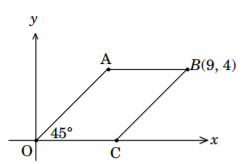
In the figure above, what is the perimeter of parallelogram OABC?
(A) 10 + 4√2
(B) 10 + 8√2
(C) 18
(D) 36
(E) It cannot be determined from the information given.
Attachment:
The attachment 2017-12-12_1002_001.png is no longer available
Attachment:
 eeee.png [ 18.47 KiB | Viewed 4925 times ]
Drop an altitude from vertex B to x-axis, point N
Draw a line from vertex A to y-axis, point M
∠ ABC = 45° (it is opposite congruent parallelogram ∠ O = 45°)
Derive:
Height is 4
-- y-coordinate of vertex B = 4
-- y-coordinate of N = 0
-- MB || ON, and BN is ⍊ to both, so distance between B and N = height of parallelogram =
-- difference between y-coordinates: (4 - 0) = 4
Height = 4 = Side BN
Triangle BCN is isosceles right triangle, from which we find two side lengths∆ BCN has one right angle and two 45° angles
-- right angle at N
-- ∠ C = 45° ( ∠ O = 45° = ∠ C, angles are corresponding in parallel lines cut by a transversal)
-- and other ∠ CBN = 45°
(Right angle at B) - (∠ABC) = ∠CBN
(90 - 45) = 45°
45-45-90: ∆ BCN is right isosceles
Sides opposite equal angles (45°) are equal
BN = CN = 4
Sides are in ratio
\(x : x : x\sqrt{2}\)Length \(4\) corresponds with \(x\)
Hypotenuse BC corresponds with
\(x\sqrt{2}\)BC =
\(4\sqrt{2}\) =
OA Side lengths: AB and OCSide OC length = 5 = AB
-- Point N coordinates are (9,0)
Points B and N lie on parallel lines; a perpendicular line from B intercepts opposite side at x-coordinate of B, so N = (9,0)
-- Point C coordinates must be (5,0)
(x-coordinate of N, 9) - (side length, 4) = x-coordinate of C
(9 - 4) = 5 = x-coordinate of C
-- Vertices O and C lie on same line; subtract x-coordinates to get distance from C to O
(5-0) = 5 = length of OC
OC = AB = 5Perimeter:
\(4\sqrt{2} + 4\sqrt{2} + 5 + 5 =\) \((10 + 8√2)\): Answer B
_________________
— The only thing more dangerous than ignorance is arrogance.
Einstein— I stand with Ukraine:
Donate to Help Ukraine!





