Given that |x – \(\frac{1}{5}\)| < \(\frac{3}{5}\) and we need to find the number of integer values that x can takeTo open |x – \(\frac{1}{5}\)| < \(\frac{3}{5}\) we need to take two cases (Watch
this video to know about the
Basics of Absolute Value)
Case 1: Assume that whatever is inside the Absolute Value/Modulus is non-negative=> x – \(\frac{1}{5}\) ≥ 0 => x ≥ \(\frac{1}{5}\)
|x – \(\frac{1}{5}\)| = x – \(\frac{1}{5}\) (as if A ≥ 0 then |A| = A)
=> x – \(\frac{1}{5}\) < \(\frac{3}{5}\)
=> x < \(\frac{3}{5}\) + \(\frac{1}{5}\)
=> x < \(\frac{4}{5}\)
And our condition was x ≥ \(\frac{1}{5}\). So the answer will be part common in x ≥ \(\frac{1}{5}\) and x < \(\frac{4}{5}\)
=> \(\frac{1}{5}\) ≤ x < \(\frac{4}{5}\) is the solution
Attachment:
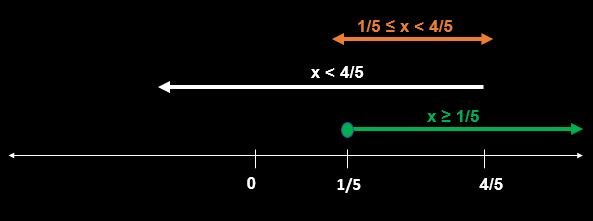 1by5 to 4by5.JPG [ 17.12 KiB | Viewed 3870 times ]
But there are no integers in this range.
Case 2: Assume that whatever is inside the Absolute Value/Modulus is Negative=> x – \(\frac{1}{5}\) < 0 => x < \(\frac{1}{5}\)
|x – \(\frac{1}{5}\)| = -(x – \(\frac{1}{5}\)) (as if A < 0 then |A| = -A)
=> -(x – \(\frac{1}{5}\)) < \(\frac{3}{5}\)
=> -x + \(\frac{1}{5}\) < \(\frac{3}{5}\)
=> x > \(\frac{1}{5}\) - \(\frac{3}{5}\)
=> x > \(\frac{-2}{5}\)
And our condition was x < \(\frac{1}{5}\). So the answer will be part common in x < \(\frac{1}{5}\) and x > \(\frac{-2}{5}\)
=> \(\frac{-2}{5}\) < x < \(\frac{1}{5}\) is the solution
Attachment:
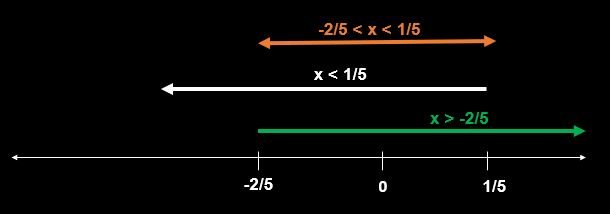 -2by5 to 1by5.JPG [ 17.21 KiB | Viewed 3726 times ]
Only integer in this range is 0So,
Answer will be BHope it helps!
Watch the following video to learn How to Solve Absolute Value Problems
_________________








