Events & Promotions
|
|

GMAT Club Daily Prep
Thank you for using the timer - this advanced tool can estimate your performance and suggest more practice questions. We have subscribed you to Daily Prep Questions via email.
Customized
for You
Track
Your Progress
Practice
Pays
Not interested in getting valuable practice questions and articles delivered to your email? No problem, unsubscribe here.
 Sep 17
12:30 AM EDT
-01:30 AM EDT
Thought your job leaves no time for GMAT prep? After multiple GMAT attempts and a demanding consulting job, Kshitij improved to 695 in under 2 months. Learn the mindset shifts, study strategy, and execution changes that made the breakthrough possible. Sep 18
01:30 AM EDT
-02:30 AM EDT
Learn how Kamakshi achieved a GMAT 675 with an impressive 96th %ile in Data Insights. Discover the unique methods and exam strategies that helped her excel in DI along with other sections for a balanced and high score. Sep 18
08:00 PM PDT
-09:00 PM PDT
Video explanations + diagnosis of 10 weakest areas + 150+ short videos + study plan! Sep 21
07:00 PM EDT
-10:00 PM EDT
Boost your GMAT score in less than one month in a live online class + 6 months access to TTP OnDemand video courses included!


 20 Sep 2020, 12:00
Kudos
Bookmarks


A
Be sure to select an answer first to save it in the Error Log before revealing the correct answer (OA)!
Difficulty:
 75%
(hard)
75%
(hard)
Question Stats:
58% (02:36) correct 42%
(02:31)
wrong
based on 381
sessions
42%
(02:31)
wrong
based on 381
sessions
History
Date
Time
Result
Not Attempted Yet
Among the computers at a store, 55 have a hard drive with at least 1 terabyte capacity, and 40 have at least a 3.2-gigahertz CPU. If the total number of computers exceeds 100, and 20 of the computers have neither a hard drive with 1-terabyte or greater capacity nor a CPU of 3.2 gigahertz or greater, which of the following could be the number of computers that have both a 1-terabyte or greater hard drive and a 3.2-gigahertz or greater CPU?
I. 10
II. 15
III. 20
A. I only
B. II only
C. III only
D. I and II
E. II and III
I. 10
II. 15
III. 20
A. I only
B. II only
C. III only
D. I and II
E. II and III
 20 Sep 2020, 13:28
Kudos
Bookmarks
In such questions, I personally always find it easier to map the data in a tabular form.
(I don't know if there is a name for this method)
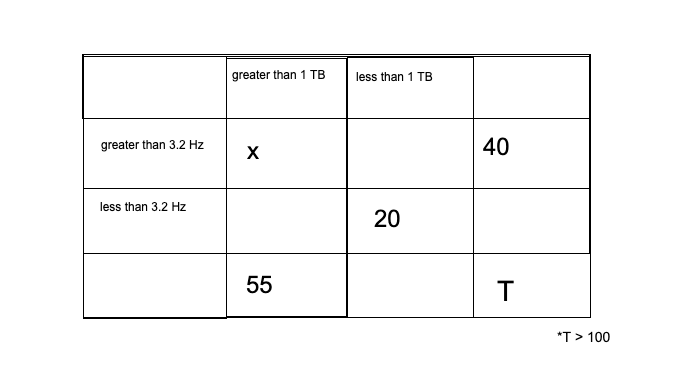
Anywho, first and foremost, using the data given in the question, make a table as given below:
untitled.png [ 19.66 KiB | Viewed 7244 times ]
I have marked the unknown ie. computers >1TB and >3.2 G Hz as x
I have marked the other unknown ie. Total no. of computers in the store as T
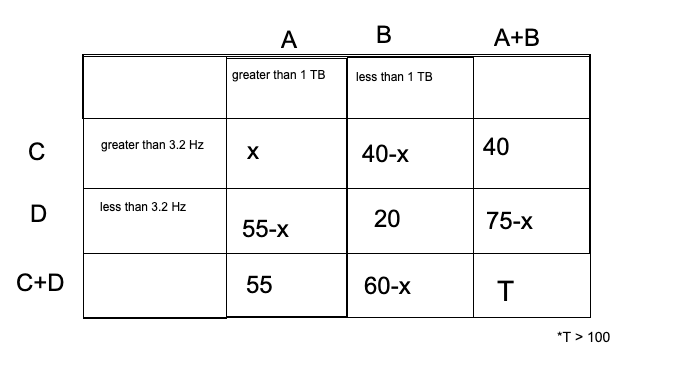
Now using the table, we can form the following equations:
untitled (2).png [ 25.52 KiB | Viewed 7185 times ]
Now lets take the bottommost horizontal row, (Even the rightmost vertical column can be considered )
)
We know 55 + 60 - x = T
115-x = T <------------- (1)
We know that T has to be greater than 100.
Plugging in the values into (1), we get
I) x = 10, T = 105 ----> Hence, possible.
II) x= 15, T = 100 ----> Not possible as T>100.
III) x = 20, T = 95 -----> Again, not possible.
Hence only (I) is possible.
Option A is our answer.
(I don't know if there is a name for this method)
Anywho, first and foremost, using the data given in the question, make a table as given below:
Attachment:
untitled.png [ 19.66 KiB | Viewed 7244 times ]
I have marked the unknown ie. computers >1TB and >3.2 G Hz as x
I have marked the other unknown ie. Total no. of computers in the store as T
Now using the table, we can form the following equations:
Attachment:
untitled (2).png [ 25.52 KiB | Viewed 7185 times ]
Now lets take the bottommost horizontal row, (Even the rightmost vertical column can be considered
)We know 55 + 60 - x = T
115-x = T <------------- (1)
We know that T has to be greater than 100.
Plugging in the values into (1), we get
I) x = 10, T = 105 ----> Hence, possible.
II) x= 15, T = 100 ----> Not possible as T>100.
III) x = 20, T = 95 -----> Again, not possible.
Hence only (I) is possible.
Option A is our answer.
General Discussion
 20 Sep 2020, 12:43
Kudos
Bookmarks
Total no of computers with 1tb HD=55
with 3.2 Tb CPU=40
computers with don't have anything =20
Now depending upon total no of computers , number of computers having both will change
Total comp are more than 100 .
So assuming comp will be around 101 will give us computers have HD and CPU or both will be 81
and total of COmp with HD and CPU= 55+40=95
so comp with both will be 95-81=14.
So answer will be less than or equal to 14
So Option A is 5
Answer will be A.
with 3.2 Tb CPU=40
computers with don't have anything =20
Now depending upon total no of computers , number of computers having both will change
Total comp are more than 100 .
So assuming comp will be around 101 will give us computers have HD and CPU or both will be 81
and total of COmp with HD and CPU= 55+40=95
so comp with both will be 95-81=14.
So answer will be less than or equal to 14
So Option A is 5
Answer will be A.