Last visit was: 24 Apr 2026, 14:45 It is currently 24 Apr 2026, 14:45
Close
GMAT Club Daily Prep
Thank you for using the timer - this advanced tool can estimate your performance and suggest more practice questions. We have subscribed you to Daily Prep Questions via email.

Customized
for You

we will pick new questions that match your level based on your Timer History

Track
Your Progress

every week, we’ll send you an estimated GMAT score based on your performance

Practice
Pays

we will pick new questions that match your level based on your Timer History
Not interested in getting valuable practice questions and articles delivered to your email? No problem, unsubscribe here.
Close
Request Expert Reply
Confirm Cancel
User avatar
v12345
Joined: 01 Mar 2015
Last visit: 19 Jan 2026
Posts: 398
Own Kudos:
1,118
 [9]
Given Kudos: 44
Location: India
Posts: 398
Kudos: 1,118
 [9]
Kudos
Add Kudos
8
Bookmarks
Bookmark this Post
Most Helpful Reply
User avatar
andreagonzalez2k
Joined: 15 Feb 2021
Last visit: 26 Jul 2025
Posts: 308
Own Kudos:
503
 [5]
Given Kudos: 14
Posts: 308
Kudos: 503
 [5]
5
Kudos
Add Kudos
Bookmarks
Bookmark this Post
General Discussion
User avatar
rsrighosh
Joined: 13 Jun 2019
Last visit: 11 Dec 2022
Posts: 184
Own Kudos:
137
 [1]
Given Kudos: 645
GMAT 1: 490 Q42 V17
GMAT 2: 550 Q39 V27
GMAT 3: 630 Q49 V27
GMAT 3: 630 Q49 V27
Posts: 184
Kudos: 137
 [1]
Kudos
Add Kudos
Bookmarks
Bookmark this Post
User avatar
v12345
Joined: 01 Mar 2015
Last visit: 19 Jan 2026
Posts: 398
Own Kudos:
1,118
 [2]
Given Kudos: 44
Location: India
Posts: 398
Kudos: 1,118
 [2]
2
Kudos
Add Kudos
Bookmarks
Bookmark this Post
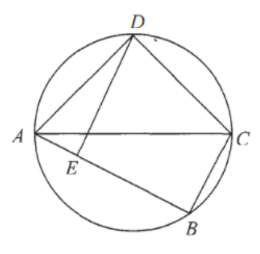
Let r be the radius of the circle with center O.
∠ADC = ∠ABC = 90° ( Diameter AC subtends right angle at circumference)
AD = DC, ∠ACD = 45°

AD subtends equal angles at circumference,
∠ACD = 45°, so ∠ABD = 45°
Then DE = EB = x.
Attachment:
CaptureAns.PNG
CaptureAns.PNG [ 44 KiB | Viewed 6268 times ]

area of quadrilateral ABCD = area of AED + area of EBD + area of BCD = 24
\(\frac{1}{2}(AB - x)*x + \frac{1}{2}x^2 + \frac{1}{2}BC*x = 24\)
\(\frac{1}{2}(AB+BC)*x= 24\)
\(x= \frac{48}{(AB + BC)}\)

Also,
area of quadrilateral ABCD = area of ABC + area of ACD = 24
\(\frac{1}{2}AB*BC + \frac{1}{2}AC*OD= 24\)
\(\frac{1}{2}AB*BC + r^2= 24\)
\(AB*BC = 2(24 - r^2)\)

In triangle ABC,
\(AB^2 + BC^2 = AC^2 = 4r^2\)
\((AB + BC)^2 - 2*AB*BC= 4r^2\)
\((AB + BC)^2 = 4r^2 + 4(24 - r^2) = 96\)
\(AB + BC = 4\sqrt{6}\)

\(x= \frac{48}{(AB + BC)} = \frac{48}{4\sqrt{6}} = 2\sqrt{6}\)
Hence, OA is (D).
User avatar
rsrighosh
Joined: 13 Jun 2019
Last visit: 11 Dec 2022
Posts: 184
Own Kudos:
Given Kudos: 645
GMAT 1: 490 Q42 V17
GMAT 2: 550 Q39 V27
GMAT 3: 630 Q49 V27
GMAT 3: 630 Q49 V27
Posts: 184
Kudos: 137
Kudos
Add Kudos
Bookmarks
Bookmark this Post
andreagonzalez2k highly interesting approach. Thanks for sharing
v12345 very well and detailed explanation. Thanks for sharing. Need to ensure I remember subtend property :)
User avatar
thakurarun85
Joined: 10 Jul 2021
Last visit: 21 Sep 2022
Posts: 216
Own Kudos:
Given Kudos: 29
Posts: 216
Kudos: 56
Kudos
Add Kudos
Bookmarks
Bookmark this Post
v12345
Let r be the radius of the circle with center O.
∠ADC = ∠ABC = 90° ( Diameter AC subtends right angle at circumference)
AD = DC, ∠ACD = 45°

AD subtends equal angles at circumference,
∠ACD = 45°, so ∠ABD = 45°
Then DE = EB = x.
Attachment:
CaptureAns.PNG

area of quadrilateral ABCD = area of AED + area of EBD + area of BCD = 24
\(\frac{1}{2}(AB - x)*x + \frac{1}{2}x^2 + \frac{1}{2}BC*x = 24\)
\(\frac{1}{2}(AB+BC)*x= 24\)
\(x= \frac{48}{(AB + BC)}\)

Also,
area of quadrilateral ABCD = area of ABC + area of ACD = 24
\(\frac{1}{2}AB*BC + \frac{1}{2}AC*OD= 24\)
\(\frac{1}{2}AB*BC + r^2= 24\)
\(AB*BC = 2(24 - r^2)\)

In triangle ABC,
\(AB^2 + BC^2 = AC^2 = 4r^2\)
\((AB + BC)^2 - 2*AB*BC= 4r^2\)
\((AB + BC)^2 = 4r^2 + 4(24 - r^2) = 96\)
\(AB + BC = 4\sqrt{6}\)

\(x= \frac{48}{(AB + BC)} = \frac{48}{4\sqrt{6}} = 2\sqrt{6}\)
Hence, OA is (D).

How area of BCD = 1/2*BC*X
User avatar
v12345
Joined: 01 Mar 2015
Last visit: 19 Jan 2026
Posts: 398
Own Kudos:
Given Kudos: 44
Location: India
Posts: 398
Kudos: 1,118
Kudos
Add Kudos
Bookmarks
Bookmark this Post
thakurarun85

How area of BCD = 1/2*BC*X

thakurarun85
BC extended to drop a perpendicular from D = height BCD = x
Area of triangle BCD = 1/2 * base * height = 1/2 * BC * x
Attachments

image.PNG
image.PNG [ 59.27 KiB | Viewed 5599 times ]

User avatar
100mitra
Joined: 29 Apr 2019
Last visit: 06 Jul 2022
Posts: 707
Own Kudos:
634
 [1]
Given Kudos: 49
Status:Learning
Posts: 707
Kudos: 634
 [1]
Kudos
Add Kudos
1
Bookmarks
Bookmark this Post
Correct Option : D


First, we have that BC || ED , which is obvious from the information.
Next is that since AD=DC , BD is the angle bisector of ∠BAC which gives BED an isosceles triangle and DE=BE.
Now draw a perpendicular from C to DE and let it intersect at F .
We have that ΔAED≅ΔDFC from RHS , and this gives all the necessary piece of info in the picture, also noting that CFEB is a rectangle.
This total areas of the 2 triangles and the rectangle gives the area of the quadrilateral

From here :-
[ABCD] = 2 [ΔAED] + [CFEB]
→24 = x(x+y) + y(x+y)
→24 = (x+y)^2
→(x+y) = DE = √24

Hence DE^2 = 24 .

PS : This is not my solution, found while serching for solution on web, credit goes to the person, who has solved it, sharing as a learning for better of all.

Posted from my mobile device
Attachments

Screenshot_20210919-103946~2.jpg
Screenshot_20210919-103946~2.jpg [ 78.86 KiB | Viewed 5491 times ]

User avatar
Fdambro294
Joined: 10 Jul 2019
Last visit: 20 Aug 2025
Posts: 1,331
Own Kudos:
Given Kudos: 1,656
Posts: 1,331
Kudos: 772
Kudos
Add Kudos
Bookmarks
Bookmark this Post
Thank you for this.

That first piece of information is key.

If from the same Line BA

A line segment ED and a line segment BC both “depart” or extend from that Line BA from the same Angle (90 degrees) ———-> then ED and BC will be parallel.

Hard question.


100mitra
Correct Option : D


First, we have that BC || ED , which is obvious from the information.
Next is that since AD=DC , BD is the angle bisector of ∠BAC which gives BED an isosceles triangle and DE=BE.
Now draw a perpendicular from C to DE and let it intersect at F .
We have that ΔAED≅ΔDFC from RHS , and this gives all the necessary piece of info in the picture, also noting that CFEB is a rectangle.
This total areas of the 2 triangles and the rectangle gives the area of the quadrilateral

From here :-
[ABCD] = 2 [ΔAED] + [CFEB]
→24 = x(x+y) + y(x+y)
→24 = (x+y)^2
→(x+y) = DE = √24

Hence DE^2 = 24 .

PS : This is not my solution, found while serching for solution on web, credit goes to the person, who has solved it, sharing as a learning for better of all.

Posted from my mobile device
User avatar
bumpbot
User avatar
Non-Human User
Joined: 09 Sep 2013
Last visit: 04 Jan 2021
Posts: 38,974
Own Kudos:
Posts: 38,974
Kudos: 1,117
Kudos
Add Kudos
Bookmarks
Bookmark this Post
Automated notice from GMAT Club BumpBot:

A member just gave Kudos to this thread, showing it’s still useful. I’ve bumped it to the top so more people can benefit. Feel free to add your own questions or solutions.

This post was generated automatically.
Moderators:
Math Expert
109818 posts
Tuck School Moderator
853 posts