Events & Promotions
|
|

GMAT Club Daily Prep
Thank you for using the timer - this advanced tool can estimate your performance and suggest more practice questions. We have subscribed you to Daily Prep Questions via email.
Customized
for You
Track
Your Progress
Practice
Pays
Not interested in getting valuable practice questions and articles delivered to your email? No problem, unsubscribe here.
 Sep 15
07:00 PM EDT
-09:00 PM EST
Elite scores are possible when you enroll in a powerful GMAT course, taught live online + 6 months access to TTP OnDemand video courses included! Class starts Tues/Thurs Sept. 15, 2026 - Nov. 15, 2027, 7:00pm-9:00pm EST Sep 17
12:30 AM EDT
-01:30 AM EDT
Thought your job leaves no time for GMAT prep? After multiple GMAT attempts and a demanding consulting job, Kshitij improved to 695 in under 2 months. Learn the mindset shifts, study strategy, and execution changes that made the breakthrough possible. Sep 18
01:30 AM EDT
-02:30 AM EDT
Learn how Kamakshi achieved a GMAT 675 with an impressive 96th %ile in Data Insights. Discover the unique methods and exam strategies that helped her excel in DI along with other sections for a balanced and high score. Sep 18
08:00 PM PDT
-09:00 PM PDT
Video explanations + diagnosis of 10 weakest areas + 150+ short videos + study plan! Sep 21
07:00 PM EDT
-10:00 PM EDT
Boost your GMAT score in less than one month in a live online class + 6 months access to TTP OnDemand video courses included!


 22 Feb 2022, 06:30
Kudos
Bookmarks


D
Be sure to select an answer first to save it in the Error Log before revealing the correct answer (OA)!
Difficulty:
 65%
(hard)
65%
(hard)
Question Stats:
54% (02:14) correct 46%
(01:35)
wrong
based on 84
sessions
46%
(01:35)
wrong
based on 84
sessions
History
Date
Time
Result
Not Attempted Yet
If AC = BC and CD = DE then, in terms of x, the value of y is
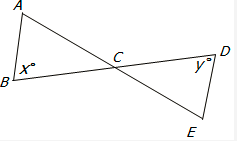
Note: Figure not drawn to scale
A. x
B. 180 - 2x
C. 90 - 2x
D. 4x - 180
E. 45 + x/4
Are You Up For the Challenge: 700 Level Questions

GMAT_PS_Magoosh_359.png [ 1.96 KiB | Viewed 5331 times ]
Note: Figure not drawn to scale
A. x
B. 180 - 2x
C. 90 - 2x
D. 4x - 180
E. 45 + x/4
Are You Up For the Challenge: 700 Level Questions
Attachment:
GMAT_PS_Magoosh_359.png [ 1.96 KiB | Viewed 5331 times ]
 22 Feb 2022, 11:18
Kudos
Bookmarks
Bunuel
When we add the given information to the diagram we get:

In an isosceles triangle, the angles opposite the equal sides are always equal.
This means ∠A = x°
Also, since the angles in a triangle must add to 180°, we know that ∠ACB = 180 - 2x
The angles in the other triangle are a little trickier, so, let's label them k to get the following diagram:

Since the angles in a triangle must add to 180°, we can write: k + k + y = 180
Simplify: 2k + y = 180
Subtract y from both sides: 2k = 180 - y
Divide both sides by 2 to get: : k = (180 - y)/2
So, we can add this information to our diagram:

Finally, since opposite angles are equal, we can write the following equation: 180 - 2x = k = (180 - y)/2 [we need to solve this equation for y]
Multiply both sides of the equation by 2 to get: 360 - 4x = 180 - y
Subtract 180 from both sides of the equation to get: 180 - 4x = -y
Multiply both sides of the equation by -1 to get: -180 + 4x = y, which can be rearranged as follows: y = 4x - 180
Answer: D
RELATED VIDEOS
 03 Apr 2024, 02:11
Kudos
Bookmarks
Automated notice from GMAT Club BumpBot:
A member just gave Kudos to this thread, showing it’s still useful. I’ve bumped it to the top so more people can benefit. Feel free to add your own questions or solutions.
This post was generated automatically.
A member just gave Kudos to this thread, showing it’s still useful. I’ve bumped it to the top so more people can benefit. Feel free to add your own questions or solutions.
This post was generated automatically.



