Events & Promotions
|
|

GMAT Club Daily Prep
Thank you for using the timer - this advanced tool can estimate your performance and suggest more practice questions. We have subscribed you to Daily Prep Questions via email.
Customized
for You
Track
Your Progress
Practice
Pays
Not interested in getting valuable practice questions and articles delivered to your email? No problem, unsubscribe here.
 Sep 26
01:00 PM EDT
-04:00 PM EDT
Top scores are possible when you enroll in a powerful GMAT course, taught live online + 6 months access to TTP OnDemand video courses included. Class starts Saturdays Sept. 26, 2026 - Dec. 19, 2026, 1:00pm-4:00pm ES Sep 29
11:00 AM EDT
-01:00 PM EDT
" Description: Top scores are possible when you enroll in a powerful GMAT course, taught live online + 6 months access to TTP OnDemand video courses included! Class starts Tues/Thur Sept. 29, 2026 - Dec. 3, 2026, 11:00am-1:00pm EST


 21 Nov 2022, 09:15
Kudos
Bookmarks


N
Be sure to select an answer first to save it in the Error Log before revealing the correct answer (OA)!
Difficulty:
(N/A)
Question Stats:
0% (00:00) correct 0%
(00:00)
wrong
based on 0
sessions
0%
(00:00)
wrong
based on 0
sessions
History
Date
Time
Result
Not Attempted Yet
Let us start this article with a question
Question:
What is the unit digit of \(1234^{567}\)?
cyclicity1.png [ 34.35 KiB | Viewed 2751 times ]
cyclicity2.png [ 22.68 KiB | Viewed 2775 times ]
cyclicity3.png [ 26.26 KiB | Viewed 2780 times ]
cyclicity4.png [ 20.72 KiB | Viewed 2764 times ]
Answer to the initial question: What is the unit digit of \(1234^{567}\)?
Now coming back to this question, we see that we are looking for the units digit of the number \(1234^{567}\)
We can follow the following steps to get the answer effectively
Step 1: The units digit depends only on the units digit of the base
Step 2: We can find out the remainder by dividing the exponent (467) by 2. In this case, the remainder is 1
Step 3: We rewrite the number as \(4^1\) and the answer is \(4\)
Question:
What is the unit digit of \(1234^{567}\)?
- To be able to answer the above question, we need to understand what ‘cyclicity’ is and how it is related to unit digits
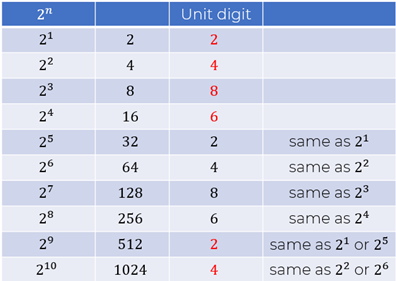
- Let us take the example of 2 and its multiple positive integral power like \(2^1, 2^2, 2^3\) and so on
Attachment:
cyclicity1.png [ 34.35 KiB | Viewed 2751 times ]
- If you look closely, you will notice a pattern of 2, 4, 8, and 6 and the pattern repeats itself after every 4th power
- Unit digit of \(2^5\) is the same as the unit digit of \(2^1\)
- Unit digit of \(2^6\) is the same as the unit digit of \(2^2\)
- Unit digit of \(2^7\) is the same as the unit digit of \(2^3\)
- Unit digit of \(2^8\) is the same as the unit digit of \(2^4\)
- This pattern continues throughout
- Does this mean that every number will show the same pattern as 2? 🤔
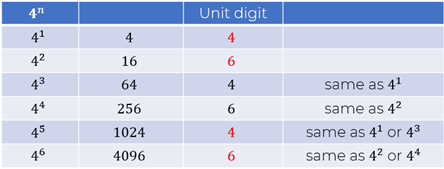
- Well, let us check one more number. Say for 4
Attachment:
cyclicity2.png [ 22.68 KiB | Viewed 2775 times ]
- We see that in the case of 4, the repeating numbers are 4 and 6 and this pattern repeats itself after every 2nd power
- Thus, we can say that
- The cyclicity of 2 is 4 (because the pattern 2, 4, 6, and 8 repeats after every 4th power), and
- The cyclicity of 4 is 2 (because the pattern 4 and 6 repeats after every 2nd power)
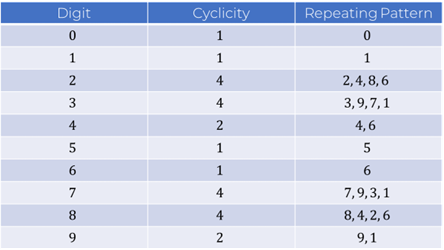
- We can do the same exercise to get the cyclicity of any other digit
Attachment:
cyclicity3.png [ 26.26 KiB | Viewed 2780 times ]
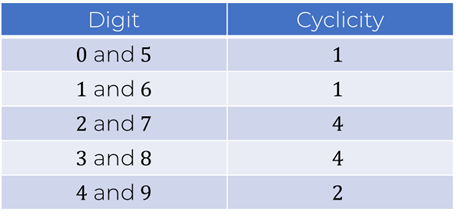
- The above table can be shortened and written as
Attachment:
cyclicity4.png [ 20.72 KiB | Viewed 2764 times ]
- Trick: This is an easier tale to learn
- Cyclicity of 0, 1, 2, 3, and 4 is the same as cyclicity of 5, 6, 7, 8, and 9 respectively
Answer to the initial question: What is the unit digit of \(1234^{567}\)?
Now coming back to this question, we see that we are looking for the units digit of the number \(1234^{567}\)
We can follow the following steps to get the answer effectively
Step 1: The units digit depends only on the units digit of the base
- We can consider this number as \(4^{567}\)
- This suggests \(4^1, 4^3, 4^5\), … will have a units digit of 4
- This suggests \(4^2, 4^4, 4^6\), … will have a units digit of 6
Step 2: We can find out the remainder by dividing the exponent (467) by 2. In this case, the remainder is 1
- We can consider the exponent as 1
Step 3: We rewrite the number as \(4^1\) and the answer is \(4\)
 22 Jan 2025, 08:03
Kudos
Bookmarks
Automated notice from GMAT Club BumpBot:
A member just gave Kudos to this thread, showing it’s still useful. I’ve bumped it to the top so more people can benefit. Feel free to add your own questions or solutions.
This post was generated automatically.
A member just gave Kudos to this thread, showing it’s still useful. I’ve bumped it to the top so more people can benefit. Feel free to add your own questions or solutions.
This post was generated automatically.
Moderator:



