Events & Promotions
|
|

GMAT Club Daily Prep
Thank you for using the timer - this advanced tool can estimate your performance and suggest more practice questions. We have subscribed you to Daily Prep Questions via email.
Customized
for You
Track
Your Progress
Practice
Pays
Not interested in getting valuable practice questions and articles delivered to your email? No problem, unsubscribe here.
 Apr 23
08:00 PM PDT
-09:00 PM PDT
Video explanations + diagnosis of 10 weakest areas + 150+ short videos + study plan! Apr 23
01:30 AM EDT
-02:30 AM EDT
Struggling with GMAT Verbal as a non-native speaker? Harsh improved his score from 595 to 695 in just 45 days—and scored a 99 %ile in Verbal (V88)! Learn how smart strategy, clarity, and guided prep helped him gain 100 points. Apr 25
12:30 AM EDT
-01:30 AM EDT
At one point, she believed GMAT wasn’t for her. After scoring 595, self-doubt crept in and she questioned her potential. But instead of quitting, she made the right strategic changes. The result? A remarkable comeback to 695. Check out how Saakshi did it. Apr 26
10:00 AM EDT
-11:00 AM EDT
The Target Test Prep course represents a quantum leap forward in GMAT preparation, a radical reinterpretation of the way that students should study. Try before you buy with a 5-day, full-access trial of the course for FREE! Apr 27
11:00 AM EDT
-12:00 PM EDT
Prefer video-based learning? The Target Test Prep OnDemand course is a one-of-a-kind video masterclass featuring 400 hours of lecture-style teaching by Scott Woodbury-Stewart, founder of Target Test Prep and one of the most accomplished GMAT instructors Apr 28
08:00 AM PDT
-11:00 AM PDT
Whether you are just beginning your MBA journey or fine-tuning your path to a 700+ score, GMAT Day is designed to give you a competitive edge.

 04 Dec 2023, 09:49
Kudos
Bookmarks


D
Be sure to select an answer first to save it in the Error Log before revealing the correct answer (OA)!
Difficulty:
 35%
(medium)
35%
(medium)
Question Stats:
74% (01:24) correct 26%
(01:42)
wrong
based on 709
sessions
26%
(01:42)
wrong
based on 709
sessions
History
Date
Time
Result
Not Attempted Yet

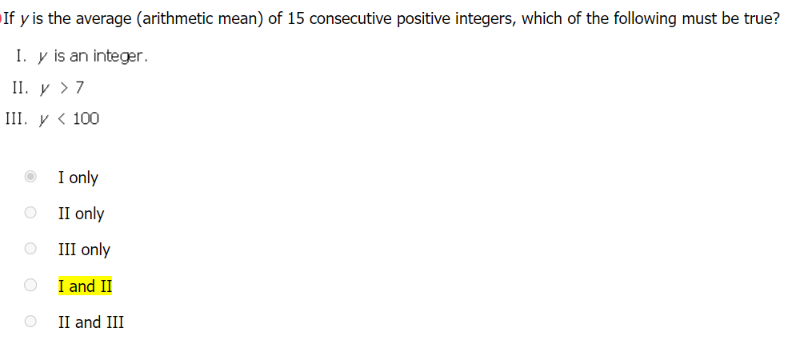
If y is the average (arithmetic mean) of 15 consecutive positive integers, which of the following must be true?
I. y is an integer.
II. y > 7
III. y < 100
A. I only
B. II only
C. III only
D. I and II
E. II and III
2023-12-04_20-37-35.png [ 29.05 KiB | Viewed 11666 times ]
I. y is an integer.
II. y > 7
III. y < 100
A. I only
B. II only
C. III only
D. I and II
E. II and III
Attachment:
2023-12-04_20-37-35.png [ 29.05 KiB | Viewed 11666 times ]
Question exposed a gap?
Take sectional Adaptive Quant, Verbal, or DI tests on GMAT Club and review the detailed score report.
Get started →


 04 Dec 2023, 09:53
Kudos
Bookmarks
guddo
Firstly, the average of any evenly spaced set is equal to its median, and the median of an odd number of integers is the middle number when arranged in order.
Therefore, the average/median will always be an integer, making I always true.
The lowest set of 15 consecutive positive integers is {1, 2, 3, 4, 5, 6, 7, 8, 9, 10, 11, 12, 13, 14, 15}. The average/median in this case is 8, so it is greater than 7. Hence, all other sets will also have averages greater than 7, making II also true.
As for III, it's not always true. We can make the set as large as we want, so the upper limit of the average is not restricted at all.
Answer: D.
General Discussion


 09 Dec 2023, 06:30
Kudos
Bookmarks
guddo
Asked: If y is the average (arithmetic mean) of 15 consecutive positive integers, which of the following must be true?
I. y is an integer. For odd number of integers (15), the average is middle value (8th integer) MUST BE TRUE
II. y > 7: If starting integer = 1(lowest); y=8>7. For all other starting integers > 1; y > 7; MUST BE TRUE
III. y < 100; If starting integer =1 ; No; If starting integer = 100; Yes. COULD BE TRUE
A. I only
B. II only
C. III only
D. I and II
E. II and III
IMO D
Asked: If y is the average (arithmetic mean) of 15 consecutive positive integers, which of the following must be true?
I. y is an integer. For odd number of integers (15), the average is middle value (8th integer) MUST BE TRUE
II. y > 7: If starting integer = 1(lowest); y=8>7. For all other starting integers > 1; y > 7; MUST BE TRUE
III. y < 100; If starting integer =1 ; No; If starting integer = 100; Yes. COULD BE TRUE
A. I only
B. II only
C. III only
D. I and II
E. II and III
IMO D