Events & Promotions
| Last visit was: 14 Sep 2026, 09:02 |
It is currently 14 Sep 2026, 09:02 |
|
|

GMAT Club Daily Prep
Thank you for using the timer - this advanced tool can estimate your performance and suggest more practice questions. We have subscribed you to Daily Prep Questions via email.
Customized
for You
Track
Your Progress
Practice
Pays
Not interested in getting valuable practice questions and articles delivered to your email? No problem, unsubscribe here.
 Sep 15
07:00 PM EDT
-09:00 PM EST
Elite scores are possible when you enroll in a powerful GMAT course, taught live online + 6 months access to TTP OnDemand video courses included! Class starts Tues/Thurs Sept. 15, 2026 - Nov. 15, 2027, 7:00pm-9:00pm EST Sep 18
08:00 PM PDT
-09:00 PM PDT
Video explanations + diagnosis of 10 weakest areas + 150+ short videos + study plan! Sep 21
07:00 PM EDT
-10:00 PM EDT
Boost your GMAT score in less than one month in a live online class + 6 months access to TTP OnDemand video courses included! Class starts Mon, Tues, Wed, Thur, Fri Sept. 21, 2026 - Oct. 9, 2027, 7:00pm-10:00pm EST


 15 Jul 2024, 23:26
Kudos
Bookmarks


E
Be sure to select an answer first to save it in the Error Log before revealing the correct answer (OA)!
Difficulty:
 85%
(hard)
85%
(hard)
Question Stats:
49% (02:21) correct 51%
(03:02)
wrong
based on 187
sessions
51%
(03:02)
wrong
based on 187
sessions
History
Date
Time
Result
Not Attempted Yet
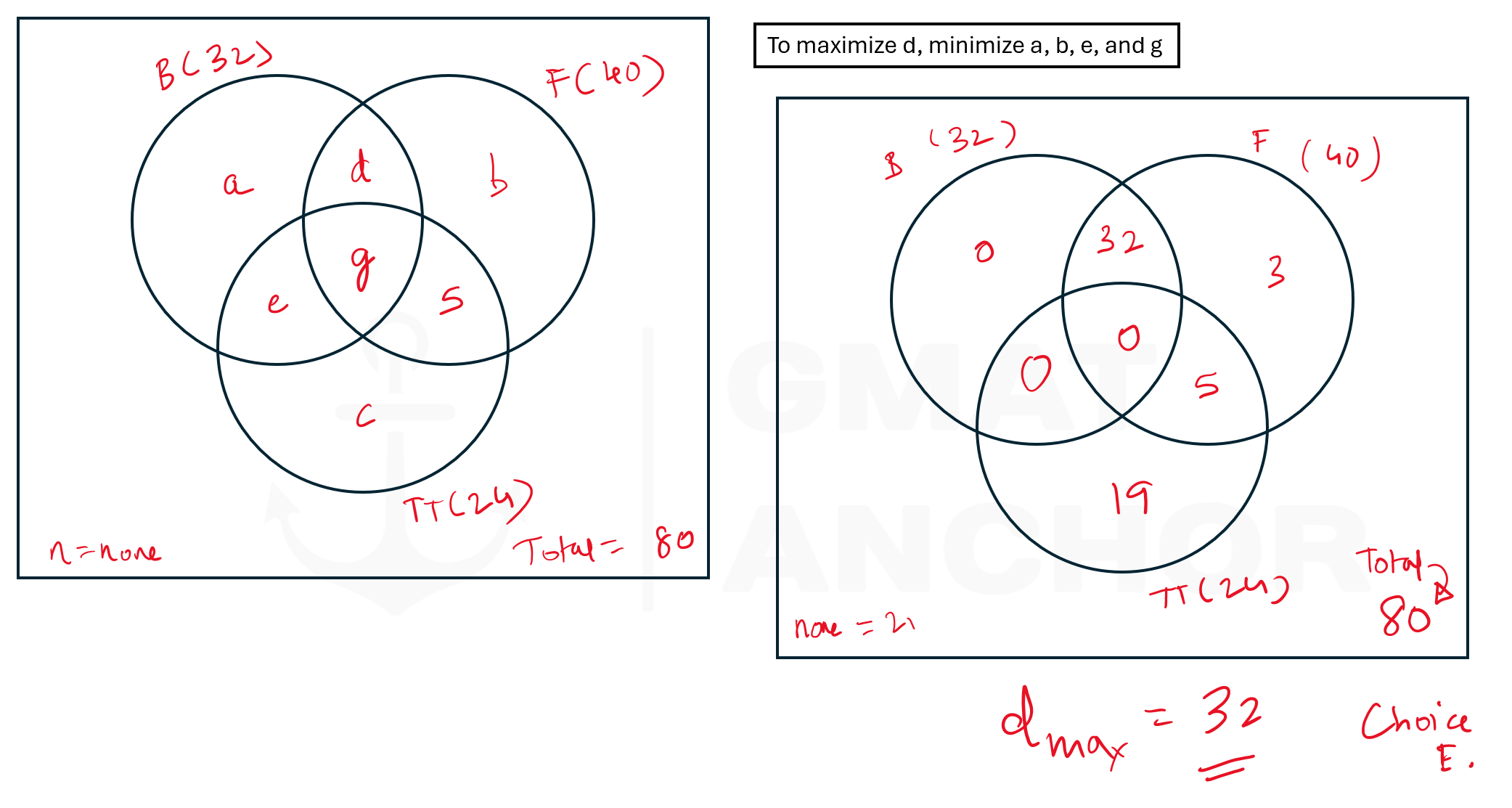
In a class of 80 students, 40% of the students play basketball, 50% play football, and 30% play table tennis. If 5 students play both football and table tennis but not basketball, what is the maximum possible number of students who play both basketball and football, but not table tennis?
A) 11
B) 19
C) 21
D) 24
E) 32
A) 11
B) 19
C) 21
D) 24
E) 32
 Updated on: 28 Jul 2025, 08:55
Originally posted by HarshavardhanR on 16 Jul 2024, 00:06.
Last edited by HarshavardhanR on 28 Jul 2025, 08:55, edited 1 time in total.
Last edited by HarshavardhanR on 28 Jul 2025, 08:55, edited 1 time in total.
Kudos
Bookmarks
I got choice E (32) as answer for this one.
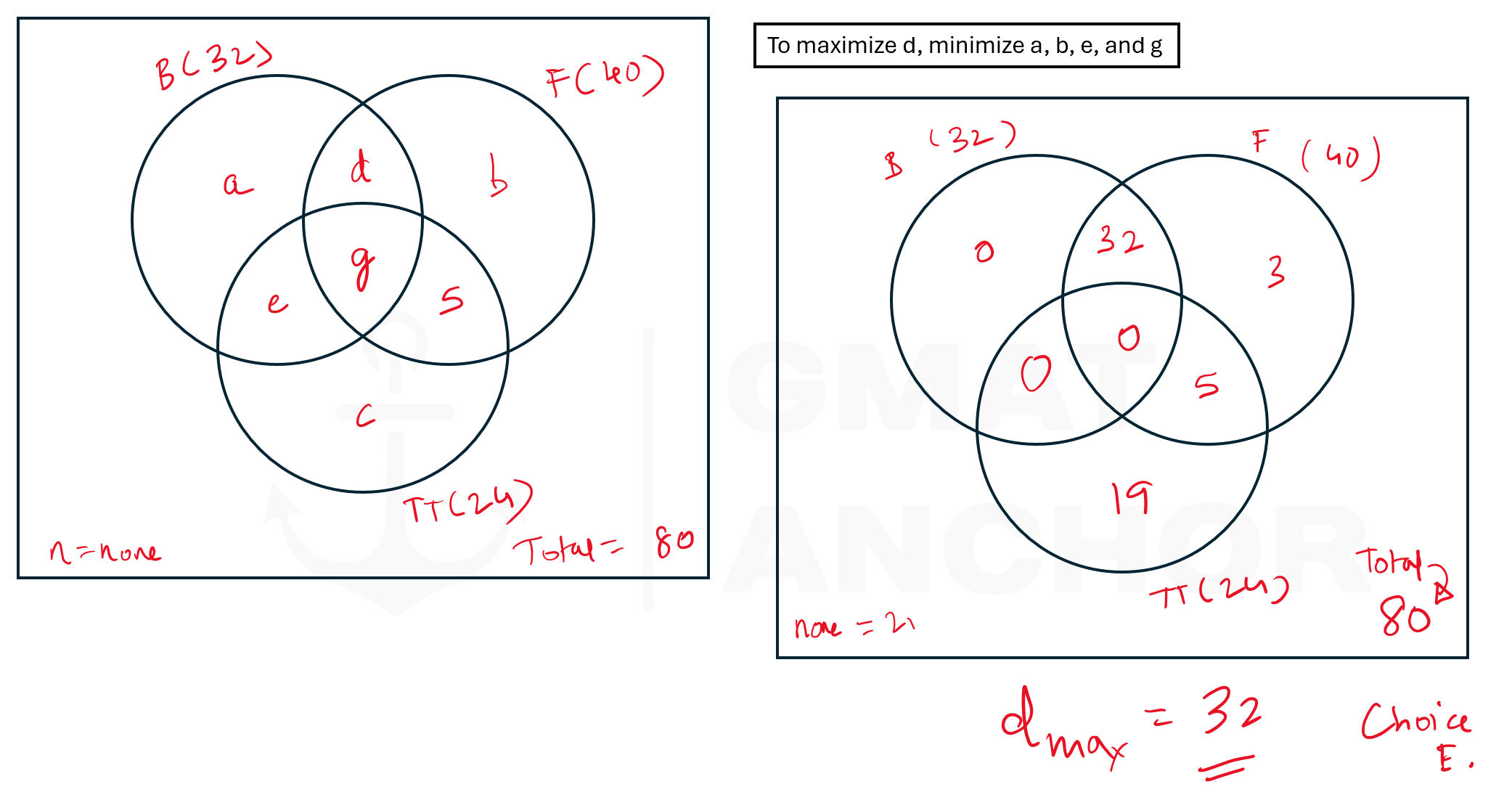
Given that those who play Basketball = 32, those who play Basketball and Football (but not TT) cannot be more than 32. But can this number be 32 itself? Seems like it can.
___
Harsha
Given that those who play Basketball = 32, those who play Basketball and Football (but not TT) cannot be more than 32. But can this number be 32 itself? Seems like it can.
___
Harsha
Attachments
GMAT-Club-Forum-yn0lbs7x.png [ 188.45 KiB | Viewed 2608 times ]
16 Jul 2024, 00:14
Kudos
Bookmarks
Thank you HarshR9 , But why did you write minimize a , b , e and g ? Dont think it should be minimize a , e and g only. Thanks a lot for the wonderful solution.
GMAT-Club-Forum-wm0wa7wq.png [ 188.45 KiB | Viewed 2448 times ]
HarshR9
Attachment:
GMAT-Club-Forum-wm0wa7wq.png [ 188.45 KiB | Viewed 2448 times ]
16 Jul 2024, 00:27
Kudos
Bookmarks
sayan640
Hi sayan640,
My understanding: When we minimize a, e, and g, we are maximizing d. When we are maximizing d (and given minimized g), we are also minimizing b by default.
So, in my view, you are correct. One does not have to specifically think about minimizing "b". This should happen by default if we focus on minimizing a, e, and g to maximize d.
That said, minimizing "b" is also an objective to be achieved here - that's why I mentioned it. For instance, if b was not at its minimum (say b = 10), then there is no way d would be at its max. So, we need to achieve min (a, e, g, as well as b). Just that minimizing b happens automatically in this case if we focus on the other terms.
But you are spot on. Carry on!
___
Harsha
Passionate about all things GMAT | Exploring the GMAT space | My website: gmatanchor.com
Attachment:
GMAT-Club-Forum-73gses5k.png [ 188.45 KiB | Viewed 2369 times ]





