Events & Promotions
|
|

GMAT Club Daily Prep
Thank you for using the timer - this advanced tool can estimate your performance and suggest more practice questions. We have subscribed you to Daily Prep Questions via email.
Customized
for You
Track
Your Progress
Practice
Pays
Not interested in getting valuable practice questions and articles delivered to your email? No problem, unsubscribe here.
 Sep 17
12:30 AM EDT
-01:30 AM EDT
Thought your job leaves no time for GMAT prep? After multiple GMAT attempts and a demanding consulting job, Kshitij improved to 695 in under 2 months. Learn the mindset shifts, study strategy, and execution changes that made the breakthrough possible. Sep 18
01:30 AM EDT
-02:30 AM EDT
Learn how Kamakshi achieved a GMAT 675 with an impressive 96th %ile in Data Insights. Discover the unique methods and exam strategies that helped her excel in DI along with other sections for a balanced and high score. Sep 18
08:00 PM PDT
-09:00 PM PDT
Video explanations + diagnosis of 10 weakest areas + 150+ short videos + study plan! Sep 21
07:00 PM EDT
-10:00 PM EDT
Boost your GMAT score in less than one month in a live online class + 6 months access to TTP OnDemand video courses included!

 08 Mar 2025, 10:07
Kudos
Bookmarks


E
Be sure to select an answer first to save it in the Error Log before revealing the correct answer (OA)!
Difficulty:
 15%
(low)
15%
(low)
Question Stats:
84% (01:03) correct 16%
(01:06)
wrong
based on 116
sessions
16%
(01:06)
wrong
based on 116
sessions
History
Date
Time
Result
Not Attempted Yet
Which of the following numbers has the largest value?
A. -11/12
B. -2/5
C. -1/3
D. -7/9
E. -1/8
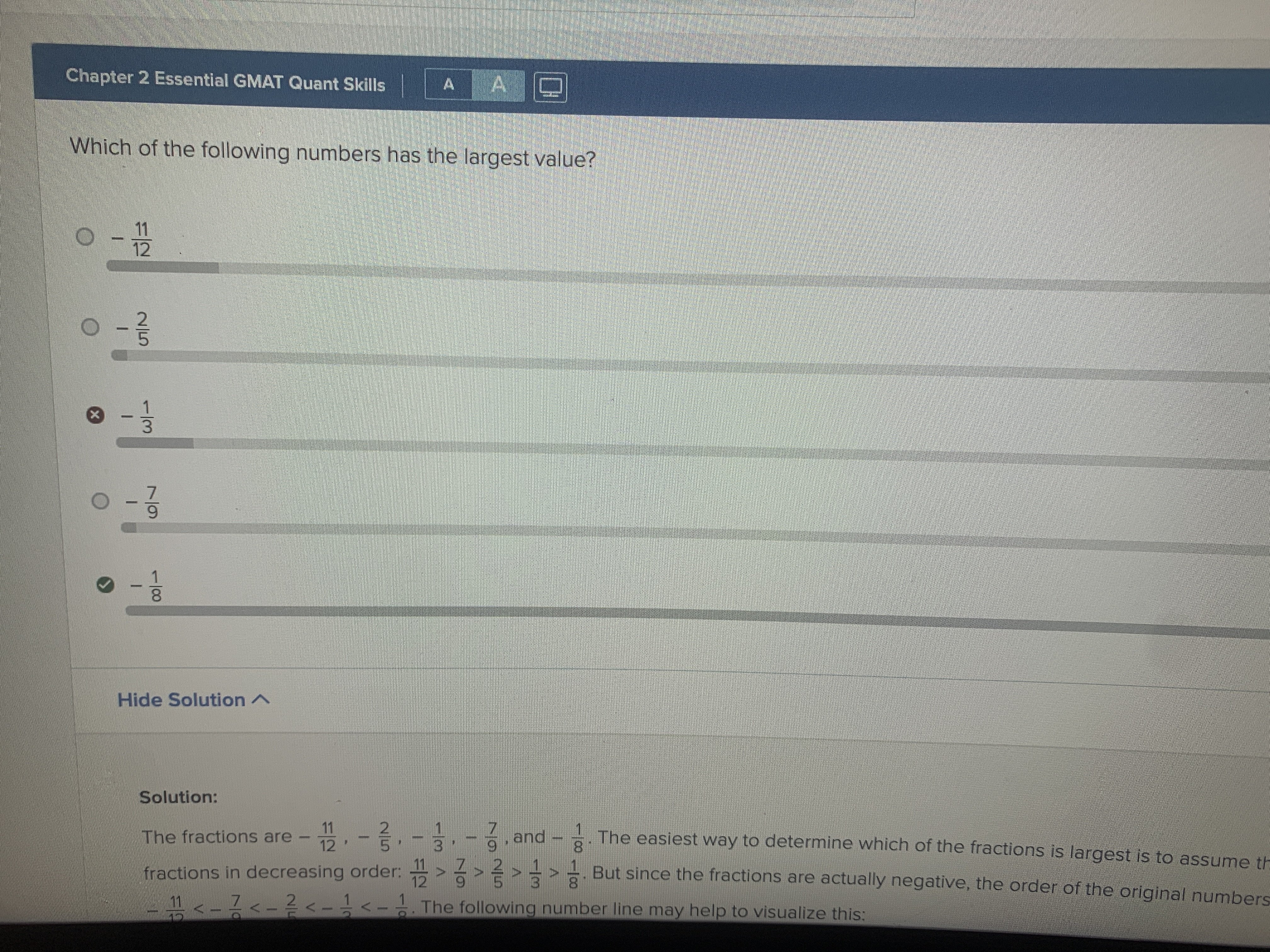
image.jpg [ 6.53 MiB | Viewed 1707 times ]
Dose anyone know any tips on how I can arrange fractions when doing the gmat ? I feel like I do a way harder method ( cross method ) to find which ones are bigger and it takes too long
A. -11/12
B. -2/5
C. -1/3
D. -7/9
E. -1/8
Attachment:
image.jpg [ 6.53 MiB | Viewed 1707 times ]
Dose anyone know any tips on how I can arrange fractions when doing the gmat ? I feel like I do a way harder method ( cross method ) to find which ones are bigger and it takes too long


 08 Mar 2025, 12:25
Kudos
Bookmarks
Hi Gyna,
Great question! I liked the fraction games in my GMAT prep.
There are a few things at play here:
1) Negatives
2) Fractions
Negative fractions should always be a red flag in your mind - anytime you see a negative fraction, you should sound an alarm and label it as a "highly likely trap". Not always but often the question writer will try to confuse you with fractions and negatives thrown together as they work in the opposite way.
You are absolutely right - you do not need to do math in this question! Usually you can identify fractions quickly enough and arrange them just logically without any math. Let's try this question:
A) -11/12 (do you spot that this is almost 1? it is really close to 1). Any time the numerator/denominator are very close, the number is inching close to 1, and obviously that's not so true in 1/2 but it is really really close for 99/100, so the larger the number, the closer we are to 1. Anyway, this is our smallest fraction actually as it is negative, let's say it is -1
B) -2/5 is around -0.5 - that's as precise we need to do
C) -1/3 - that's the biggest so far. Good but let's check the last 2 answers
D) -7/9 - that's up there with -11/12, so no need to bother, we can rule it out
E) -1/8 - that's the winner as you only really need to compare -1/8 and -1/3 and -1/8 is def bigger (1/8 is not bigger than 1/3 but -1/8 is bigger than -1/3)
Anyway, most of the time, you can approximate fractions and get a pretty quick solution. Check this link for the important arithmetic shortcuts you should absolutely know by heart:
https://gmatclub.com/forum/what-arithme ... 80128.html
Great question! I liked the fraction games in my GMAT prep.
There are a few things at play here:
1) Negatives
2) Fractions
Negative fractions should always be a red flag in your mind - anytime you see a negative fraction, you should sound an alarm and label it as a "highly likely trap". Not always but often the question writer will try to confuse you with fractions and negatives thrown together as they work in the opposite way.
You are absolutely right - you do not need to do math in this question! Usually you can identify fractions quickly enough and arrange them just logically without any math. Let's try this question:
A) -11/12 (do you spot that this is almost 1? it is really close to 1). Any time the numerator/denominator are very close, the number is inching close to 1, and obviously that's not so true in 1/2 but it is really really close for 99/100, so the larger the number, the closer we are to 1. Anyway, this is our smallest fraction actually as it is negative, let's say it is -1
B) -2/5 is around -0.5 - that's as precise we need to do
C) -1/3 - that's the biggest so far. Good but let's check the last 2 answers
D) -7/9 - that's up there with -11/12, so no need to bother, we can rule it out
E) -1/8 - that's the winner as you only really need to compare -1/8 and -1/3 and -1/8 is def bigger (1/8 is not bigger than 1/3 but -1/8 is bigger than -1/3)
Anyway, most of the time, you can approximate fractions and get a pretty quick solution. Check this link for the important arithmetic shortcuts you should absolutely know by heart:
https://gmatclub.com/forum/what-arithme ... 80128.html



