Last visit was: 24 Apr 2026, 00:57 It is currently 24 Apr 2026, 00:57
Close
GMAT Club Daily Prep
Thank you for using the timer - this advanced tool can estimate your performance and suggest more practice questions. We have subscribed you to Daily Prep Questions via email.

Customized
for You

we will pick new questions that match your level based on your Timer History

Track
Your Progress

every week, we’ll send you an estimated GMAT score based on your performance

Practice
Pays

we will pick new questions that match your level based on your Timer History
Not interested in getting valuable practice questions and articles delivered to your email? No problem, unsubscribe here.
Close
Request Expert Reply
Confirm Cancel
User avatar
AtlanticGMAT
Joined: 27 Jan 2013
Last visit: 17 Sep 2025
Posts: 255
Own Kudos:
645
 [5]
Given Kudos: 38
GMAT 1: 760 Q47 V48
GMAT 2: 770 Q49 V47
GMAT 3: 780 Q49 V51
Expert
Expert reply
GMAT 3: 780 Q49 V51
Posts: 255
Kudos: 645
 [5]
1
Kudos
Add Kudos
4
Bookmarks
Bookmark this Post
avatar
qlx
Joined: 17 Mar 2014
Last visit: 12 Feb 2016
Posts: 61
Own Kudos:
Given Kudos: 38
Posts: 61
Kudos: 293
Kudos
Add Kudos
Bookmarks
Bookmark this Post
avatar
Fanja91
Joined: 28 May 2014
Last visit: 15 Mar 2015
Posts: 13
Own Kudos:
Posts: 13
Kudos: 9
Kudos
Add Kudos
Bookmarks
Bookmark this Post
User avatar
AtlanticGMAT
Joined: 27 Jan 2013
Last visit: 17 Sep 2025
Posts: 255
Own Kudos:
Given Kudos: 38
GMAT 1: 760 Q47 V48
GMAT 2: 770 Q49 V47
GMAT 3: 780 Q49 V51
Expert
Expert reply
GMAT 3: 780 Q49 V51
Posts: 255
Kudos: 645
Kudos
Add Kudos
Bookmarks
Bookmark this Post
Hi there,

Thank you for participating. Here goes the solution. The easiest way to solve this is by re-drawing the shape a few different ways. For statement 1 you'll notice that you can get x to change. So that statement must be insufficient. For statement 2 you'll get the same of affect although to a lesser extent as the angles flanking x will absorb some of the changes.

Put the statements together and the half rectangle becomes a square. This forces symmetry on the three angles.

For a more in depth explanation you might want to check out this GMAT Question of the Day post.

Let me know if you have any questions!

A.
User avatar
pretzel
Joined: 04 Jan 2014
Last visit: 28 Oct 2014
Posts: 79
Own Kudos:
Given Kudos: 24
Posts: 79
Kudos: 69
Kudos
Add Kudos
Bookmarks
Bookmark this Post
I don't get it either.
User avatar
AtlanticGMAT
Joined: 27 Jan 2013
Last visit: 17 Sep 2025
Posts: 255
Own Kudos:
Given Kudos: 38
GMAT 1: 760 Q47 V48
GMAT 2: 770 Q49 V47
GMAT 3: 780 Q49 V51
Expert
Expert reply
GMAT 3: 780 Q49 V51
Posts: 255
Kudos: 645
Kudos
Add Kudos
Bookmarks
Bookmark this Post
Hi,

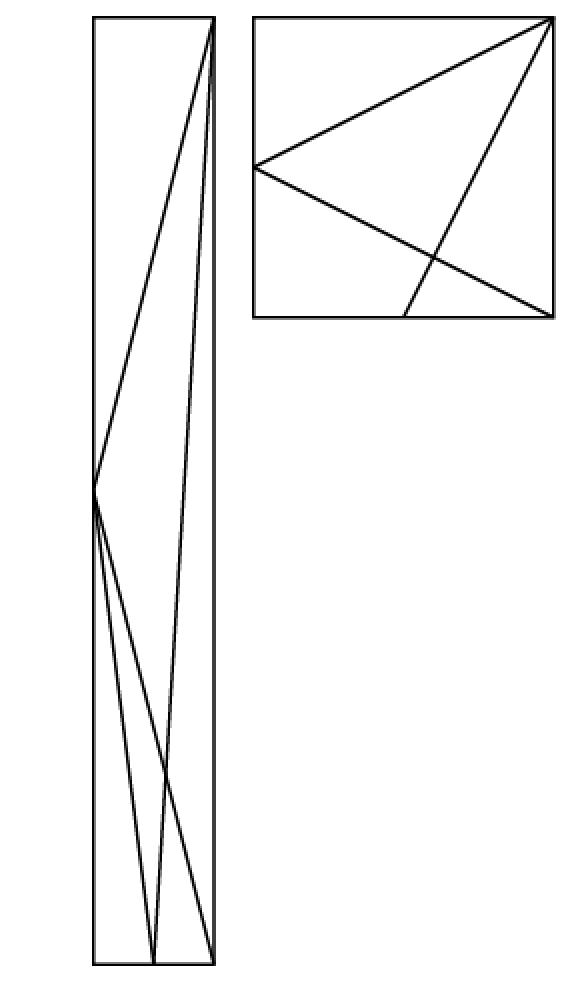
Thanks for participating! My analysis on statement (2) was wrong. I'm not sure why I didn't see this but if you make the rectangle very tall and skinny and x will change. Statement (2) is insufficient. You can also use this process of distortion with Official Guide DS 149.

Happy Studies,

A.
User avatar
AtlanticGMAT
Joined: 27 Jan 2013
Last visit: 17 Sep 2025
Posts: 255
Own Kudos:
Given Kudos: 38
GMAT 1: 760 Q47 V48
GMAT 2: 770 Q49 V47
GMAT 3: 780 Q49 V51
Expert
Expert reply
GMAT 3: 780 Q49 V51
Posts: 255
Kudos: 645
Kudos
Add Kudos
Bookmarks
Bookmark this Post
Hi All, (updated this for accuracy)

Any questions on this?

Happy Studies,

A.
User avatar
AtlanticGMAT
Joined: 27 Jan 2013
Last visit: 17 Sep 2025
Posts: 255
Own Kudos:
Given Kudos: 38
GMAT 1: 760 Q47 V48
GMAT 2: 770 Q49 V47
GMAT 3: 780 Q49 V51
Expert
Expert reply
GMAT 3: 780 Q49 V51
Posts: 255
Kudos: 645
Kudos
Add Kudos
Bookmarks
Bookmark this Post
I would love to see an alternate solution to this one. Any geometry wizards out there?

A.
avatar
Icerockboom
Joined: 27 Mar 2014
Last visit: 24 Jan 2015
Posts: 18
Own Kudos:
33
 [2]
Given Kudos: 12
Posts: 18
Kudos: 33
 [2]
2
Kudos
Add Kudos
Bookmarks
Bookmark this Post
(1) easy to see x changes when the measures of the rectangular change.
(2) x changes when the measures of the rectangular change also.
Says, LM = MC = 1/4 DC.
Call the angle of MBC = y. Then tany = MC/BC, tan(x+y)=DC/BC => tany/tan(x+y)=1/4 (m)
tan(x+y)=(tanx+tany)/(1-tanx*tany)
(m)=>tanx = [4(tany)^2+3tany]/(4tany+1) which is not a constant (as tany is not a constant). Then x is not a constant!

(1) & (2) is sufficient.
look at triangle DKL and BMC, DK=BM(=KB), KL/BC=MC/DL=1/2, DLK = MCB = 90
=> triangle DKL = triangle BMC
=> DL=BC
=> MC = 1/2 BC
=> tany = 1/2 which is a constant. then tanx is a constant, then x is a constant.
User avatar
AtlanticGMAT
Joined: 27 Jan 2013
Last visit: 17 Sep 2025
Posts: 255
Own Kudos:
Given Kudos: 38
GMAT 1: 760 Q47 V48
GMAT 2: 770 Q49 V47
GMAT 3: 780 Q49 V51
Expert
Expert reply
GMAT 3: 780 Q49 V51
Posts: 255
Kudos: 645
Kudos
Add Kudos
Bookmarks
Bookmark this Post
Hi Icerockboom,

Awesome!! Yes - I meant to check back again because I came to the same conclusion. The answer is C because that forces the shape to be a square and the angle to be a constant. But proving the insufficiency of B is a bit too involved for a GMAT question. You really shouldn't have to think about trigonometry. And distorting the shape which would normally work on a GMAT question isn't so easy to see. Really solid work on that. Kudos!

A.
User avatar
AtlanticGMAT
Joined: 27 Jan 2013
Last visit: 17 Sep 2025
Posts: 255
Own Kudos:
645
 [1]
Given Kudos: 38
GMAT 1: 760 Q47 V48
GMAT 2: 770 Q49 V47
GMAT 3: 780 Q49 V51
Expert
Expert reply
GMAT 3: 780 Q49 V51
Posts: 255
Kudos: 645
 [1]
1
Kudos
Add Kudos
Bookmarks
Bookmark this Post
Hi All,

So in addition to the trigonometry you can prove that statement (2) is insufficient by distorting the shape. See the diagram and notice how angle x changes in size. Hope this is helpful!

avatar
nitin1negi
Joined: 28 Mar 2014
Last visit: 20 Aug 2014
Posts: 17
Own Kudos:
29
 [1]
Given Kudos: 17
Location: India
GPA: 3
WE:Business Development (Retail Banking)
Posts: 17
Kudos: 29
 [1]
1
Kudos
Add Kudos
Bookmarks
Bookmark this Post
I feel answer is B.
Given is that we have rectangle of any dimensions. K is centre and KL is perpendicular to DC at L.
We have to find angle x which is made by lines joining KB and BM.
I) This option says KB is equal to MB. This question is answered by assuming we are constructing the figure. Finding KB length is simple as it is the distance between K and B. Lets say it is a cms. So MB length is also a cms. But we do not know where the point M is. It could on the line DC as shown or may not be there. Nothing is given. So Insufficient.
II) This option clearly says M is mid point of LC. Now considering this option, we know where the point M is. Also we know where K is. So simply joining K to B and M to B will give the angle KBM i.e. X. So sufficient.
User avatar
AtlanticGMAT
Joined: 27 Jan 2013
Last visit: 17 Sep 2025
Posts: 255
Own Kudos:
Given Kudos: 38
GMAT 1: 760 Q47 V48
GMAT 2: 770 Q49 V47
GMAT 3: 780 Q49 V51
Expert
Expert reply
GMAT 3: 780 Q49 V51
Posts: 255
Kudos: 645
Kudos
Add Kudos
Bookmarks
Bookmark this Post
Hi nitin1negi,

Good job on statement 1. Statement 2 is tricky. You are right about the midpoint but that doesn't mean that the value of x will be a constant. If you look at the diagrams in the previous post you can see that we can maintain the midpoints while changing the value of x. If the value of x can change while following the rules of the question then the statement must be insufficient. This process of distorting shapes can be helpful when trying to prove insufficiency.

Happy Studies,

A.
avatar
igorgomes
Joined: 06 Apr 2012
Last visit: 23 Jun 2015
Posts: 1
Own Kudos:
6
 [1]
Given Kudos: 1
Posts: 1
Kudos: 6
 [1]
1
Kudos
Add Kudos
Bookmarks
Bookmark this Post
I don't agree on answer being B.

Let the smaller side A and the other B.

Let the angles on corner where is X be theta and gamma.

With only the statement (2), we can come with the following:

tan(theta) = a/2 / b/2
theta = arctan(a/b)

tan(gamma) = b/4 / a
gamma = arctan(b/4a)

So, x = 90 - arctan(a/b) - arctan(b/4a)

So, the answer depends on a and b values. Can't be B.
User avatar
AtlanticGMAT
Joined: 27 Jan 2013
Last visit: 17 Sep 2025
Posts: 255
Own Kudos:
Given Kudos: 38
GMAT 1: 760 Q47 V48
GMAT 2: 770 Q49 V47
GMAT 3: 780 Q49 V51
Expert
Expert reply
GMAT 3: 780 Q49 V51
Posts: 255
Kudos: 645
Kudos
Add Kudos
Bookmarks
Bookmark this Post
Hi Igor,

Great work - agreed. The answer can't possibly be B based on your assessment. For those who want to avoid trig you can re-draw the shape in a variety of different ways and see that the size of the angle will change.

Happy Studies,

A.
User avatar
ssriva2
Joined: 22 Aug 2014
Last visit: 31 Dec 2015
Posts: 94
Own Kudos:
Given Kudos: 49
Posts: 94
Kudos: 37
Kudos
Add Kudos
Bookmarks
Bookmark this Post
HerrGrau


In the figure above ABCD is a rectangle and point K is the center of ABCD. What is the value of x?

(1) KB is equal to MB
(2) M is the midpoint of LC


Hi All,

I thought that you might enjoy a tough Data Sufficiency Geometry question. Good Luck!


Hey Bunuel,

Can you please shed some light on this question?
I am not able to understand how the half rectangle can be square?
User avatar
bumpbot
User avatar
Non-Human User
Joined: 09 Sep 2013
Last visit: 04 Jan 2021
Posts: 38,965
Own Kudos:
Posts: 38,965
Kudos: 1,117
Kudos
Add Kudos
Bookmarks
Bookmark this Post
Automated notice from GMAT Club BumpBot:

A member just gave Kudos to this thread, showing it’s still useful. I’ve bumped it to the top so more people can benefit. Feel free to add your own questions or solutions.

This post was generated automatically.
Moderators:
Math Expert
109802 posts
498 posts
212 posts