Events & Promotions
| Last visit was: 02 Sep 2026, 09:52 |
It is currently 02 Sep 2026, 09:52 |
|
|

GMAT Club Daily Prep
Thank you for using the timer - this advanced tool can estimate your performance and suggest more practice questions. We have subscribed you to Daily Prep Questions via email.
Customized
for You
Track
Your Progress
Practice
Pays
Not interested in getting valuable practice questions and articles delivered to your email? No problem, unsubscribe here.
 Sep 02
08:00 PM PDT
-09:00 PM PDT
Video explanations + diagnosis of 10 weakest areas + 150+ short videos + study plan! Sep 03
01:30 AM EDT
-02:30 AM EDT
At one point, she believed GMAT wasn’t for her. After scoring 595, self-doubt crept in and she questioned her potential. But instead of quitting, she made the right strategic changes. The result? A remarkable comeback to 695. Check out how Saakshi did it. Aug 27
10:00 AM EDT
-11:00 AM EDT
We’ve worked incredibly hard to build TTP into the best test prep experience possible, and it would mean a lot to us to win Newsweek’s 2026 Readers’ Choice Award for Best Test Prep. If TTP has helped you, we’d be incredibly grateful for your vote. Sep 02
12:30 AM EDT
-01:30 AM EDT
Thought your job leaves no time for GMAT prep? After multiple GMAT attempts and a demanding consulting job, Kshitij improved to 695 in under 2 months. Learn the mindset shifts, study strategy, and execution changes that made the breakthrough possible. Sep 04
10:00 AM PDT
-11:00 AM PDT
What does test anxiety really look like on the GMAT? For many test takers, it does not look like a panic attack. Instead, it shows up as brain fog, rereading, negative comparisons, mental noise.... Sep 06
09:30 AM EDT
-12:30 PM EST
Top scores are possible when you enroll in a powerful EA course, taught live online + 6 months access to TTP OnDemand video courses included! Perfect class schedule and easy course access for working professionals. Class starts Sundays Sept. 6, 2026.- Sep 07
12:01 AM PDT
-11:59 PM PDT
On the 7th, GMAT Club Tests will be Free! Including all the Quizzes, Questions, and Tests. 12 AM - 11:59 PM PDT - Sep 09
07:00 AM PDT
-10:00 AM PDT
Meet AdComs and explore top Master’s programs - MiM, MiF, MSc, MSBA and more. - Application Fee Waivers - Free 1-Week of GMAT Club Tests: - Master's Application Toolkit - Grand Prize Giveaway  Sep 15
07:00 PM EDT
-09:00 PM EST
Elite scores are possible when you enroll in a powerful GMAT course, taught live online + 6 months access to TTP OnDemand video courses included! Class starts Tues/Thurs Sept. 15, 2026 - Nov. 15, 2027, 7:00pm-9:00pm EST Sep 21
08:00 PM EDT
-10:00 PM EDT
Boost your GMAT score in less than one month in a live online class + 6 months access to TTP OnDemand video courses included! Class starts Mon, Tues, Wed, Thur, Fri Sept. 21, 2026 - Oct. 9, 2027, 7:00pm-10:00pm EST

 23 May 2026, 07:26
Kudos
Bookmarks
Hello experts,
I have been preparing for the GMAT focus since last year and I have already given the GMAT once in feb, which was very discouraging.
I am good at everything when it is not in the test environment. After giving the exam, and going back I feel like I should have gotten a 645+ easily. but I am not able to manage myself in the test scenario.
any advice would be appreciated.
Thank you for your time.
Below are my mock scores:
whenever I hit a rough question, my confidence dips and start making mistakes.
S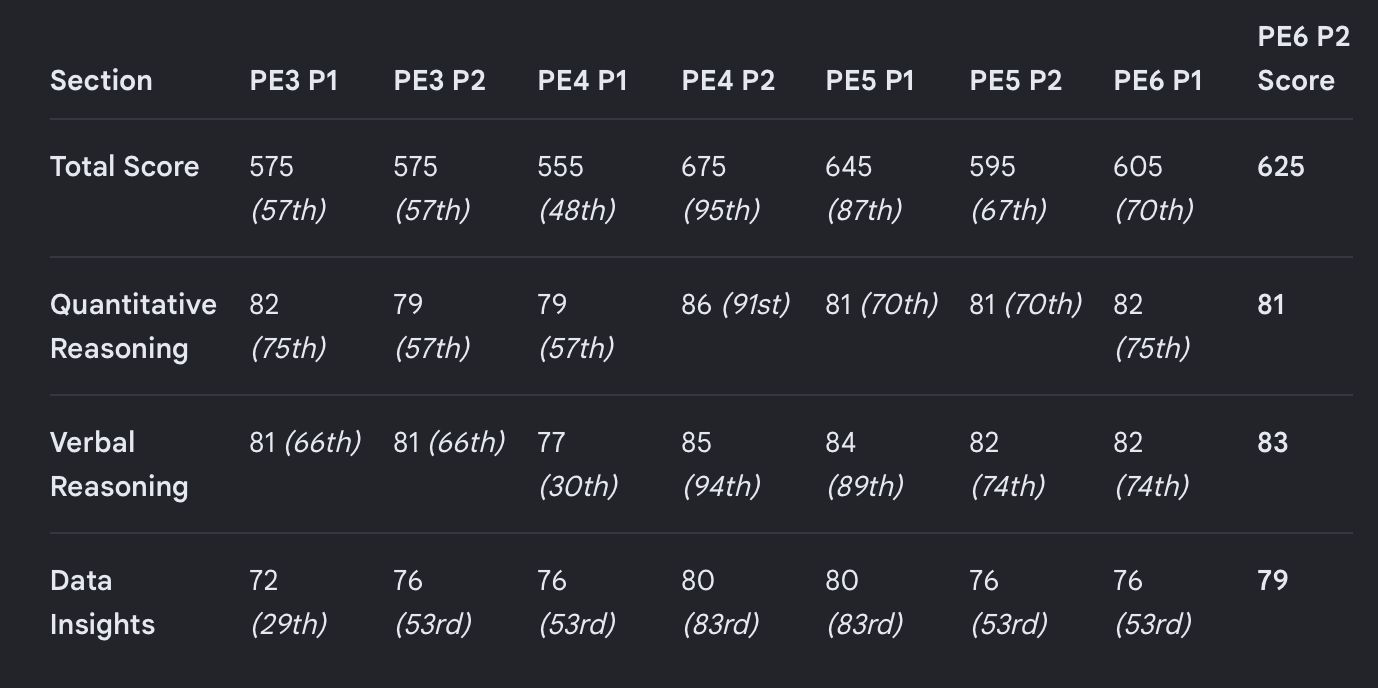

GMAT-Club-Forum-hfcl04r4.png [ 109.59 KiB | Viewed 2834 times ]
I have been preparing for the GMAT focus since last year and I have already given the GMAT once in feb, which was very discouraging.
I am good at everything when it is not in the test environment. After giving the exam, and going back I feel like I should have gotten a 645+ easily. but I am not able to manage myself in the test scenario.
any advice would be appreciated.
Thank you for your time.
Below are my mock scores:
whenever I hit a rough question, my confidence dips and start making mistakes.
S
Attachment:
GMAT-Club-Forum-hfcl04r4.png [ 109.59 KiB | Viewed 2834 times ]

 23 May 2026, 08:52
Kudos
Bookmarks
What are your accuracies like when you do individual Quant, Verbal, and Data Insights questions untimed?
If they aren't above 90%, then key to achieving your target score is to increase those accuracies.
Even better would be practicing until you can achieve long streaks of correct answers in a row, as discussed in the following post on the streaks method.
How to Ace the GMAT Using the Streaks Method
If they aren't above 90%, then key to achieving your target score is to increase those accuracies.
Even better would be practicing until you can achieve long streaks of correct answers in a row, as discussed in the following post on the streaks method.
How to Ace the GMAT Using the Streaks Method

 24 May 2026, 05:25
Kudos
Bookmarks
It is incredibly frustrating to know you have the skills to score a 645+ but see a test-day score that doesn’t reflect your true potential. What you are describing is a classic case of performance anxiety and test-taking management issues, not a lack of aptitude.
When you encounter a brutal question and your confidence dips, your brain enters a "fight or flight" state. This literally hijacks your working memory—the very thing you need to solve complex quantitative and verbal logic.
To bridge the gap between your mock capability and your actual test performance, you need to shift your focus from content to behavioral strategy. Here is a game plan to help you manage yourself in the test environment.
1. Reframe the "Rough Question" (The Art of the Strategic Skip)
The GMAT Focus Edition is an adaptive test, which means it is designed to push you to your limit. You will see questions you don't know how to solve, and that is exactly how the test is supposed to work.
If you only practice in a relaxed environment, the high-stress test center will always feel jarring. You need to "stress-test" your preparation.
You mentioned your mock scores were cut off in your message, but the pattern you described (spiraling after a tough question) points to a specific type of error. When reviewing your mocks, categorize your mistakes into two buckets:
When you encounter a brutal question and your confidence dips, your brain enters a "fight or flight" state. This literally hijacks your working memory—the very thing you need to solve complex quantitative and verbal logic.
To bridge the gap between your mock capability and your actual test performance, you need to shift your focus from content to behavioral strategy. Here is a game plan to help you manage yourself in the test environment.
1. Reframe the "Rough Question" (The Art of the Strategic Skip)
The GMAT Focus Edition is an adaptive test, which means it is designed to push you to your limit. You will see questions you don't know how to solve, and that is exactly how the test is supposed to work.
- Change your goal: Your goal is not to get every question right; your goal is to maximize your score. Getting stuck and spiraling on a hard question destroys your momentum and causes you to miss subsequent, easier questions.
- The 2-Minute Rule: If you have read a question, spent 1 to 1.5 minutes on it, and still don't have a clear path to the solution, let it go. Guess, flag it for review, and move on immediately.
- Leverage the Review Feature: The Focus Edition allows you to bookmark questions and change up to three answers per section at the end. Use this as a psychological safety net. Tell yourself, "I'm going to guess and flag this now, and if I have time, I'll come back to it with a fresh brain."
If you only practice in a relaxed environment, the high-stress test center will always feel jarring. You need to "stress-test" your preparation.
- Replicate Exam Conditions: When you take mocks, do not pause the timer for any reason. Take them at the exact same time of day as your actual scheduled exam.
- Use the "Next Question" Reset: Create a physical or mental trigger for when you hit a roadblock. For example, take one deep breath, exhale fully, click your answer, and mentally "erase the chalkboard." Once you click next, the previous question no longer exists.
- Practice "Panic Drills": During your regular practice sets, intentionally give yourself a highly difficult question with a strict 90-second timer. Practice the physical act of realizing you are stuck, choosing an answer, and moving on without emotional residue.
You mentioned your mock scores were cut off in your message, but the pattern you described (spiraling after a tough question) points to a specific type of error. When reviewing your mocks, categorize your mistakes into two buckets:
- Conceptual Errors: "I didn't know how to solve this formula/logic."
- Execution/Anxiety Errors: "I knew how to do this, but I rushed because I was panicked about the previous question."
Stealthz3r
 24 May 2026, 09:11
Kudos
Bookmarks
You may immensely benefit from Forum Quiz, an excellent resource to practice various difficulty level questions. All the Best.






