Events & Promotions
|
|

GMAT Club Daily Prep
Thank you for using the timer - this advanced tool can estimate your performance and suggest more practice questions. We have subscribed you to Daily Prep Questions via email.
Customized
for You
Track
Your Progress
Practice
Pays
Not interested in getting valuable practice questions and articles delivered to your email? No problem, unsubscribe here.
 Aug 31
10:00 AM EDT
-11:00 AM EDT
Virtual Roundtable Discussions connect you with prospective students, admissions team members, and student ambassadors. Ask questions, explore the student experience and life in Bloomington, and learn about the MBA program, Kelley culture, and admissions. Sep 02
01:00 PM PDT
-02:00 PM PDT
Inquire for a free profile evaluation and guarantee statement for possible admits and scholarships! Sep 03
10:00 AM PDT
-11:00 AM PDT
Looking to secure a coveted spot at a top business school? Our team of seasoned MBA admissions consultants, including top B schools alumni and industry leaders, is here to help turn your dreams into reality. Let’s kick-start your journey to success! Sep 03
11:00 AM PDT
-12:00 PM PDT
We go inside the MIT Sloan School of Management with Donna Levinson, Assistant Dean of Admissions at MIT Sloan, for a detailed conversation on Sloan’s MBA experience, curriculum, global community, application process, and admissions philosophy. Sep 03
09:00 PM IST
-10:00 AM IST
Join our free webinar on building a stronger Round 2 MBA application for INSEAD, LBS, Kellogg, HEC & other T20 B-schools after missing Round 1. Learn what actually changes in Round 2 and rebuild your candidacy. Sep 04
12:00 PM EDT
-01:00 PM EDT
The old MBA recruiting playbook is dead. Here’s how top admits are getting ahead this summer. Sep 06
09:30 AM EDT
-12:30 PM EST
Top scores are possible when you enroll in a powerful EA course, taught live online + 6 months access to TTP OnDemand video courses included! Perfect class schedule and easy course access for working professionals. Class starts Sept. 6, 9:30am-12:30pm EST- Sep 09
07:00 AM PDT
-10:00 AM PDT
Meet AdComs and explore top Master’s programs - MiM, MiF, MSc, MSBA and more. - Application Fee Waivers - Free 1-Week of GMAT Club Tests: - Master's Application Toolkit - Grand Prize Giveaway

 05 Apr 2022, 09:45
Kudos
Bookmarks
Executive Assessment Sample Questions
If you’re considering taking the Executive Assessment to apply to business schools’ executive MBA programs or another program that accepts the EA, you’re likely aware that, in addition to the Integrated Reasoning and Quantitative Reasoning sections, the EA includes a Verbal Reasoning section. So, you may be wondering what types of questions appear on the Verbal Reasoning section of the EA and how to prepare for it. In this article, I’ll cover the three main EA verbal question types and provide some tips for mastering each of them. First, however, let’s discuss some basics of the EA Verbal Reasoning section.The Executive Assessment Verbal Reasoning Section
The Verbal Reasoning section of the Executive Assessment tests skill in comprehending written material, analyzing and evaluating arguments, and correcting material to effectively express ideas in standard written English. Another way of looking at the EA Verbal section is that it’s a test of skill in noticing details and issues and using logic to arrive at correct answers.The EA Verbal section is made up of 14 multiple choice questions that a test-taker has 30 minutes to answer. The questions are presented in two modules of 7 questions each, and the level of difficulty of the questions that appear in the second module depends on the test-taker’s performance on the questions on the first module. So, depending on how many of the questions in the first module a test-taker gets correct, the difficulty of the questions in the second module could be relatively high, relatively low, or somewhere in between.
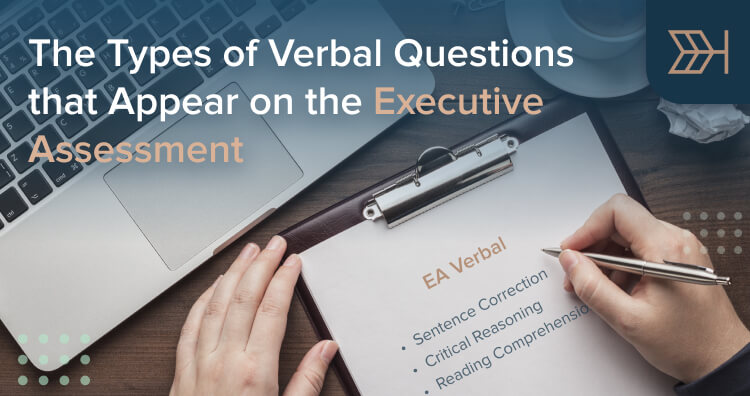
Of the 14 questions that make up the Verbal section of the EA, 6 are Sentence Correction questions, 4 are Critical Reasoning questions, and 4 are Reading Comprehension questions. Let’s now discuss each of these, starting with Sentence Correction questions.
Executive Assessment Verbal Question Types
EA Sentence Correction Questions
EA Sentence Correction questions test skill in determining which version of a sentence most correctly and effectively expresses an idea. The format of Sentence Correction questions is the following.A Sentence Correction question first presents a sentence, and all or part of the sentence is underlined. That sentence is followed by five answer choices, which present five different versions of the underlined portion of the original sentence.
The first answer choice, choice (A), repeats the underlined portion of the original sentence. In other words, the words and punctuation underlined in the original sentence will make up answer choice (A). Each of the other four choices offers an alternative way of wording the underlined portion of the sentence.
The task of a test-taker in answering a Sentence Correction question is to identify the answer choice that produces the best version of the sentence in terms of both grammatical correctness and meaning conveyed.
To see how EA Sentence Correction questions work, let’s consider a sample EA Sentence Correction question:
EA Sentence Correction Example
Potential discoveries of signs of carbon-based life on another planet have captured the imagination of astronomers being the focus of research for some.
A. have captured the imagination of astronomers being
B. has been captured in imagination of astronomers to be
C. is captured in the imagination of astronomers and is the
D. have captured the imagination of astronomers and are
E. captures the imagination of astronomers for
Solution:
As we just discussed, to correctly answer this question, we have to identify the answer choice that produces the best version of the sentence in terms of both grammatical correctness and meaning conveyed. So, to find the correct answer, we consider each sentence version, looking for errors in grammar or construction and considering whether it effectively conveys a meaning that makes sense.
The first thing we notice is that we can eliminate choices (B), (C), and (E) on the basis of grammar issues because the verbs “has,” “is,” and “captures” in those versions don’t agree with the plural subject of the sentence, which is “discoveries.” So, we are left with two choices, (A) and (D), both of which use the plural verb “have,” which agrees with “discoveries.”
Now, reading each of the remaining sentence versions, we see that the (A) version conveys a meaning that doesn’t make sense. After all, “astronomers being the focus of research” conveys the illogical meaning that astronomers, rather than “discoveries of carbon-based life,” are “the focus of research.” So, choice (D) is the correct answer to this Sentence Correction question, since only the sentence version produced by choice (D) both is grammatically correct and conveys a meaning that makes sense.
Now that we have a basic understanding of how EA Sentence Correction questions work, let’s discuss some key tips for Sentence Correction mastery.
Tips for EA Sentence Correction Mastery
The correct answer to a Sentence Correction question may not be ideal. – When answering a Sentence Correction question, look for the best choice, not a perfect choice because, often, the correct answer will produce an OK, but not ideal, sentence.Pay attention to meaning conveyed. – As we saw in the above example question, often a choice in a Sentence Correction question will be incorrect because the sentence that choice produces conveys a meaning that doesn’t make sense. So, while learning grammar rules is an important aspect of Sentence Correction mastery, we also have to develop skill in determining whether a sentence conveys a meaning that makes sense.
Practice by carefully analyzing sentence versions. – The most effective way to develop strong Sentence Correction skills is to practice Sentence Correction untimed, analyzing practice questions choice by choice and focusing on understanding and accuracy. Then, once you’ve become skilled at seeing the issues in the sentence versions and getting questions correct, you can seek to speed up to the pace you’ll have to keep on test day.
To read the complete article, view my full article on Target Test Prep’s blog.






