Events & Promotions
| Last visit was: 06 Sep 2026, 19:35 |
It is currently 06 Sep 2026, 19:35 |
|
|

GMAT Club Daily Prep
Thank you for using the timer - this advanced tool can estimate your performance and suggest more practice questions. We have subscribed you to Daily Prep Questions via email.
Customized
for You
Track
Your Progress
Practice
Pays
Not interested in getting valuable practice questions and articles delivered to your email? No problem, unsubscribe here.
 Sep 07
12:01 AM PDT
-11:59 PM PDT
On the 7th, GMAT Club Tests will be Free! Including all the Quizzes, Questions, and Tests. 12 AM - 11:59 PM PDT Sep 07
12:30 AM EDT
-01:30 AM EDT
Tejas studied hard but kept repeating the same mistakes. After 3 attempts at 645, a focused 4-week strategy helped him identify and fix what was holding him back—leading to a 695 with just 12–15 hours of study per week.- Sep 07
10:00 AM PDT
-11:00 AM PDT
A complete walkthrough of GMAT Club’s free 12-week GMAT study plan: what you study each week, how progress and goals are tracked, how the error log works, and how your practice unlocks paid tools at no cost.  Sep 02
01:00 PM EDT
-11:59 PM EDT
Take 30% off all study plans with code COURSEWORK - Expires on Monday 9/7 Sep 04
01:30 AM EDT
-02:30 AM EDT
This Labor Day, turn your hard work into real score gains. From 615→715 in 15 days to 705 in 30 days, our students prove what's possible with personalized, expert guidance. Save up to 25% on 1-on-1 tutoring. Sep 04
10:00 AM EDT
-11:59 PM EDT
We’ve worked incredibly hard to build TTP into the best test prep experience possible, and it would mean a lot to us to win Newsweek’s 2026 Readers’ Choice Award for Best Test Prep. If TTP has helped you, we’d be incredibly grateful for your vote. Sep 06
09:30 AM EDT
-12:30 PM EST
Top scores are possible when you enroll in a powerful EA course, taught live online + 6 months access to TTP OnDemand video courses included! Perfect class schedule and easy course access for working professionals. Class starts Sundays Sept. 6, 2026.- Sep 09
07:00 AM PDT
-10:00 AM PDT
Meet AdComs and explore top Master’s programs - MiM, MiF, MSc, MSBA and more. - Application Fee Waivers - Free 1-Week of GMAT Club Tests: - Master's Application Toolkit - Grand Prize Giveaway - Sep 09
10:00 AM PDT
-11:00 AM PDT
Three MBA applications. Three rejections. No interview invites. A year later, Aman was admitted to Cambridge Judge, SMU, and IMD. In this episode of MBA Admit Stories, Aman shares how he rebuilt his MBA application...  Sep 10
08:00 PM PDT
-09:00 PM PDT
Free- full-length test + 15 concept videos + 150+ short videos + study plan! Sep 15
07:00 PM EDT
-09:00 PM EST
Elite scores are possible when you enroll in a powerful GMAT course, taught live online + 6 months access to TTP OnDemand video courses included! Class starts Tues/Thurs Sept. 15, 2026 - Nov. 15, 2027, 7:00pm-9:00pm EST Sep 21
08:00 PM EDT
-10:00 PM EDT
Boost your GMAT score in less than one month in a live online class + 6 months access to TTP OnDemand video courses included! Class starts Mon, Tues, Wed, Thur, Fri Sept. 21, 2026 - Oct. 9, 2027, 7:00pm-10:00pm EST

mcelroytutoring
Expert
Tutor
Joined: 10 Jul 2015
Last visit: 20 Aug 2026
Posts: 1,206
Given Kudos: 282
Status:Expert GMAT, GRE, and LSAT Tutor / Coach
Affiliations: Harvard University, A.B. with honors in Government, 2002
Location: United States (CO)
Age: 46 (11 years and counting on GMAT Club!)
GMAT 1: 770 Q47 V48
GMAT 2: 730 Q44 V47
GMAT 3: 750 Q50 V42
GMAT 4: 730 Q48 V42 (Online)
GRE 1: Q168 V169
GRE 2: Q170 V170
Expert reply
 Updated on: 16 Jul 2020, 13:22
Originally posted by mcelroytutoring on 06 Aug 2016, 17:24.
Last edited by mcelroytutoring on 16 Jul 2020, 13:22, edited 3 times in total.
Last edited by mcelroytutoring on 16 Jul 2020, 13:22, edited 3 times in total.
Kudos
Bookmarks
Yes, some of you out there are Q51 or bust...but there are others out there who are having pacing issues, and just need something in the mid-to-high 40s.
Check out the post linked below for an example of how to crack Q45 without having to make it all the way through the test (but make sure to guess on every remaining question to avoid the penalty for not finishing). All opinions are welcome...even the angry, disagreeing ones. ; )
hiline-gmat-algorithm-studies-223122.html#p1719701
For more information: leveraging-the-gmat-scoring-algorithm-to-your-advantage-221175.html
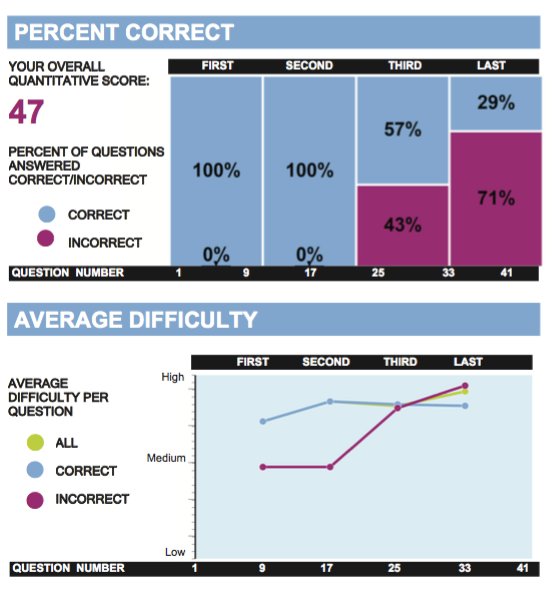
Check out the post linked below for an example of how to crack Q45 without having to make it all the way through the test (but make sure to guess on every remaining question to avoid the penalty for not finishing). All opinions are welcome...even the angry, disagreeing ones. ; )
hiline-gmat-algorithm-studies-223122.html#p1719701
For more information: leveraging-the-gmat-scoring-algorithm-to-your-advantage-221175.html
Archived Topic
Hi there,
This topic has been closed and archived due to inactivity or violation of community quality standards. No more replies are possible here.
Where to now? Join ongoing discussions on thousands of quality questions in our Quantitative Questions Forum
Still interested in this question? Check out the "Best Topics" block below for a better discussion on this exact question, as well as several more related questions.
Thank you for understanding, and happy exploring!
 08 Aug 2016, 10:01
Kudos
Bookmarks
Fascinating!
My biggest question about this (and my biggest qualm with 'front-load your efforts' strategies thus far), though, is - how realistic is it, really, to expect 100% accuracy on the first ~25 questions? It's a simple enough strategy for a test prep instructor, or for a student who's going to end up with a very high Quant score anyways, but will it actually increase scores for people who are weaker on Quant?
I'm imagining a student of mine who's about at the '650 level' on Quant, meaning that he or she can realistically answer a bit more than half of all 650 level Quant questions correctly in two minutes each. If that student invested almost the entire time on the first 25 questions, he or she would have a bit less than 3 minutes per question, on average. Is that enough for the student to go from 60% accuracy at the 650 level, up to 100% accuracy at the 800 level? My instincts say no - my typical student probably wouldn't be able to sustain that performance through the first 25 questions, even with three minutes per question, given that the questions they'd be seeing would be much harder.
I do think that most GMAT questions are possible for most students to answer in unlimited time, assuming they have the basic background and terminology they need. But in 3 minutes? That's not that much easier than 2 minutes. And there will always be a small but significant number of questions that you aren't going to get right no matter what you do... and there'll be way more of those popping up with this approach. Thoughts?
My biggest question about this (and my biggest qualm with 'front-load your efforts' strategies thus far), though, is - how realistic is it, really, to expect 100% accuracy on the first ~25 questions? It's a simple enough strategy for a test prep instructor, or for a student who's going to end up with a very high Quant score anyways, but will it actually increase scores for people who are weaker on Quant?
I'm imagining a student of mine who's about at the '650 level' on Quant, meaning that he or she can realistically answer a bit more than half of all 650 level Quant questions correctly in two minutes each. If that student invested almost the entire time on the first 25 questions, he or she would have a bit less than 3 minutes per question, on average. Is that enough for the student to go from 60% accuracy at the 650 level, up to 100% accuracy at the 800 level? My instincts say no - my typical student probably wouldn't be able to sustain that performance through the first 25 questions, even with three minutes per question, given that the questions they'd be seeing would be much harder.
I do think that most GMAT questions are possible for most students to answer in unlimited time, assuming they have the basic background and terminology they need. But in 3 minutes? That's not that much easier than 2 minutes. And there will always be a small but significant number of questions that you aren't going to get right no matter what you do... and there'll be way more of those popping up with this approach. Thoughts?
mcelroytutoring
Expert
Tutor
Joined: 10 Jul 2015
Last visit: 20 Aug 2026
Posts: 1,206
Given Kudos: 282
Status:Expert GMAT, GRE, and LSAT Tutor / Coach
Affiliations: Harvard University, A.B. with honors in Government, 2002
Location: United States (CO)
Age: 46 (11 years and counting on GMAT Club!)
GMAT 1: 770 Q47 V48
GMAT 2: 730 Q44 V47
GMAT 3: 750 Q50 V42
GMAT 4: 730 Q48 V42 (Online)
GRE 1: Q168 V169
GRE 2: Q170 V170
Expert reply
Updated on: 04 Aug 2021, 15:10
Originally posted by mcelroytutoring on 08 Aug 2016, 10:17.
Last edited by mcelroytutoring on 04 Aug 2021, 15:10, edited 2 times in total.
Last edited by mcelroytutoring on 04 Aug 2021, 15:10, edited 2 times in total.
Kudos
Bookmarks
ccooley
Yes, you're right--it's unrealistic to expect 100% accuracy from a student who has trouble finishing on time, even if we give them an extra 30-45 seconds per question. However, the principle still holds true...the last 7-10 questions count very little, so focus most of your efforts on the first 27-30 questions and you should have a good shot.
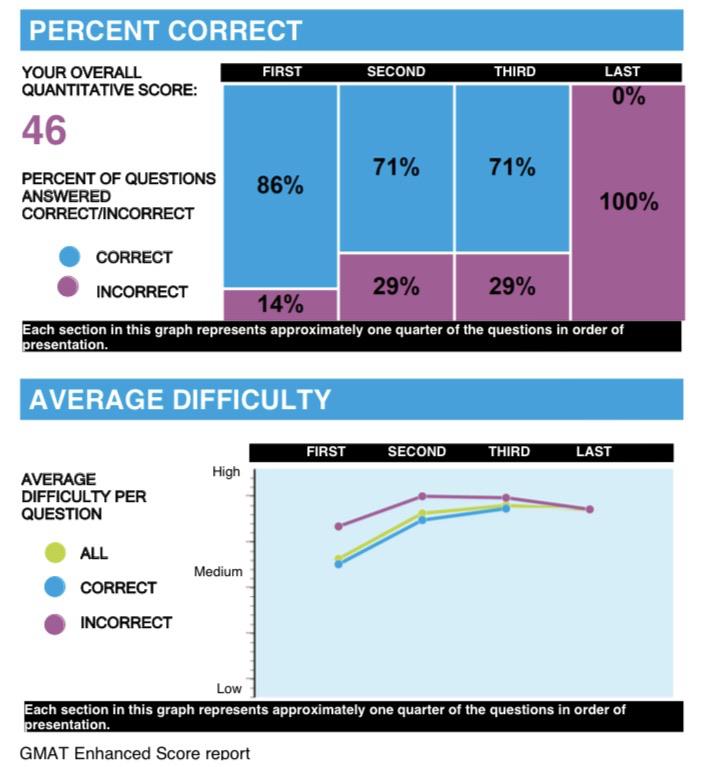
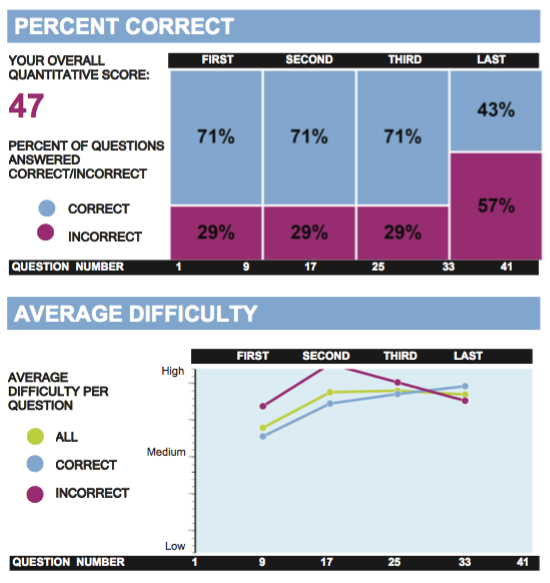
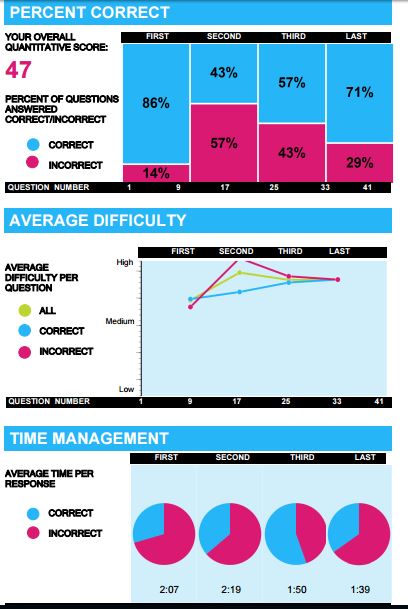
Of course, there are other paths to success, but in every instance I've seen thus far, you have to answer at least 4 out of the first 7 counted questions correctly to get a great score. I've seen a Q47 scored with a (by quarters) 71% / 71% / 71% / 43% split, which suggests that you don't have to ace the 1st half so long as you keep succeeding into the 3rd quarter of the test (questions #19-27). I've also seen a Q47 scored with an 86% / 43% / 57% / 71% split, and a Q46 scored with an 86%, 71%, 71%, 0% split. Note that in all of these scenarios, students are only answering 53-64% of questions correctly, but are still earning solid Quant scores.
 13 Oct 2023, 11:08
Kudos
Bookmarks
Automated notice from GMAT Club BumpBot:
A member just gave Kudos to this thread, showing it’s still useful. I’ve bumped it to the top so more people can benefit. Feel free to add your own questions or solutions.
This post was generated automatically.
A member just gave Kudos to this thread, showing it’s still useful. I’ve bumped it to the top so more people can benefit. Feel free to add your own questions or solutions.
This post was generated automatically.
Archived Topic
Hi there,
This topic has been closed and archived due to inactivity or violation of community quality standards. No more replies are possible here.
Where to now? Join ongoing discussions on thousands of quality questions in our Quantitative Questions Forum
Still interested in this question? Check out the "Best Topics" block above for a better discussion on this exact question, as well as several more related questions.
Thank you for understanding, and happy exploring!





