Events & Promotions
|
|

GMAT Club Daily Prep
Thank you for using the timer - this advanced tool can estimate your performance and suggest more practice questions. We have subscribed you to Daily Prep Questions via email.
Customized
for You
Track
Your Progress
Practice
Pays
Not interested in getting valuable practice questions and articles delivered to your email? No problem, unsubscribe here.
 Sep 10
01:00 AM EDT
-02:00 AM EDT
Learn how Keshav, a Chartered Accountant, scored an impressive 705 on GMAT in just 30 days with GMATWhiz's expert guidance. In this video, he shares preparation tips and strategies that worked for him, including the mock, time management, and more. Sep 04
10:00 AM EDT
-11:59 PM EDT
We’ve worked incredibly hard to build TTP into the best test prep experience possible, and it would mean a lot to us to win Newsweek’s 2026 Readers’ Choice Award for Best Test Prep. If TTP has helped you, we’d be incredibly grateful for your vote. Sep 08
12:30 AM EDT
-01:30 AM EDT
Looking for your GMAT motivation to break through the score plateau? Pragati improved her score by massive 160 points with strategic guidance and hard-work! Find out how personalized mentorship and a strong mindset can turn GMAT struggles into success. Sep 09
07:00 AM PDT
-10:00 AM PDT
Meet AdComs and explore top Master’s programs - MiM, MiF, MSc, MSBA and more. - Application Fee Waivers - Free 1-Week of GMAT Club Tests: - Master's Application Toolkit - Grand Prize Giveaway- Sep 09
10:00 AM PDT
-11:00 AM PDT
Three MBA applications. Three rejections. No interview invites. A year later, Aman was admitted to Cambridge Judge, SMU, and IMD. In this episode of MBA Admit Stories, Aman shares how he rebuilt his MBA application...  Sep 10
08:00 PM PDT
-09:00 PM PDT
Free- full-length test + 15 concept videos + 150+ short videos + study plan! Sep 15
07:00 PM EDT
-09:00 PM EST
Elite scores are possible when you enroll in a powerful GMAT course, taught live online + 6 months access to TTP OnDemand video courses included! Class starts Tues/Thurs Sept. 15, 2026 - Nov. 15, 2027, 7:00pm-9:00pm EST Sep 21
07:00 PM EDT
-10:00 PM EDT
Boost your GMAT score in less than one month in a live online class + 6 months access to TTP OnDemand video courses included! Class starts Mon, Tues, Wed, Thur, Fri Sept. 21, 2026 - Oct. 9, 2027, 7:00pm-10:00pm EST

 27 Dec 2019, 08:14
Kudos
Bookmarks
In a right angled triangle, the square of the length of the hypotenuse is equal to the sum of the squares of the lengths of the perpendicular sides. As we all know, this is the statement of the Pythagorean Theorem, which applies to all right angled triangles.
In the triangle shown below, the lengths of the perpendicular sides are ‘a’ and ‘b’ respectively; the length of the hypotenuse is ‘c’. Then, as per Pythagoras theorem,
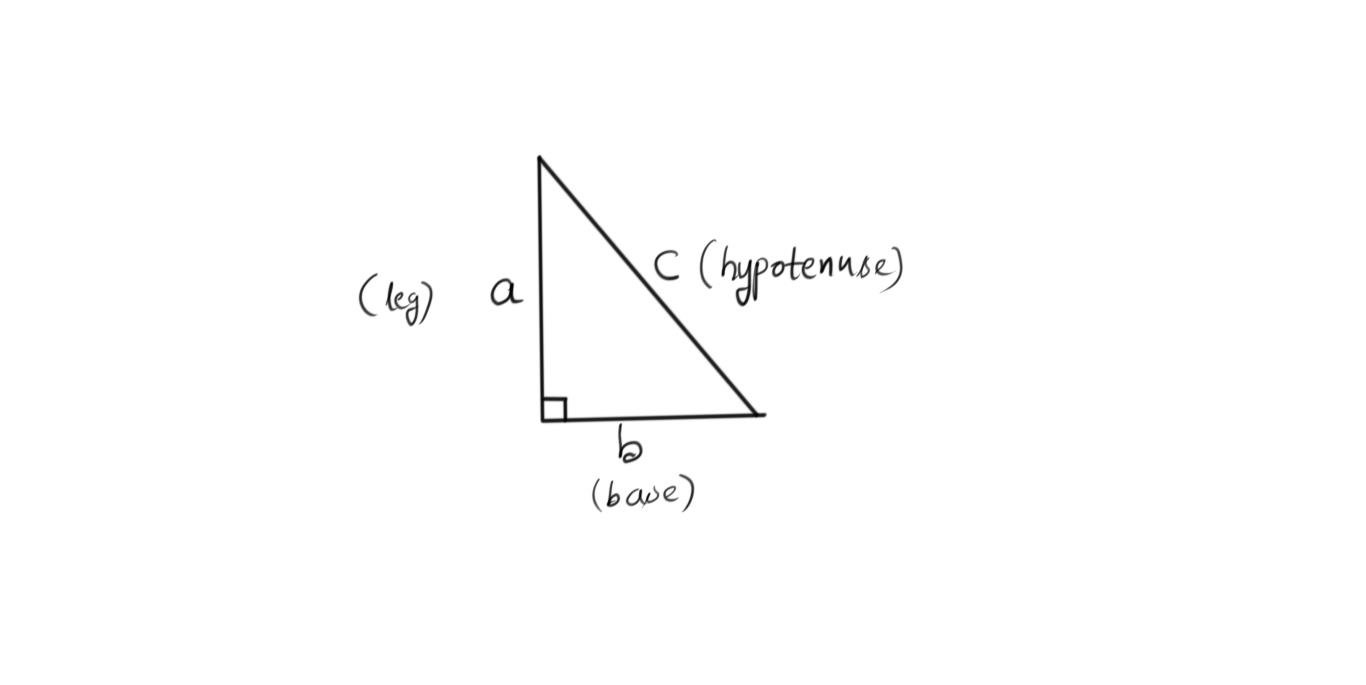
27th Dec 2019 - Org Post.jpg [ 22.7 KiB | Viewed 2234 times ]
\(c^2 = a^2 + b^2\\
\)
The values of a, b and c which satisfy the above equation are called Pythagorean triplets. Before we start the discussion on how to generate Pythagorean triplets, a few important points to remember about them:
1)Pythagorean triplets are always positive integers.
2) Multiples of primitive Pythagorean triplets are also Pythagorean triplets.
3) Values of a, b and c where one of the values is an irrational number, do not represent Pythagorean triplets. For example, 1,1, and √2 are not Pythagorean triplets although they represent the sides of a right-angled triangle.
4)If the sides of a triangle represent a Pythagorean triplet, the triangle is necessarily a right-angled triangle.
5)Pythagorean triplets are conventionally represented in the form of (a,b,c) where a<b<c.
6)A primitive Pythagorean triplet will always have one even number and two odd numbers.
Generating Primitive Pythagorean triplets is a fairly easy task using Euclid’s formula. As per this formula, the values of a, b and c can be calculated as follows:
a = \(x^2 – y^2\); b = 2xy; c =\( x^2 + y^2\). The conditions imposed on these equations are:
i) x and y are co-prime
ii) Difference of x and y is odd. This means, x and y are not both odd.
iii) Clearly, since a, b and c have to be positive integers, it follows that x has to be greater than y.
Remember that multiples of (\(x^2-y^2\)), 2xy and (\(x^2+y^2\)) will also be Pythagorean triplets. But, they are not considered primitive Pythagorean triplets and hence, the above conditions need not hold true for them.
Let’s take a few examples to understand how this works and then you can go ahead and generate many more Pythagorean triplets.
If x = 2 and y = 1, a = \(2^2 – 1^2\) = 4-1 = 3; b = 2*2*1 = 4; c = \(2^2 + 1^2\) = 4+1 = 5. We got the almost omnipresent (3,4,5).
If x = 3 and y = 2, we get a = 5, b = 12 and c = 13.
If x = 4 and y = 1, we get a = 15, b = 8 and c = 17.
This way, it will be easy for you to generate Primitive Pythagorean triplets. Naturally, the more triplets you add to your memory, the easier it becomes for you to identify right angled triangles using the triplets. Very often on the GMAT, if you can prove that a triangle given is a right angled triangle, it may turn out to be very helpful to take the problem forward from that stage.
Go ahead and generate at least another 5 to 7 primitive Pythagorean triplets. Also try to figure out their multiples, which will also be Pythagorean triplets. Once you are done, try your hand at this question.
in-the-triangle-abc-if-ad-16-and-dc-9-then-what-is-the-area-of-313291.html
Cheers!
In the triangle shown below, the lengths of the perpendicular sides are ‘a’ and ‘b’ respectively; the length of the hypotenuse is ‘c’. Then, as per Pythagoras theorem,
Attachment:
27th Dec 2019 - Org Post.jpg [ 22.7 KiB | Viewed 2234 times ]
\(c^2 = a^2 + b^2\\
\)
The values of a, b and c which satisfy the above equation are called Pythagorean triplets. Before we start the discussion on how to generate Pythagorean triplets, a few important points to remember about them:
1)Pythagorean triplets are always positive integers.
2) Multiples of primitive Pythagorean triplets are also Pythagorean triplets.
3) Values of a, b and c where one of the values is an irrational number, do not represent Pythagorean triplets. For example, 1,1, and √2 are not Pythagorean triplets although they represent the sides of a right-angled triangle.
4)If the sides of a triangle represent a Pythagorean triplet, the triangle is necessarily a right-angled triangle.
5)Pythagorean triplets are conventionally represented in the form of (a,b,c) where a<b<c.
6)A primitive Pythagorean triplet will always have one even number and two odd numbers.
Generating Primitive Pythagorean triplets is a fairly easy task using Euclid’s formula. As per this formula, the values of a, b and c can be calculated as follows:
a = \(x^2 – y^2\); b = 2xy; c =\( x^2 + y^2\). The conditions imposed on these equations are:
i) x and y are co-prime
ii) Difference of x and y is odd. This means, x and y are not both odd.
iii) Clearly, since a, b and c have to be positive integers, it follows that x has to be greater than y.
Remember that multiples of (\(x^2-y^2\)), 2xy and (\(x^2+y^2\)) will also be Pythagorean triplets. But, they are not considered primitive Pythagorean triplets and hence, the above conditions need not hold true for them.
Let’s take a few examples to understand how this works and then you can go ahead and generate many more Pythagorean triplets.
If x = 2 and y = 1, a = \(2^2 – 1^2\) = 4-1 = 3; b = 2*2*1 = 4; c = \(2^2 + 1^2\) = 4+1 = 5. We got the almost omnipresent (3,4,5).
If x = 3 and y = 2, we get a = 5, b = 12 and c = 13.
If x = 4 and y = 1, we get a = 15, b = 8 and c = 17.
This way, it will be easy for you to generate Primitive Pythagorean triplets. Naturally, the more triplets you add to your memory, the easier it becomes for you to identify right angled triangles using the triplets. Very often on the GMAT, if you can prove that a triangle given is a right angled triangle, it may turn out to be very helpful to take the problem forward from that stage.
Go ahead and generate at least another 5 to 7 primitive Pythagorean triplets. Also try to figure out their multiples, which will also be Pythagorean triplets. Once you are done, try your hand at this question.
in-the-triangle-abc-if-ad-16-and-dc-9-then-what-is-the-area-of-313291.html
Cheers!
Archived Topic
Hi there,
This topic has been closed and archived due to inactivity or violation of community quality standards. No more replies are possible here.
Where to now? Join ongoing discussions on thousands of quality questions in our Quantitative Questions Forum
Still interested in this question? Check out the "Best Topics" block below for a better discussion on this exact question, as well as several more related questions.
Thank you for understanding, and happy exploring!


 30 Dec 2019, 14:16
Kudos
Bookmarks
Luckily, you really only need 3/4/5 and 5/12/13 for the GMAT! I'd be interested in seeing any official problem where you would really benefit from a more general knowledge of the number theory behind Pythagorean triplets. (I'm also curious whether anybody's seen a problem using 8/15/17.)
Archived Topic
Hi there,
This topic has been closed and archived due to inactivity or violation of community quality standards. No more replies are possible here.
Where to now? Join ongoing discussions on thousands of quality questions in our Quantitative Questions Forum
Still interested in this question? Check out the "Best Topics" block above for a better discussion on this exact question, as well as several more related questions.
Thank you for understanding, and happy exploring!



