Events & Promotions
|
|

GMAT Club Daily Prep
Thank you for using the timer - this advanced tool can estimate your performance and suggest more practice questions. We have subscribed you to Daily Prep Questions via email.
Customized
for You
Track
Your Progress
Practice
Pays
Not interested in getting valuable practice questions and articles delivered to your email? No problem, unsubscribe here.
 Sep 02
01:00 PM EDT
-11:59 PM EDT
Take 30% off all study plans with code COURSEWORK - Expires on Monday 9/7 Sep 04
10:00 AM PDT
-11:00 AM PDT
What does test anxiety really look like on the GMAT? For many test takers, it does not look like a panic attack. Instead, it shows up as brain fog, rereading, negative comparisons, mental noise.... Sep 04
10:00 AM EDT
-11:59 PM EDT
We’ve worked incredibly hard to build TTP into the best test prep experience possible, and it would mean a lot to us to win Newsweek’s 2026 Readers’ Choice Award for Best Test Prep. If TTP has helped you, we’d be incredibly grateful for your vote. Sep 06
09:30 AM EDT
-12:30 PM EST
Top scores are possible when you enroll in a powerful EA course, taught live online + 6 months access to TTP OnDemand video courses included! Perfect class schedule and easy course access for working professionals. Class starts Sundays Sept. 6, 2026.- Sep 07
12:01 AM PDT
-11:59 PM PDT
On the 7th, GMAT Club Tests will be Free! Including all the Quizzes, Questions, and Tests. 12 AM - 11:59 PM PDT - Sep 07
10:00 AM PDT
-11:00 AM PDT
A complete walkthrough of GMAT Club’s free 12-week GMAT study plan: what you study each week, how progress and goals are tracked, how the error log works, and how your practice unlocks paid tools at no cost. - Sep 09
07:00 AM PDT
-10:00 AM PDT
Meet AdComs and explore top Master’s programs - MiM, MiF, MSc, MSBA and more. - Application Fee Waivers - Free 1-Week of GMAT Club Tests: - Master's Application Toolkit - Grand Prize Giveaway - Sep 09
10:00 AM PDT
-11:00 AM PDT
Three MBA applications. Three rejections. No interview invites. A year later, Aman was admitted to Cambridge Judge, SMU, and IMD. In this episode of MBA Admit Stories, Aman shares how he rebuilt his MBA application...  Sep 15
07:00 PM EDT
-09:00 PM EST
Elite scores are possible when you enroll in a powerful GMAT course, taught live online + 6 months access to TTP OnDemand video courses included! Class starts Tues/Thurs Sept. 15, 2026 - Nov. 15, 2027, 7:00pm-9:00pm EST Sep 21
08:00 PM EDT
-10:00 PM EDT
Boost your GMAT score in less than one month in a live online class + 6 months access to TTP OnDemand video courses included! Class starts Mon, Tues, Wed, Thur, Fri Sept. 21, 2026 - Oct. 9, 2027, 7:00pm-10:00pm EST

 17 May 2020, 14:11
Kudos
Bookmarks
“Simplify” process skill to your rescue!

INTRODUCTION
How many times have you experienced a situation when just a cursory glance of the question scares you because you see those weird looking expressions?
How many times has it happened that you reach a point in the solution and you just cannot go further because you are stuck?
To successfully combat such situations, you need to master “simplify” process skill.
What is simplify process skill?
As we discussed in this article, “simplify” process skill is defined as follows:

Let’s take our first example and learn how to apply “simplify” process skill.
Solve this 700-level Algebra question from the Official Guide Advanced book.
EX 1
If n > 4, what is the value of the integer n?
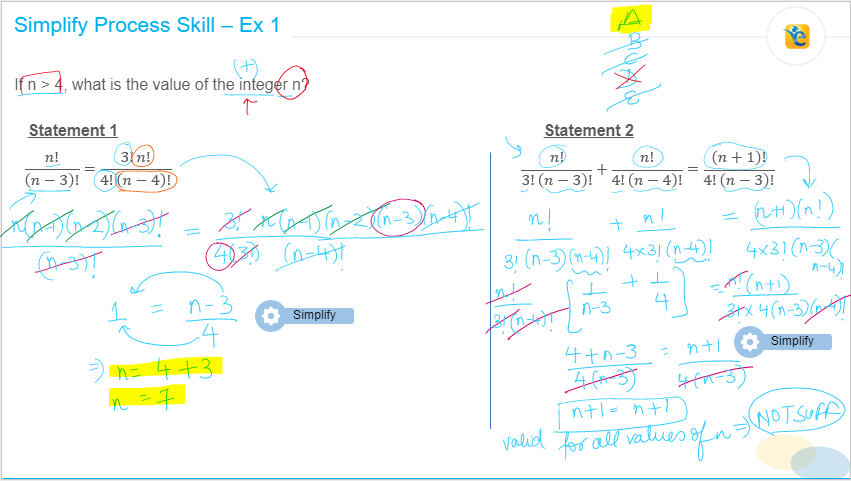
(1) \(\frac{n!}{(n-3)!}=\frac{3!n!}{4!(n-4)!}\)
(2) \(\frac{n!}{3!(n-3)!}+\frac{n!}{4!(n-4)!}=\frac{(n+1)!}{4!(n-3)!}\)
Now review the solution of this question. If you prefer a video solution, you may view it here.
SIMPLIFY PROCESS SKILL AT PLAY
Before getting started with analyzing the given statements, let’s see what’s given to us in the question.
- • We are given that n is an integer, which is greater than 4.
• And, we are asked to find the value of n.
Let’s look at the solution to understand how it’s done.
While analyzing statement 1, we notice that all the terms in the equation are factorials. By applying the conceptual knowledge of factorial, that n! is the product of all integers from 1 to n, let’s simplify this equation:
- • What is the common factor between the numerator and the denominator of \(\frac{n!}{(n – 3)!}\)?
- o It is (n – 3)!
- By applying the definition of factorial, we can write n! as n × (n – 1) × (n – 2) × (n – 3)!
• Therefore, \(\frac{n!}{(n – 3)!} = n × (n – 1) × (n – 2)\)
Similarly, the right-hand side of the equation can be simplified by cancelling out the common factor in both numerator and denominator.
- • The common factor between 3! and 4! is 3!
- o 4! = 4 × 3!
• Therefore,\(\frac{ (3! × n!)}{(4! × (n – 4)!)}=\frac{(n × (n – 1) × (n – 2) × (n - 3))}{4}\)
Equating both we get, n × (n – 1) × (n – 2) = \(\frac{n × (n – 1) × (n – 2) × (n – 3)}{4}\)
Now that we have a much-simplified form, let’s see whether the above equation can be simplified further or not.
- • The answer is yes!
- o We can simplify this equation by cancelling out the common terms on both sides of the equation
- The common terms are n × (n -1) × (n – 2)
Cancelling out, we get,
- • \(1 =\frac{(n – 3)}{4}\)
• Implies, n – 3 = 4
This is the simplest form of the given equation, which cannot be simplified any further. And we can directly get the value of n from this simplified equation.
Similarly, statement 2 can be simplified by applying the same process as that on statement 1.
- • Take the common factors out from the respective numerators and denominators on both sides of the equation and cancel them out.
Now, some of you might think that the information, that n > 4, given in the question is redundant.
- • But it’s not.
- o We need to make sure that the denominators are not zeroes and
o We cannot cancel out the common factors from the numerator and denominator, unless we know that they are not equal to 0.
Essentially, in this question,
- • We have applied the simplification process skill to reduce a complex looking equation into its simplest form by cancelling out the common factors and arrived at the answer very easily.
• In terms of conceptual knowledge, we applied the definition of factorial and the fact that the denominator of a fraction cannot be 0.
Let’s now look at another example:
First solve this question. It is from OG Quantitative Review.
EX 2
The function f is defined for each positive three-digit integer n by \(f(n)= 2^x3^y5^z\) , where x, y and z are the hundreds, tens, and units’ digits of n, respectively. If m and v are three-digit positive integers such that f(m) = 9 x f(v), then m - v = ?
Now review the solution of this question. If you prefer a video solution, you may view it here.
SIMPLIFY PROCESS SKILL AT PLAY
Let’s see what’s the role of the simplify process skill in solving this question
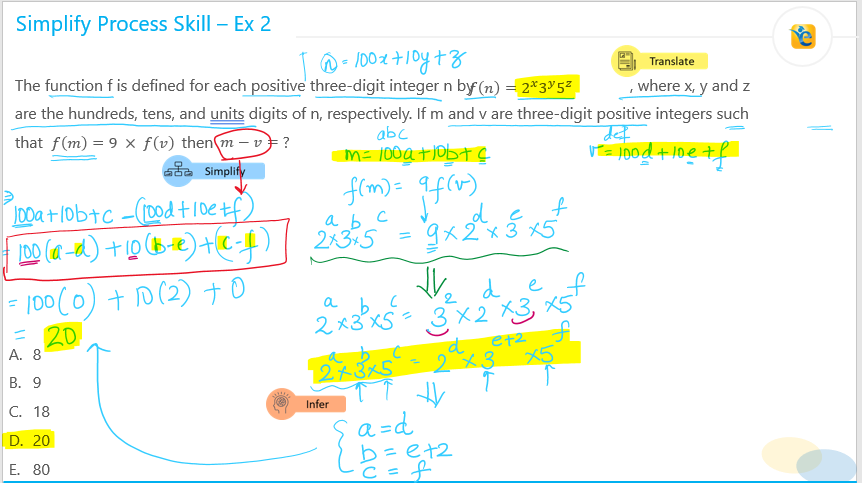
- • As you can see, in this solution, on a high level we have used the equation f(m) = 9 x f(v), given in the question, to establish relationship between the respective digits of m and v by applying a property of exponents.
Now, most of you might think what is the role of simplify here? Let me explain that now:
- • We have assumed that m = abc, and n = def.
• And then we have established a relationship between {a and d}, {b and e}, {c and f}.
Now, tell me, using the above information can we find the value of m – v directly?
- • No, right?
- o Because we know m – v = abc – def, but we don’t have any expression where we can use the established relations between the respective digits of m and v.
For that we need to simplify the expression, m – v = abc – def, by applying the place value concept.
- • The three-digit number, abc, can be written as 100a + 10b + c, and
• The three-digit number, def, can be written as 100d + 10e + f.
Thus, abc – def = 100a + 10b + c – 100d – 10e – f, which can be further simplified as 100(a - d) + 10 (b – e) + (c – f).
Now, in this above expression we can use the relations that we have established earlier to get to the final answer.
Therefore, in this approach, simplify process skill helped us get to an expression where we can use the established relations between the respective digits to get to the final answer.
Let’s work on another example, where simplify process skill is required, though there are no weird expressions given to us in the question.
First solve this question.
EX 3
If x and y are integers, what is the remainder when \(x^2 + y^2\) is divided by 5?
- 1. When x – y is divided by 5, the remainder is 1.
2. When x + y is divided by 5, the remainder is 2.
Now review the solution of this question. If you prefer a video solution, you may view it here.
SIMPLIFY PROCESS SKILL AT PLAY
Now, let’s look at how we applied simplification process skill in this question
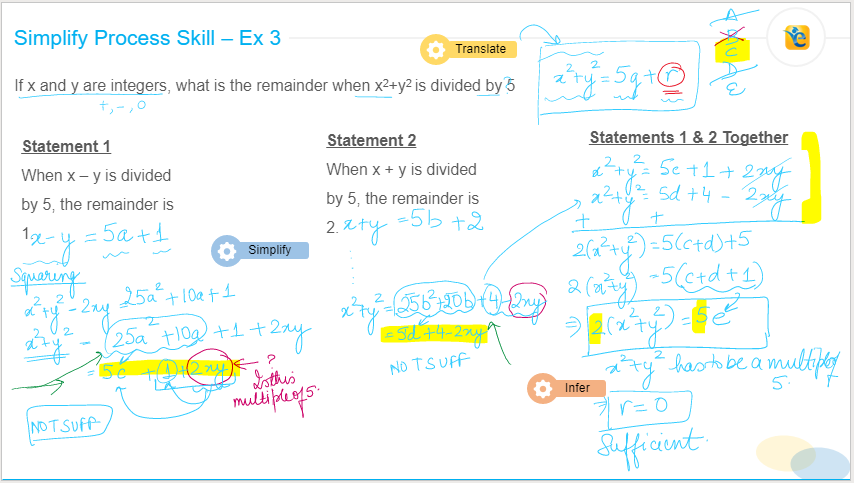
- • What can we infer from the derived equation, \(x^2 + y^2 = 25a^2 + 10a + 1 + 2xy\), in statement 1 analysis? Are we able to draw any inferences quickly from this complicated looking equation?
- o No, right?
o Because of the multiple variables present, {xy, a} and their powers, it seems difficult or time taking
- o Let’s try to simplify this complicated looking expression
o How to do it?
- If we observe the right-hand side of the equation \(25a^2 + 10a + 1 + 2xy\), carefully, we notice that the first two terms – {\(25a^2\) and 10a} - are multiples of 5
So, we can take 5 common from both the terms and represent the remaining part with some other variable ”c” as shown below
- • \(25a^2 + 10a = 5 × (5a^2 + 2a) = 5c\), where \(c = 5a^2 + 2a\)
- o \(x^2 = y^2 = 5c + 1 + 2xy\)
- Now, by applying the conceptual knowledge, we can infer that this equation is of the form:
- • Dividend = divisor × quotient + remainder, where dividend = \(x^2 + y^2\), divisor is 5 and the remainder term is 1 + 2xy
Hence, we can conclude that Statement 1 is not sufficient to answer the question
Similarly, in statement 2 we have simplified the complex looking expression, \(25b^2 + 20b + 4 - 2xy\), by replacing, \(25b^2 + 20b\), with 5d and inferred that the value of the remainder depends upon the value of xy.
Further, when we combined the information from both statements, we got
- \(2 (x^2 + y^2) = 5c + 5d + 5\)
Which is further simplified to get to the form \(x^2 + y^2 = 5q + r\), where r is the remainder
- o This is done by taking 5 common from the three terms on the RHS of the equation and replacing it with a new variable “e”
o \(2(x^2 + y^2) = 5 × (c + d + 1) = 5e\)
All in all, in this question, simplify process skill is used to simplify the complex looking expression derived in the analysis of both statements and get them to the general remainder form, so that we can draw the inferences easily and get to the final answer.
In contrast to the first two examples, there are no weird or complex looking expressions in this question. So, most of you might think simplification is not necessary to solve this question, until you start manipulating the equations given in the statements to get the LHS of the equations to the form \(x^2 + y^2\).
CONCLUDING REMARKS
Through these three examples from Number Properties we understood that:
- 1. Simplify Process Skill is applied on complex or weird looking expressions in the question.
2. Simplify Process Skill can be applied on simple expressions, in the question, which cannot be used directly in the solution.
3. Simplify Process Skill can be applied on the expressions that are not present in the question but are derived in the solution.
Example 1 is a direct application of the definition of Simplify Process Skill. In this question, we converted the complex equations given in the statements to their simplest forms and arrived at the answer.
Whereas, in Example 2 we do not have any weird expression given in the question, but we have an expression in which we cannot use the established relations. Hence, we applied Simplify Process Skill to convert the given expression into a form in which the established relations can be used to get to the final answer.
And finally, in Example 3, which looks pretty simple and straight forward, most of us might think there is no role of Simplification. But we have seen how Simplify Process Skill is applied on an equation that is derived in the solution, and further made the process of drawing inferences from the simplified equation much easier.
In summary, we can say that the Simplify Process Skill can be applied on the complex expressions given in the question or derived in the solution or the expressions that can be manipulated to be used in the solution.
So, start building this process skill to get closer to your Q50/Q51 score.
Happy learning!
Archived Topic
Hi there,
This topic has been closed and archived due to inactivity or violation of community quality standards. No more replies are possible here.
Where to now? Join ongoing discussions on thousands of quality questions in our Quantitative Questions Forum
Still interested in this question? Check out the "Best Topics" block below for a better discussion on this exact question, as well as several more related questions.
Thank you for understanding, and happy exploring!





