Events & Promotions
|
|

GMAT Club Daily Prep
Thank you for using the timer - this advanced tool can estimate your performance and suggest more practice questions. We have subscribed you to Daily Prep Questions via email.
Customized
for You
Track
Your Progress
Practice
Pays
Not interested in getting valuable practice questions and articles delivered to your email? No problem, unsubscribe here.
 Sep 06
09:30 AM EDT
-12:30 PM EST
Top scores are possible when you enroll in a powerful EA course, taught live online + 6 months access to TTP OnDemand video courses included! Perfect class schedule and easy course access for working professionals. Class starts Sundays Sept. 6, 2026. Sep 02
01:00 PM EDT
-11:59 PM EDT
Take 30% off all study plans with code COURSEWORK - Expires on Monday 9/7 Sep 04
10:00 AM EDT
-11:59 PM EDT
We’ve worked incredibly hard to build TTP into the best test prep experience possible, and it would mean a lot to us to win Newsweek’s 2026 Readers’ Choice Award for Best Test Prep. If TTP has helped you, we’d be incredibly grateful for your vote. Sep 07
12:01 AM PDT
-11:59 PM PDT
On the 7th, GMAT Club Tests will be Free! Including all the Quizzes, Questions, and Tests. 12 AM - 11:59 PM PDT- Sep 07
10:00 AM PDT
-11:00 AM PDT
A complete walkthrough of GMAT Club’s free 12-week GMAT study plan: what you study each week, how progress and goals are tracked, how the error log works, and how your practice unlocks paid tools at no cost. - Sep 09
07:00 AM PDT
-10:00 AM PDT
Meet AdComs and explore top Master’s programs - MiM, MiF, MSc, MSBA and more. - Application Fee Waivers - Free 1-Week of GMAT Club Tests: - Master's Application Toolkit - Grand Prize Giveaway - Sep 09
10:00 AM PDT
-11:00 AM PDT
Three MBA applications. Three rejections. No interview invites. A year later, Aman was admitted to Cambridge Judge, SMU, and IMD. In this episode of MBA Admit Stories, Aman shares how he rebuilt his MBA application...  Sep 15
07:00 PM EDT
-09:00 PM EST
Elite scores are possible when you enroll in a powerful GMAT course, taught live online + 6 months access to TTP OnDemand video courses included! Class starts Tues/Thurs Sept. 15, 2026 - Nov. 15, 2027, 7:00pm-9:00pm EST Sep 21
08:00 PM EDT
-10:00 PM EDT
Boost your GMAT score in less than one month in a live online class + 6 months access to TTP OnDemand video courses included! Class starts Mon, Tues, Wed, Thur, Fri Sept. 21, 2026 - Oct. 9, 2027, 7:00pm-10:00pm EST

 05 Dec 2021, 18:56
Kudos
Bookmarks
Hello, everyone. I would like to preface this post by saying that I have been reading a Buddhist text lately, one that I return to year after year and would heartily recommend, Who Ordered This Truckload of Dung? by Ajahn Brahm.
Today I achieved something whose outcome was most uncertain when I created a twenty-question quiz of GMAT Club Quant questions: I answered each question correctly. These were not just any questions. I had decided to bite the bullet and face one of my weaker areas, one that many people seem to dread, Combinatorics and Probability. (I even posted an incorrect "solution" to such a question in the forum at one point.) It is not that I dislike math. I love its logic, the joy that comes with solving a tough question. It is just that, by the time I turned twenty, I began to grow undisciplined with my study of mathematics, relying more on what I remembered and fitting pieces together than on eagerly learning new concepts the way I once had done.
I started my set with a mind to do my best to understand the question. Sure, it can be humbling to see an elegant solution by Bunuel, chetan2u, VeritasKarishma, or one of the other Quant Experts, but I accept that they are working with a different set of skills than I may be, whether innate or learned. This time, I made up my mind to simply work through each question.
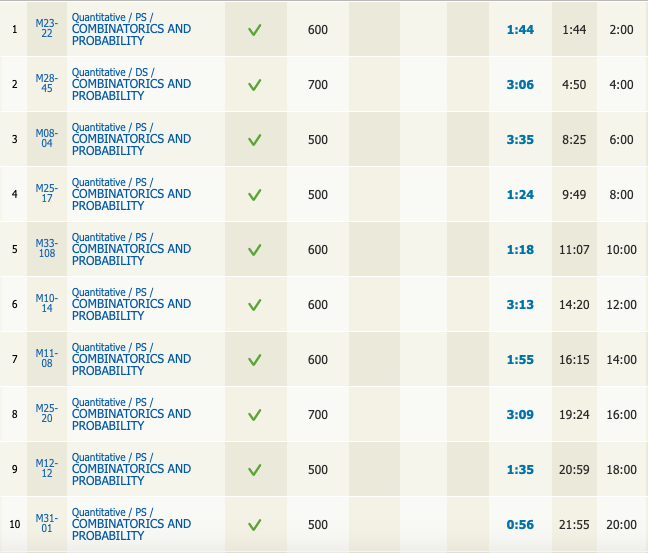
Now, for the images. I am leaving up the question ID numbers so that anyone who is interested can take on the same gauntlet.
Screen Shot 2021-12-05 at 19.20.01.png [ 103.81 KiB | Viewed 1613 times ]
Through the first half of the quiz, I fell behind test pace, but I told myself, Who cares? Will the exam throw me twenty such questions? One thing I like about mixed sets is that I have no idea what difficulty a given question may be when I encounter it. Some questions went quite well, such as numbers 5 and 10, while others took time, such as 2, 3, 6, and 8. (I think 3 may have been a hangover effect from solving 2.) No matter what I saw on the screen, I employed the same strategy I teach all my students, asking myself three questions and putting pen to pad:
1) What is the question asking? (It is easy to fall into a trap if you are not careful.)
2) What information do I have? (Not everything has to be taken in at once. I have seen the look on many a face that says, Uh oh! I'm stuck in quicksand and can't move! But if you work with one piece of information at a time, the problem can become much more manageable. Sometimes you can reframe the question. Sometimes writing down that first piece of information allows you to see where to go with the next.)
3) What is the core concept that is being tested? (No matter how bad the problem looks, it will be based on some fundamental concept, even if it builds on multiple concepts simultaneously.)
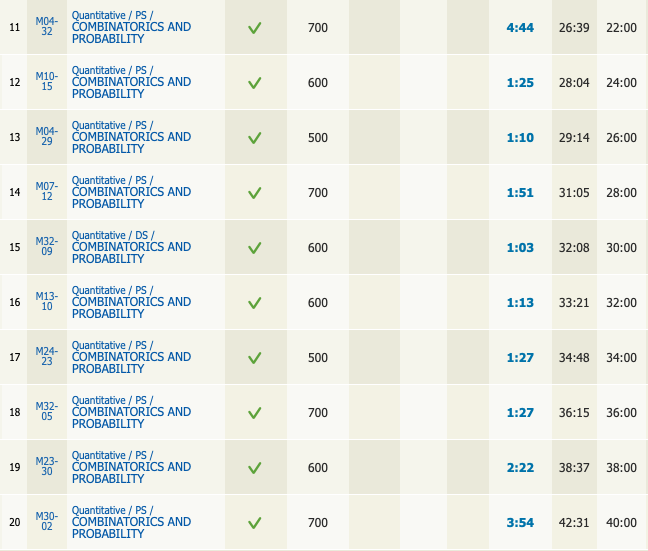
Sometimes my first approach was not getting me too far, but the important thing was that I kept going. As soon as I saw that I was pursuing a dead end, I assessed what I had done that seemed productive, and I moved away from what had gotten me into trouble, answerless while the clock was ticking. At the halfway point, I hit such a question. (See question 11 below.) I started out by figuring out the number of five-digit integers that could be formed from 0-5, inclusive, and I failed to appreciate the part in the question stem that specified, which are divisible by 3. Now, I had to remember divisibility rules (the sum of the digits of an integer must be divisible by 3 for the integer itself to be divisible by 3), and I had to work from the ground up. I lost almost five minutes on that one. But then look at what happened: I rattled off the next seven questions in under two minutes apiece.
Screen Shot 2021-12-05 at 19.20.29.png [ 104.67 KiB | Viewed 1562 times ]
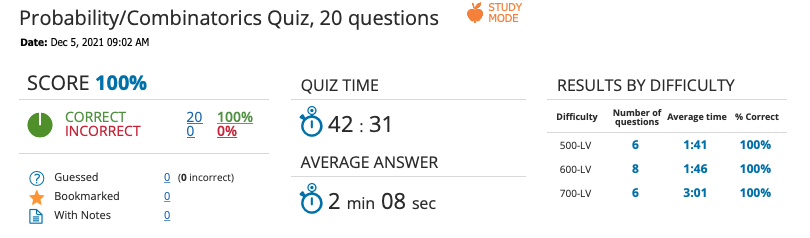
I recalled something a colleague of mine told me about his route to earning a 51 in the Quant section. He said that at one point during his exam, he sacrificed eight minutes on a single question, confident from his practice results that he could bounce back in time. You know what? He did. He had gone from being ahead of the clock to falling behind, but, with laser focus, he persisted, and the results he knew he could attain followed. At the end of my set, I hit one of those questions that pushed me to my logical limits. On many questions, I can work with a small enough set to observe patterns, and I would say I am pretty quick at arithmetic. But this question had answers running into the thousands. I wondered how I could break it down. I drew a picture of a round table. It was the second such arrangement question on my quiz. At first, I did not see my answer. But then I thought, okay, I have a sequence of BSSB (for brother, sister, sister, brother), and I know the different arrangements from, say, left to right. But what about the other direction, if the same sequence were run in reverse, as in B1, S1, S2, B2 becoming B2, S2, S1, B1? That would be a different arrangement. I doubled my tally. Still no matching answer. But then I considered the rest of the people sitting around that table, five others. And I reversed their order, too. That took my number of total arrangements to an answer that felt right, that had a firm logical grounding. And, of course, I was right. Upon confirming my answer, the first thing I noticed on the next screen was the following:
Screen Shot 2021-12-05 at 19.13.11.png [ 55.3 KiB | Viewed 1526 times ]
I had done it. I had survived a GMAT Club Quant minefield laced with Combinatorics and Probability questions. The point of my writing this post is not to gloat. I see room for improvement. Some of those easier questions could certainly have been completed more efficiently—some of those harder ones, too—and I will comb through the OEs and community dialogue to take notes. But, at the same time, this set allowed me to appreciate the bigger point that, with a combination of discipline and knowledge, the sky is the limit. I do not have to be anyone else. I can work on being the best me.
Make of this post what you will. (I would be happy to share other quiz results that show my mistakes.) Many thanks to the Quant Experts who take the time to post questions and share solutions to guide learners like me.
As always, good luck with your studies.
- Andrew
Today I achieved something whose outcome was most uncertain when I created a twenty-question quiz of GMAT Club Quant questions: I answered each question correctly. These were not just any questions. I had decided to bite the bullet and face one of my weaker areas, one that many people seem to dread, Combinatorics and Probability. (I even posted an incorrect "solution" to such a question in the forum at one point.) It is not that I dislike math. I love its logic, the joy that comes with solving a tough question. It is just that, by the time I turned twenty, I began to grow undisciplined with my study of mathematics, relying more on what I remembered and fitting pieces together than on eagerly learning new concepts the way I once had done.
I started my set with a mind to do my best to understand the question. Sure, it can be humbling to see an elegant solution by Bunuel, chetan2u, VeritasKarishma, or one of the other Quant Experts, but I accept that they are working with a different set of skills than I may be, whether innate or learned. This time, I made up my mind to simply work through each question.
Now, for the images. I am leaving up the question ID numbers so that anyone who is interested can take on the same gauntlet.
Attachment:
Screen Shot 2021-12-05 at 19.20.01.png [ 103.81 KiB | Viewed 1613 times ]
1) What is the question asking? (It is easy to fall into a trap if you are not careful.)
2) What information do I have? (Not everything has to be taken in at once. I have seen the look on many a face that says, Uh oh! I'm stuck in quicksand and can't move! But if you work with one piece of information at a time, the problem can become much more manageable. Sometimes you can reframe the question. Sometimes writing down that first piece of information allows you to see where to go with the next.)
3) What is the core concept that is being tested? (No matter how bad the problem looks, it will be based on some fundamental concept, even if it builds on multiple concepts simultaneously.)
Sometimes my first approach was not getting me too far, but the important thing was that I kept going. As soon as I saw that I was pursuing a dead end, I assessed what I had done that seemed productive, and I moved away from what had gotten me into trouble, answerless while the clock was ticking. At the halfway point, I hit such a question. (See question 11 below.) I started out by figuring out the number of five-digit integers that could be formed from 0-5, inclusive, and I failed to appreciate the part in the question stem that specified, which are divisible by 3. Now, I had to remember divisibility rules (the sum of the digits of an integer must be divisible by 3 for the integer itself to be divisible by 3), and I had to work from the ground up. I lost almost five minutes on that one. But then look at what happened: I rattled off the next seven questions in under two minutes apiece.
Attachment:
Screen Shot 2021-12-05 at 19.20.29.png [ 104.67 KiB | Viewed 1562 times ]
Attachment:
Screen Shot 2021-12-05 at 19.13.11.png [ 55.3 KiB | Viewed 1526 times ]
Make of this post what you will. (I would be happy to share other quiz results that show my mistakes.) Many thanks to the Quant Experts who take the time to post questions and share solutions to guide learners like me.
As always, good luck with your studies.
- Andrew
Archived Topic
Hi there,
This topic has been closed and archived due to inactivity or violation of community quality standards. No more replies are possible here.
Where to now? Join ongoing discussions on thousands of quality questions in our Quantitative Questions Forum
Still interested in this question? Check out the "Best Topics" block below for a better discussion on this exact question, as well as several more related questions.
Thank you for understanding, and happy exploring!

PyjamaScientist

Admitted - Which School Forum Moderator
Joined: 25 Oct 2020
Last visit: 14 Jul 2026
Posts: 1,123
Own Kudos:
Given Kudos: 633
Schools: Ross '25 (M$)
GMAT 1: 740 Q49 V42 (Online)
Products:
05 Dec 2021, 23:41
Kudos
Bookmarks
Sailing on the boat similar to yours. And the way you have encapsulated your experience, it gives great confidence to people like me.
But one thing that caught my eye was the usage of "past perfect tense" in your first sentence, is it correct usage?
"I had survived a GMAT Club Quant minefield laced with Combinatorics and Probability questions."
P.S. Studying for SC does that to you. Lol.
But one thing that caught my eye was the usage of "past perfect tense" in your first sentence, is it correct usage?
"I had survived a GMAT Club Quant minefield laced with Combinatorics and Probability questions."
P.S. Studying for SC does that to you. Lol.
06 Dec 2021, 16:04
Kudos
Bookmarks
PyjamaScientist
Glad you enjoyed my little writeup, PyjamaScientist. I see your responses to DS and PS Butler questions now and then, and they look sound. As for the question at hand, the past perfect is a construct often employed to wrap up a tale that starts in the present, drifts into the past, and then pops back out to the present again to refer to the past. You cannot take a single line written in the past perfect and say that it needs to employ the simple past first to be valid. SC sentences are constructed without a larger context in which to ground the given sentence. (At best, you may see a compound sentence.)
In my earlier post in that final paragraph, I was reporting from the present about a state of mind I had been in in the past, and a reader understands a line such as I had done it to refer to a more complete thought or feeling that I was exhilarated that I had done it or I was relieved that I had done it. The simple past would have kept my thoughts and feelings anchored in the moment, but my storytelling point of view was ready to move on. (I did not think about it consciously as I was writing, to be honest, in a clear case of native speaker syndrome.)
Good question. I hope my response does not further confuse you.
- Andrew
Archived Topic
Hi there,
This topic has been closed and archived due to inactivity or violation of community quality standards. No more replies are possible here.
Where to now? Join ongoing discussions on thousands of quality questions in our Quantitative Questions Forum
Still interested in this question? Check out the "Best Topics" block above for a better discussion on this exact question, as well as several more related questions.
Thank you for understanding, and happy exploring!





