Events & Promotions
|
|

GMAT Club Daily Prep
Thank you for using the timer - this advanced tool can estimate your performance and suggest more practice questions. We have subscribed you to Daily Prep Questions via email.
Customized
for You
Track
Your Progress
Practice
Pays
Not interested in getting valuable practice questions and articles delivered to your email? No problem, unsubscribe here.
 Sep 10
08:00 PM PDT
-09:00 PM PDT
Free- full-length test + 15 concept videos + 150+ short videos + study plan! Sep 08
12:30 AM EDT
-01:30 AM EDT
Looking for your GMAT motivation to break through the score plateau? Pragati improved her score by massive 160 points with strategic guidance and hard-work! Find out how personalized mentorship and a strong mindset can turn GMAT struggles into success. Sep 10
01:00 AM EDT
-02:00 AM EDT
Learn how Keshav, a Chartered Accountant, scored an impressive 705 on GMAT in just 30 days with GMATWhiz's expert guidance. In this video, he shares preparation tips and strategies that worked for him, including the mock, time management, and more. Sep 15
07:00 PM EDT
-09:00 PM EST
Elite scores are possible when you enroll in a powerful GMAT course, taught live online + 6 months access to TTP OnDemand video courses included! Class starts Tues/Thurs Sept. 15, 2026 - Nov. 15, 2027, 7:00pm-9:00pm EST Sep 21
07:00 PM EDT
-10:00 PM EDT
Boost your GMAT score in less than one month in a live online class + 6 months access to TTP OnDemand video courses included! Class starts Mon, Tues, Wed, Thur, Fri Sept. 21, 2026 - Oct. 9, 2027, 7:00pm-10:00pm EST

 19 Apr 2009, 21:27
Kudos
Bookmarks
If a triangle is inscribed in a semi circle, i.e. it is a right angle triangle with diameter as base... is there any rule/formula about finding the area of this triangle?
Also, will all such triangles in a semi circle have the same area? Or the same perimeter?
Also, will all such triangles in a semi circle have the same area? Or the same perimeter?
Archived Topic
Hi there,
This topic has been closed and archived due to inactivity or violation of community quality standards. No more replies are possible here.
Where to now? Join ongoing discussions on thousands of quality questions in our Quantitative Questions Forum
Still interested in this question? Check out the "Best Topics" block below for a better discussion on this exact question, as well as several more related questions.
Thank you for understanding, and happy exploring!
 19 Apr 2009, 22:53
Kudos
Bookmarks
thinkblue
No, they dont have the same area or same perimeter if inscribed in a semi-circle.
 21 Apr 2009, 16:16
Kudos
Bookmarks
The response that you've already received correctly states that there is no way to know the area of triangle ABD at this point; you'd need some more information. Frankly, that's probably all you wanted! 
However, let me add a couple things to this discussion, just in case.
First, a diagram, just to give these things handles:
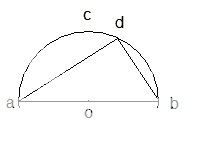
Thus, line AB is a diameter of the circle with center O, point D is arbitrarily chosen on the circle, and C is straight "up" from the middle (not rigorous, but you know what I mean).
You are correct in saying that ADB must be a right angle, regardless of where D is chosen.
1) There is no lower bound on the area of triangle ADB. If we "push" point D further and further and further to the right, the triangle gets shorter and shorter, see? Thus, the area of triangle ADB can get arbitrarily close to zero.
2) There is, however, an upper bound on the area of triangle ADB! Namely, \(r^2\). When point D coincides with point C, we create a nice 45-45-90 triangle, and visual inspection seems to indicate that it has the maximum area. (the formula is easy to work out: the base of the triangle is the diameter, which is 2r, and the height would then equal r. Thus, \((1/2) * b * h = (1/2) * 2r * r = r^2\)
We can also get that result analytically: Since we're building off of the diameter, the Base of the triangle is fixed. Thus, in order to maximize area, what should you do? Ah, let's maximize the other variable: the Height. And how do you do that? By putting the height right in the middle where it has the most "headroom", so to speak.
Enjoy!
However, let me add a couple things to this discussion, just in case.
First, a diagram, just to give these things handles:
Thus, line AB is a diameter of the circle with center O, point D is arbitrarily chosen on the circle, and C is straight "up" from the middle (not rigorous, but you know what I mean).
You are correct in saying that ADB must be a right angle, regardless of where D is chosen.
1) There is no lower bound on the area of triangle ADB. If we "push" point D further and further and further to the right, the triangle gets shorter and shorter, see? Thus, the area of triangle ADB can get arbitrarily close to zero.
2) There is, however, an upper bound on the area of triangle ADB! Namely, \(r^2\). When point D coincides with point C, we create a nice 45-45-90 triangle, and visual inspection seems to indicate that it has the maximum area. (the formula is easy to work out: the base of the triangle is the diameter, which is 2r, and the height would then equal r. Thus, \((1/2) * b * h = (1/2) * 2r * r = r^2\)
We can also get that result analytically: Since we're building off of the diameter, the Base of the triangle is fixed. Thus, in order to maximize area, what should you do? Ah, let's maximize the other variable: the Height. And how do you do that? By putting the height right in the middle where it has the most "headroom", so to speak.
Enjoy!





