Events & Promotions
|
|

GMAT Club Daily Prep
Thank you for using the timer - this advanced tool can estimate your performance and suggest more practice questions. We have subscribed you to Daily Prep Questions via email.
Customized
for You
Track
Your Progress
Practice
Pays
Not interested in getting valuable practice questions and articles delivered to your email? No problem, unsubscribe here.
 Sep 07
12:01 AM PDT
-11:59 PM PDT
On the 7th, GMAT Club Tests will be Free! Including all the Quizzes, Questions, and Tests. 12 AM - 11:59 PM PDT- Sep 09
07:00 AM PDT
-10:00 AM PDT
Meet AdComs and explore top Master’s programs - MiM, MiF, MSc, MSBA and more. - Application Fee Waivers - Free 1-Week of GMAT Club Tests: - Master's Application Toolkit - Grand Prize Giveaway


 26 May 2017, 04:43
Kudos
Bookmarks
There are 2 circular cylinders X and Y, and both cylinders contain water inside. Cylinder X has \(5\pi\) square inches as the base area and 6 inches as the height of the water inside, and cylinder Y has \(10\pi\) square inches as the base area and 2 inches as the height of the water inside. If the height of the water becomes the same when the water drawn from cylinder X is poured into cylinder Y, what is the height of water in these cylinders, in inches?
A. 2.5
B. 3
C. 10/3
D. 4
E. 4.5
A. 2.5
B. 3
C. 10/3
D. 4
E. 4.5
26 May 2017, 04:45
Kudos
Bookmarks
Official Solution:
There are 2 circular cylinders X and Y, and both cylinders contain water inside. Cylinder X has \(5\pi\) square inches as the base area and 6 inches as the height of the water inside, and cylinder Y has \(10\pi\) square inches as the base area and 2 inches as the height of the water inside. If the height of the water becomes the same when the water drawn from cylinder X is poured into cylinder Y, what is the height of water in these cylinders, in inches?
A. 2.5
B. 3
C. 10/3
D. 4
E. 4.5
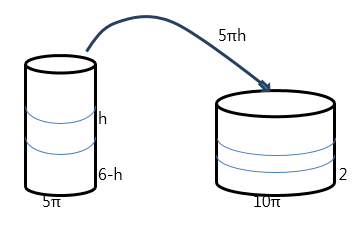
As shown in the figure above, since the heights of both cylinders become the same, you get \(2 * 10\pi + 5 \pi h = 2 * 5\pi(6-h)\). This is because it is said that if \(5 \pi h\) amount of water from cylinder X gets poured into cylinder Y, the height becomes equal, but the base area of the right cylinder \((10\pi)\) is already twice of the base area of the left cylinder \((5\pi)\), so the volume also becomes twice as large. This is why there is "2 (twice)" before \(5\pi(6 - h)\). If you divide both sides by \(\pi\) and expand, you get \(20 + 5h = 60 - 10h, 15h = 40\), then \(h = \frac{40}{15} = \frac{8}{3}\). If so, since the question says that the heights of both cylinders are the same, you get \(6 - \frac{8}{3} = \frac{10}{3}\). Therefore, the answer is C.
(Other explanation) As shown in the figure above, since the heights of both cylinders become the same, you get \(6(5 \pi ) + 2(10 \pi ) = 5 \pi k + 10 \pi k\) or \(50 \pi = 15 \pi k\). Therefore, \(k= \frac{10}{3}\). The answer is C.
Answer: C
There are 2 circular cylinders X and Y, and both cylinders contain water inside. Cylinder X has \(5\pi\) square inches as the base area and 6 inches as the height of the water inside, and cylinder Y has \(10\pi\) square inches as the base area and 2 inches as the height of the water inside. If the height of the water becomes the same when the water drawn from cylinder X is poured into cylinder Y, what is the height of water in these cylinders, in inches?
A. 2.5
B. 3
C. 10/3
D. 4
E. 4.5
As shown in the figure above, since the heights of both cylinders become the same, you get \(2 * 10\pi + 5 \pi h = 2 * 5\pi(6-h)\). This is because it is said that if \(5 \pi h\) amount of water from cylinder X gets poured into cylinder Y, the height becomes equal, but the base area of the right cylinder \((10\pi)\) is already twice of the base area of the left cylinder \((5\pi)\), so the volume also becomes twice as large. This is why there is "2 (twice)" before \(5\pi(6 - h)\). If you divide both sides by \(\pi\) and expand, you get \(20 + 5h = 60 - 10h, 15h = 40\), then \(h = \frac{40}{15} = \frac{8}{3}\). If so, since the question says that the heights of both cylinders are the same, you get \(6 - \frac{8}{3} = \frac{10}{3}\). Therefore, the answer is C.
(Other explanation) As shown in the figure above, since the heights of both cylinders become the same, you get \(6(5 \pi ) + 2(10 \pi ) = 5 \pi k + 10 \pi k\) or \(50 \pi = 15 \pi k\). Therefore, \(k= \frac{10}{3}\). The answer is C.
Answer: C
Moderator: