Events & Promotions
| Last visit was: 06 Sep 2026, 16:39 |
It is currently 06 Sep 2026, 16:39 |
|
|

GMAT Club Daily Prep
Thank you for using the timer - this advanced tool can estimate your performance and suggest more practice questions. We have subscribed you to Daily Prep Questions via email.
Customized
for You
Track
Your Progress
Practice
Pays
Not interested in getting valuable practice questions and articles delivered to your email? No problem, unsubscribe here.
 Sep 07
12:01 AM PDT
-11:59 PM PDT
On the 7th, GMAT Club Tests will be Free! Including all the Quizzes, Questions, and Tests. 12 AM - 11:59 PM PDT- Sep 07
10:00 AM PDT
-11:00 AM PDT
A complete walkthrough of GMAT Club’s free 12-week GMAT study plan: what you study each week, how progress and goals are tracked, how the error log works, and how your practice unlocks paid tools at no cost.  Sep 02
01:00 PM EDT
-11:59 PM EDT
Take 30% off all study plans with code COURSEWORK - Expires on Monday 9/7 Sep 04
10:00 AM EDT
-11:59 PM EDT
We’ve worked incredibly hard to build TTP into the best test prep experience possible, and it would mean a lot to us to win Newsweek’s 2026 Readers’ Choice Award for Best Test Prep. If TTP has helped you, we’d be incredibly grateful for your vote. Sep 06
09:30 AM EDT
-12:30 PM EST
Top scores are possible when you enroll in a powerful EA course, taught live online + 6 months access to TTP OnDemand video courses included! Perfect class schedule and easy course access for working professionals. Class starts Sundays Sept. 6, 2026.- Sep 09
07:00 AM PDT
-10:00 AM PDT
Meet AdComs and explore top Master’s programs - MiM, MiF, MSc, MSBA and more. - Application Fee Waivers - Free 1-Week of GMAT Club Tests: - Master's Application Toolkit - Grand Prize Giveaway - Sep 09
10:00 AM PDT
-11:00 AM PDT
Three MBA applications. Three rejections. No interview invites. A year later, Aman was admitted to Cambridge Judge, SMU, and IMD. In this episode of MBA Admit Stories, Aman shares how he rebuilt his MBA application...  Sep 15
07:00 PM EDT
-09:00 PM EST
Elite scores are possible when you enroll in a powerful GMAT course, taught live online + 6 months access to TTP OnDemand video courses included! Class starts Tues/Thurs Sept. 15, 2026 - Nov. 15, 2027, 7:00pm-9:00pm EST Sep 21
08:00 PM EDT
-10:00 PM EDT
Boost your GMAT score in less than one month in a live online class + 6 months access to TTP OnDemand video courses included! Class starts Mon, Tues, Wed, Thur, Fri Sept. 21, 2026 - Oct. 9, 2027, 7:00pm-10:00pm EST


 Updated on: 12 Mar 2026, 07:45
Originally posted by RonPurewal on 26 Feb 2026, 22:20.
Last edited by Bunuel on 12 Mar 2026, 07:45, edited 2 times in total.
Last edited by Bunuel on 12 Mar 2026, 07:45, edited 2 times in total.
Kudos
Bookmarks
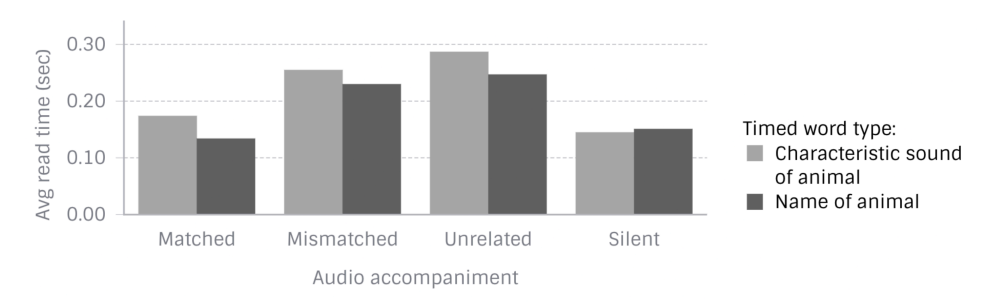
A team of researchers used eye tracking to measure how long participants took to read a single animal-related word—either the name of an animal (e.g., cat, dog, horse, bird) or its characteristic sound (e.g., meow, bark, whinny, chirp)—within each of several sentences displayed on a screen, one sentence at a time. Each sentence was accompanied by one of the following four types of audio tracks:
• Matched audio (e.g., the sound of a dog barking for a sentence containing “dog” or “bark”)
• Mismatched audio (e.g., the sound of a bird chirping for a sentence containing “cat” or “meow”)
• Unrelated audio (e.g., the sound of a car horn for a sentence containing “horse” or “whinny”)
• Silence
• Matched audio (e.g., the sound of a dog barking for a sentence containing “dog” or “bark”)
• Mismatched audio (e.g., the sound of a bird chirping for a sentence containing “cat” or “meow”)
• Unrelated audio (e.g., the sound of a car horn for a sentence containing “horse” or “whinny”)
• Silence


400 words per minute.
Be sure to select an answer first to save it in the Error Log before revealing the correct answer (OA)!
Difficulty:
 55%
(hard)
55%
(hard)
Question Stats:
56% (03:10) correct 44%
(03:17)
wrong
based on 515
sessions
44%
(03:17)
wrong
based on 515
sessions
History
Date
Time
Result
Not Attempted Yet
If participants read the words without auditory accompaniment at their respective ordinary reading speeds for elementary English text, then the average speed at which the participants of this study ordinarily read elementary English text with words of the same average length as those in this study is closest to
| 100 words per minute. | |
| 200 words per minute. | |
| 300 words per minute. | |
| 400 words per minute. | |
| 500 words per minute. |
ShowHide Answer
Official Answer
400 words per minute.
How much more or less time, on average, did participants take to read the name of an animal with matched audio playing than to read the same name with mismatched audio playing?: No
How much more or less time, on average, did participants take to read the name of an animal with irrelevant sounds playing than to read the name of an animal’s characteristic sound with irrelevant sounds playing?: Yes
How much more or less time, on average, did participants take to read a sentence containing the name of an animal’s characteristic sound, without audio accompaniment, than to read a sentence containing the name of an animal itself, also without audio accompaniment?: No
Be sure to select an answer first to save it in the Error Log before revealing the correct answer (OA)!
Difficulty:
95%
(hard)
Question Stats:
16% (01:36) correct
84%
(01:35)
wrong
based on 607
sessions
History
Date
Time
Result
Not Attempted Yet
For each of the following questions about the study and its participants as described, select Yes if the question is answered by the information and data provided. Otherwise, select No.
| Yes | No | |
| How much more or less time, on average, did participants take to read the name of an animal with matched audio playing than to read the same name with mismatched audio playing? | ||
| How much more or less time, on average, did participants take to read the name of an animal with irrelevant sounds playing than to read the name of an animal’s characteristic sound with irrelevant sounds playing? | ||
| How much more or less time, on average, did participants take to read a sentence containing the name of an animal’s characteristic sound, without audio accompaniment, than to read a sentence containing the name of an animal itself, also without audio accompaniment? |
ShowHide Answer
Official Answer
How much more or less time, on average, did participants take to read the name of an animal with matched audio playing than to read the same name with mismatched audio playing?: No
How much more or less time, on average, did participants take to read the name of an animal with irrelevant sounds playing than to read the name of an animal’s characteristic sound with irrelevant sounds playing?: Yes
How much more or less time, on average, did participants take to read a sentence containing the name of an animal’s characteristic sound, without audio accompaniment, than to read a sentence containing the name of an animal itself, also without audio accompaniment?: No
Three
Be sure to select an answer first to save it in the Error Log before revealing the correct answer (OA)!
Difficulty:
55%
(hard)
Question Stats:
60% (01:39) correct
40%
(01:22)
wrong
based on 483
sessions
History
Date
Time
Result
Not Attempted Yet
How many of the researchers’ four specific hypotheses are supported by the results of the study?
| None | |
| One | |
| Two | |
| Three | |
| Four |
I32-14
I32-15
I32-18
Screenshot 2026-02-27 091106.png [ 53.13 KiB | Viewed 2812 times ]
I32-15
I32-18
Attachment:
Screenshot 2026-02-27 091106.png [ 53.13 KiB | Viewed 2812 times ]
05 Mar 2026, 03:30
Kudos
Bookmarks
Official Solution:
For each of the following questions about the study and its participants as described, select Yes if the question is answered by the information and data provided. Otherwise, select No.
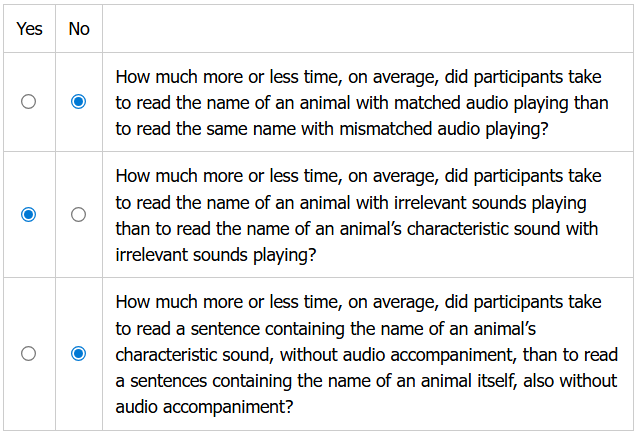
We are not told whether the same set of timed words was used for each of the different types of audio accompaniment, so it’s impossible to know whether the data represent differential timings for identical words. It’s possible that the timed words could have been standardized across all four types of audio backings—but this can’t be known to be true (or false!) with any certainty. Therefore, the first question cannot be answered.
The average time taken by participants to read the name of an animal with irrelevant sounds playing is the height of the right-hand bar for “Unrelated” on the graph, and the average time taken by participants to read the name of an animal’s characteristic sound with irrelevant sounds playing is the height of the left-hand bar for “Unrelated”. The second question can therefore be answered by finding the difference between these two values.
The researchers only measured the time participants took to read a single animal-related word in each sentence. They did not measure how long participants took to read whole sentences, so the third question cannot be answered.
The correct response to this item overall is therefore No, Yes, No.

GMAT-Club-Forum-hmip297n.png [ 56.56 KiB | Viewed 2474 times ]
For each of the following questions about the study and its participants as described, select Yes if the question is answered by the information and data provided. Otherwise, select No.
We are not told whether the same set of timed words was used for each of the different types of audio accompaniment, so it’s impossible to know whether the data represent differential timings for identical words. It’s possible that the timed words could have been standardized across all four types of audio backings—but this can’t be known to be true (or false!) with any certainty. Therefore, the first question cannot be answered.
The average time taken by participants to read the name of an animal with irrelevant sounds playing is the height of the right-hand bar for “Unrelated” on the graph, and the average time taken by participants to read the name of an animal’s characteristic sound with irrelevant sounds playing is the height of the left-hand bar for “Unrelated”. The second question can therefore be answered by finding the difference between these two values.
The researchers only measured the time participants took to read a single animal-related word in each sentence. They did not measure how long participants took to read whole sentences, so the third question cannot be answered.
The correct response to this item overall is therefore No, Yes, No.
Attachment:
GMAT-Club-Forum-hmip297n.png [ 56.56 KiB | Viewed 2474 times ]
05 Mar 2026, 04:45
Kudos
Bookmarks
Official Solution:
How many of the researchers’ four specific hypotheses are supported by the results of the study
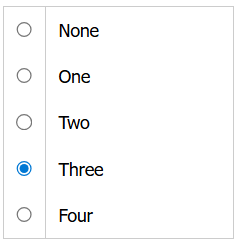
The researchers’ starting hypotheses are four separate time comparisons:
• With matching sound < with no sound (silence), for animal names
• With mismatched sound > with no sound (silence), for animal names
• With matching sound < with no sound (silence), for animal sound names
• With mismatched sound > with no sound (silence), for animal sound names
...where all of these inequalities are in terms of the average time, in seconds, taken by participants to read the words under these respective conditions.
Let’s check the graph for these one at a time:
• With matching sound < with no sound (silence), for animal names:
These are the darker, right-hand bars for “Matched” and “Silent” respectively. The Matched time is slightly lower—it’s noticeably closer to 0.10 than to 0.20 second, whereas the Silent time is approximately halfway between 0.10 and 0.20 second—so these times DO satisfy the relevant hypothesis.
• With mismatched sound > with no sound (silence), for animal names:
These are the darker, right-hand bars for “Mismatched” and “Silent” respectively. The Mismatched time is obviously much greater than the Silent time, so the corresponding hypothesis IS also satisfied.
• With matching sound < with no sound (silence), for animal sound names:
These are the lighter, left-hand bars for “Matched” and “Silent” respectively. The Matched time is clearly greater than the Silent time here, so these times DO NOT satisfy the relevant hypothesis.
• With mismatched sound > with no sound (silence), for animal sound names:
These are the lighter, left-hand bars for “Mismatched” and “Silent” respectively. The Mismatched time is obviously much greater than the
Silent time, so this hypothesis IS satisfied.
Thus three of the four hypotheses are satisfied overall.

GMAT-Club-Forum-7aie23kq.png [ 6.82 KiB | Viewed 2384 times ]
How many of the researchers’ four specific hypotheses are supported by the results of the study
The researchers’ starting hypotheses are four separate time comparisons:
• With matching sound < with no sound (silence), for animal names
• With mismatched sound > with no sound (silence), for animal names
• With matching sound < with no sound (silence), for animal sound names
• With mismatched sound > with no sound (silence), for animal sound names
...where all of these inequalities are in terms of the average time, in seconds, taken by participants to read the words under these respective conditions.
Let’s check the graph for these one at a time:
• With matching sound < with no sound (silence), for animal names:
These are the darker, right-hand bars for “Matched” and “Silent” respectively. The Matched time is slightly lower—it’s noticeably closer to 0.10 than to 0.20 second, whereas the Silent time is approximately halfway between 0.10 and 0.20 second—so these times DO satisfy the relevant hypothesis.
• With mismatched sound > with no sound (silence), for animal names:
These are the darker, right-hand bars for “Mismatched” and “Silent” respectively. The Mismatched time is obviously much greater than the Silent time, so the corresponding hypothesis IS also satisfied.
• With matching sound < with no sound (silence), for animal sound names:
These are the lighter, left-hand bars for “Matched” and “Silent” respectively. The Matched time is clearly greater than the Silent time here, so these times DO NOT satisfy the relevant hypothesis.
• With mismatched sound > with no sound (silence), for animal sound names:
These are the lighter, left-hand bars for “Mismatched” and “Silent” respectively. The Mismatched time is obviously much greater than the
Silent time, so this hypothesis IS satisfied.
Thus three of the four hypotheses are satisfied overall.
Attachment:
GMAT-Club-Forum-7aie23kq.png [ 6.82 KiB | Viewed 2384 times ]
Updated on: 12 Mar 2026, 07:40
Originally posted by RonPurewal on 05 Mar 2026, 02:30.
Last edited by Bunuel on 12 Mar 2026, 07:40, edited 1 time in total.
Last edited by Bunuel on 12 Mar 2026, 07:40, edited 1 time in total.
Kudos
Bookmarks
Official Solution:
If participants read the words without auditory accompaniment at their respective ordinary reading speeds for elementary English text, then the average speed at which the participants of this study ordinarily read elementary English text with words of the same average length as those in this study is closest to
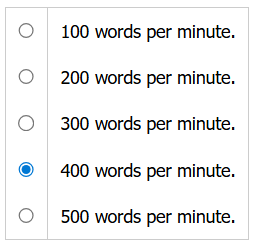
This problem asks us to read the study participants’ average reading time without sound accompaniment from the bar graph, and then to convert that figure into words per minute.
The two average times per word without audio accompaniment in the bar graph—the heights of the two bars in the rightmost pair—are roughly 0.14 and 0.15 second, respectively, so, readers take an overall average of about 0.145 second to read each word. That’s 0.145 second per 1 word, or 1 word per 0.145 second.
Convert to words per minute with standard unit-conversion methods:
\((\frac{1 \ word}{0.145 \ sec}) (\frac{60 \ sec}{1 \ min})= \frac{60}{0.145} ≈ 414\)
words per minute, so the answer is closest to (D) 400 words per minute

GMAT-Club-Forum-pp3z9ra8.png [ 15.06 KiB | Viewed 2338 times ]
If participants read the words without auditory accompaniment at their respective ordinary reading speeds for elementary English text, then the average speed at which the participants of this study ordinarily read elementary English text with words of the same average length as those in this study is closest to
This problem asks us to read the study participants’ average reading time without sound accompaniment from the bar graph, and then to convert that figure into words per minute.
The two average times per word without audio accompaniment in the bar graph—the heights of the two bars in the rightmost pair—are roughly 0.14 and 0.15 second, respectively, so, readers take an overall average of about 0.145 second to read each word. That’s 0.145 second per 1 word, or 1 word per 0.145 second.
Convert to words per minute with standard unit-conversion methods:
\((\frac{1 \ word}{0.145 \ sec}) (\frac{60 \ sec}{1 \ min})= \frac{60}{0.145} ≈ 414\)
words per minute, so the answer is closest to (D) 400 words per minute
Attachment:
GMAT-Club-Forum-pp3z9ra8.png [ 15.06 KiB | Viewed 2338 times ]