Events & Promotions
|
|

GMAT Club Daily Prep
Thank you for using the timer - this advanced tool can estimate your performance and suggest more practice questions. We have subscribed you to Daily Prep Questions via email.
Customized
for You
Track
Your Progress
Practice
Pays
Not interested in getting valuable practice questions and articles delivered to your email? No problem, unsubscribe here.
 Sep 07
12:01 AM PDT
-11:59 PM PDT
On the 7th, GMAT Club Tests will be Free! Including all the Quizzes, Questions, and Tests. 12 AM - 11:59 PM PDT- Sep 09
07:00 AM PDT
-10:00 AM PDT
Meet AdComs and explore top Master’s programs - MiM, MiF, MSc, MSBA and more. - Application Fee Waivers - Free 1-Week of GMAT Club Tests: - Master's Application Toolkit - Grand Prize Giveaway


 Updated on: 24 Dec 2025, 23:03
Originally posted by Sajjad1994 on 08 Apr 2020, 09:51.
Last edited by Bunuel on 24 Dec 2025, 23:03, edited 3 times in total.
Last edited by Bunuel on 24 Dec 2025, 23:03, edited 3 times in total.
Moved to new forum
Kudos
Bookmarks


Dropdown 1: 12 Months
Dropdown 2: True
Be sure to select an answer first to save it in the Error Log before revealing the correct answer (OA)!
Difficulty:
 95%
(hard)
95%
(hard)
Question Stats:
50% (02:30) correct 50%
(02:33)
wrong
based on 193
sessions
50%
(02:33)
wrong
based on 193
sessions
History
Date
Time
Result
Not Attempted Yet
GMAT Pill
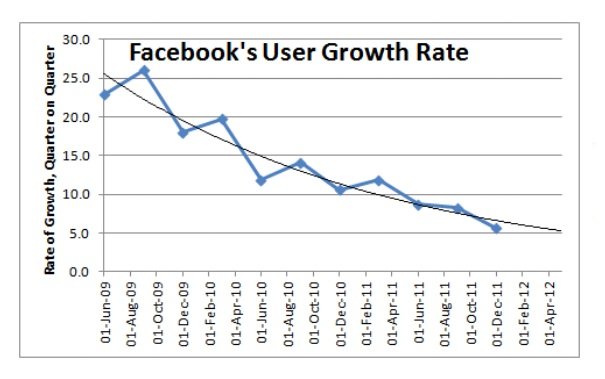
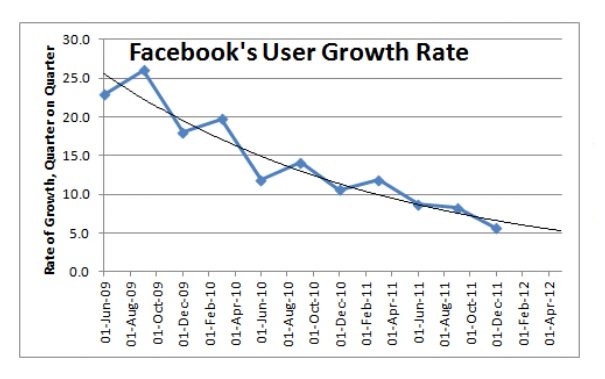 This is a Time VS QoQ Rate of Growth chart for Facebook between June 2009 and April 2012 - just before its IPO in May 2012. The dotted line shows actual data while the smooth line shows an estimated regression of those data points.
Choose the appropriate drop-down that best fills in the sentence with accurate information about the graph.
1. The quarter over quarter growth rate took months to fall from the 10%-15% range down to the 5%-10% range.
2. The graph shows there tends to be a seasonal effect on the decline of Facebook's rate of growth during the time period shown .
1q2w.jpg [ 55.18 KiB | Viewed 4714 times ]
Choose the appropriate drop-down that best fills in the sentence with accurate information about the graph.
1. The quarter over quarter growth rate took months to fall from the 10%-15% range down to the 5%-10% range.
2. The graph shows there tends to be a seasonal effect on the decline of Facebook's rate of growth during the time period shown .
Attachment:
1q2w.jpg [ 55.18 KiB | Viewed 4714 times ]
Archived Topic
Hi there,
This topic has been closed and archived due to inactivity or violation of community quality standards. No more replies are possible here.
Where to now? Join ongoing discussions on thousands of quality questions in our Graphs and Tables (G&T) Forum
Still interested in this question? Check out the "Best Topics" block below for a better discussion on this exact question, as well as several more related questions.
Thank you for understanding, and happy exploring!
ShowHide Answer
Official Answer
Dropdown 1: 12 Months
Dropdown 2: True
 08 Apr 2020, 10:03
Kudos
Bookmarks
1)C,12 months,since the 15% bracket started on April 2010 and 10% bracket went to 5-10% bracket range on April 2011
2)A, True since the decline is not straight rather it's seasonal
Posted from my mobile device
2)A, True since the decline is not straight rather it's seasonal
Posted from my mobile device

Sajjad1994
- First question has been explained and an easy one to figure out.
- Second question's answer is true(A) as one can observe that seasonal means the figures(values) must show a pattern of crests and troughs. Here crests and troughs are only leading down(de-growing) and that's why such a curve(regression).
- In other words are lowers lows and lower highs wherein lower highs are higher than the lower lows and thus the seasonality is shown.
- OR in other words, roughly every alternate point in the graph is on the same side of the regression curve. Hence it is TRUE that there tends to be a seasonal effect on the decline of Facebook's rate of growth during the time period.
2. Answer A