Events & Promotions
|
|

GMAT Club Daily Prep
Thank you for using the timer - this advanced tool can estimate your performance and suggest more practice questions. We have subscribed you to Daily Prep Questions via email.
Customized
for You
Track
Your Progress
Practice
Pays
Not interested in getting valuable practice questions and articles delivered to your email? No problem, unsubscribe here.
 Sep 07
12:01 AM PDT
-11:59 PM PDT
On the 7th, GMAT Club Tests will be Free! Including all the Quizzes, Questions, and Tests. 12 AM - 11:59 PM PDT- Sep 09
07:00 AM PDT
-10:00 AM PDT
Meet AdComs and explore top Master’s programs - MiM, MiF, MSc, MSBA and more. - Application Fee Waivers - Free 1-Week of GMAT Club Tests: - Master's Application Toolkit - Grand Prize Giveaway


 15 May 2025, 00:46
Kudos
Bookmarks


Dropdown 1: 2
Dropdown 2: 4.5%
Be sure to select an answer first to save it in the Error Log before revealing the correct answer (OA)!
Difficulty:
 95%
(hard)
95%
(hard)
Question Stats:
41% (02:43) correct 59%
(03:38)
wrong
based on 144
sessions
59%
(03:38)
wrong
based on 144
sessions
History
Date
Time
Result
Not Attempted Yet
A power analyst is inspecting the noise emissions of a series of electric components. According to regulatory standards, any component emitting more than 4 dB of noise is considered to exceed acceptable limits. A senior analyst further specifies that samples with a Channel Current exceeding 380 mV must be excluded from the analysis, as such values suggest test equipment anomalies rather than actual component issues.
The analyst plots 30 observations he makes:
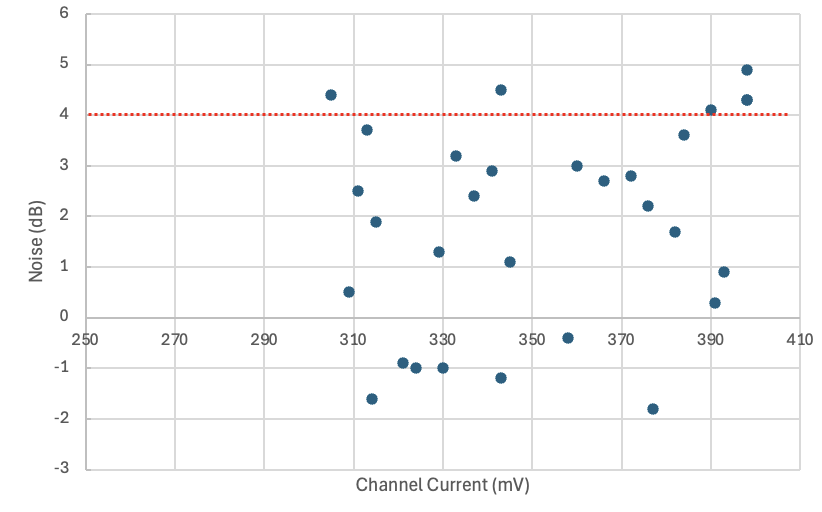
The engineering lead wants to understand the risk of regulatory detection for components placed into the market.
The risk of detection is defined as:
Risk of Detection (%) = (Sum of (Noise of each valid outlier − 4)) / (Total number of valid samples) × 100
Based on the information above, the number of valid outliers is , and the average risk of detection in the market is approximately .
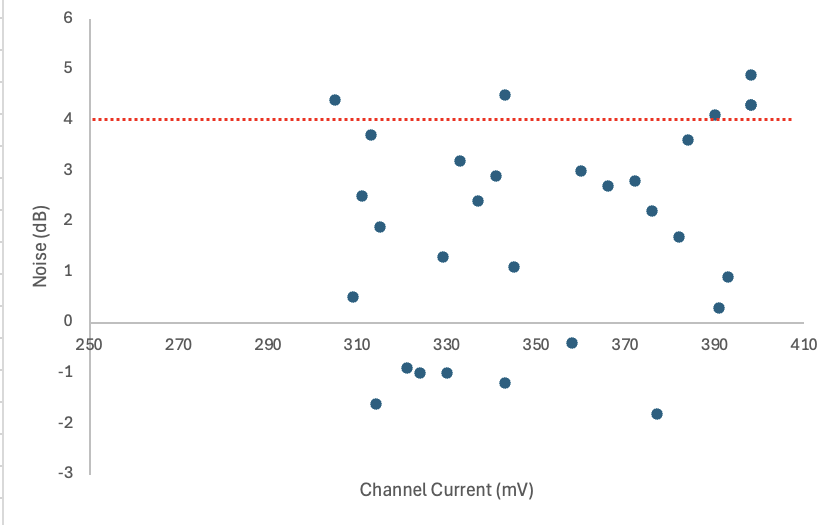
GMAT-Club-Forum-9983beyy.png [ 16.45 KiB | Viewed 1506 times ]

GMAT-Club-Forum-rimvaapd.png [ 24.55 KiB | Viewed 1227 times ]
The analyst plots 30 observations he makes:
The engineering lead wants to understand the risk of regulatory detection for components placed into the market.
The risk of detection is defined as:
Risk of Detection (%) = (Sum of (Noise of each valid outlier − 4)) / (Total number of valid samples) × 100
Based on the information above, the number of valid outliers is , and the average risk of detection in the market is approximately .
Attachment:
GMAT-Club-Forum-9983beyy.png [ 16.45 KiB | Viewed 1506 times ]
Attachment:
GMAT-Club-Forum-rimvaapd.png [ 24.55 KiB | Viewed 1227 times ]
Archived Topic
Hi there,
This topic has been closed and archived due to inactivity or violation of community quality standards. No more replies are possible here.
Where to now? Join ongoing discussions on thousands of quality questions in our Graphs and Tables (G&T) Forum
Still interested in this question? Check out the "Best Topics" block below for a better discussion on this exact question, as well as several more related questions.
Thank you for understanding, and happy exploring!
ShowHide Answer
Official Answer
Dropdown 1: 2
Dropdown 2: 4.5%
 17 May 2025, 03:21
Kudos
Bookmarks
This is how I got this right:
1. Outliers are the ones beyond 4 DB, out of those valid are the ones with mV less than 380.
2. Valid samples is 30-7 = 23
Noise of each valid outlier is 4.2 and 4.3, using the formula you get approx 4.5%
1. Outliers are the ones beyond 4 DB, out of those valid are the ones with mV less than 380.
2. Valid samples is 30-7 = 23
Noise of each valid outlier is 4.2 and 4.3, using the formula you get approx 4.5%
 15 Jan 2026, 10:18
Kudos
Bookmarks
how is risk detection 4.5%?
Archived Topic
Hi there,
This topic has been closed and archived due to inactivity or violation of community quality standards. No more replies are possible here.
Where to now? Join ongoing discussions on thousands of quality questions in our Graphs and Tables (G&T) Forum
Still interested in this question? Check out the "Best Topics" block above for a better discussion on this exact question, as well as several more related questions.
Thank you for understanding, and happy exploring!





