Events & Promotions
|
|

GMAT Club Daily Prep
Thank you for using the timer - this advanced tool can estimate your performance and suggest more practice questions. We have subscribed you to Daily Prep Questions via email.
Customized
for You
Track
Your Progress
Practice
Pays
Not interested in getting valuable practice questions and articles delivered to your email? No problem, unsubscribe here.
 Sep 07
12:01 AM PDT
-11:59 PM PDT
On the 7th, GMAT Club Tests will be Free! Including all the Quizzes, Questions, and Tests. 12 AM - 11:59 PM PDT- Sep 09
07:00 AM PDT
-10:00 AM PDT
Meet AdComs and explore top Master’s programs - MiM, MiF, MSc, MSBA and more. - Application Fee Waivers - Free 1-Week of GMAT Club Tests: - Master's Application Toolkit - Grand Prize Giveaway

 16 May 2024, 01:12
Kudos
Bookmarks


Be sure to select an answer first to save it in the Error Log before revealing the correct answer (OA)!
Difficulty:
(N/A)
Question Stats:
100% (01:58) correct 0% (00:00) wrong based on 3 sessions
History
Date
Time
Result
Not Attempted Yet
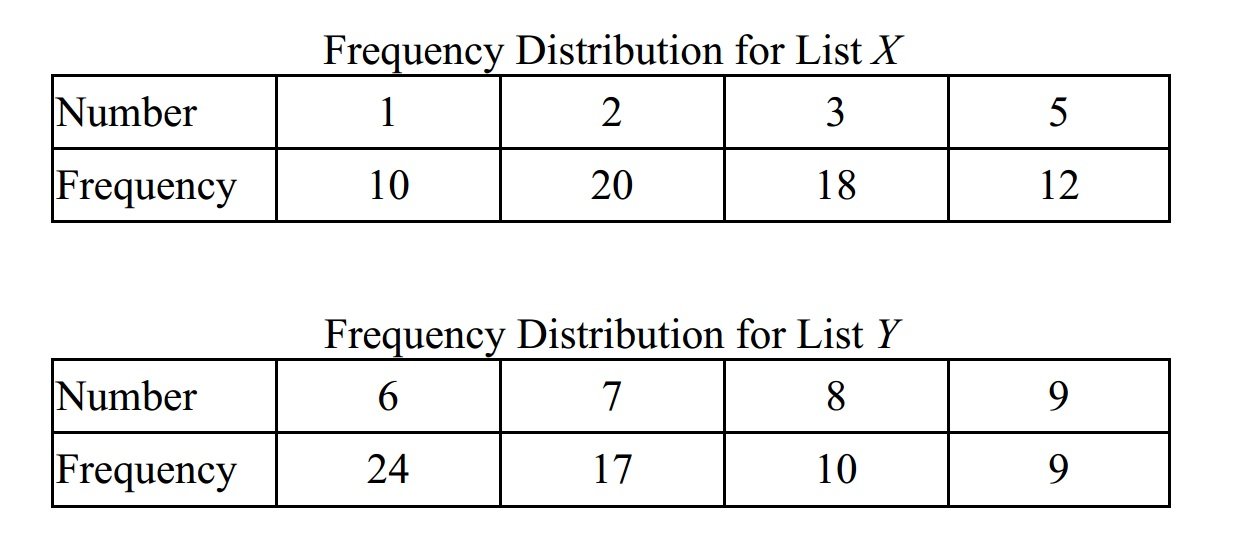
List X and list Y each contain 60 numbers. Frequency distributions for each list are given above. The average (arithmetic mean) of the numbers in list X is 2.7, and the average of the numbers in list Y is 7.1. List Z contains 120 numbers: the 60 numbers in list X and the 60 numbers in list Y.
Quantity A
The average of the 120 numbers in list Z
Quantity B
The median of the 120 numbers in list Z

GMAT-Club-Forum-jd4h44g0.jpeg [ 98.41 KiB | Viewed 964 times ]
List X and list Y each contain 60 numbers. Frequency distributions for each list are given above. The average (arithmetic mean) of the numbers in list X is 2.7, and the average of the numbers in list Y is 7.1. List Z contains 120 numbers: the 60 numbers in list X and the 60 numbers in list Y.
Quantity A
The average of the 120 numbers in list Z
Quantity B
The median of the 120 numbers in list Z
Attachment:
GMAT-Club-Forum-jd4h44g0.jpeg [ 98.41 KiB | Viewed 964 times ]
 19 May 2024, 12:34
Kudos
Bookmarks
when we come across a problem like this, where we can use your method it will save a lot of time, versus calculating a weighted mean, or just calculating a total sum for both sets using n and the mean (ex. 60x2.7 + 60x7.1) and then dividing to find the aggregate mean ( [60x2.7 + 60x7.1]/120 = 4.9).
This is also a good time to remind people that the median is the (n+1)/2 th value
. what I mean by this is:
. when whole number result: the median is that number in the list
. when decimal number result: the median is the average of the number at that place and the next place
in this case (120+1)/2 --> 60.5th value --> means the median is the average of the 60th and 61st value, in this case 5 and 6, so 5+6/2 = 5.5
I think this is more obvious if you think of the frequency table as shown in the attached graphic.
You can see there are 10 values that are 1, up to the 30th value is 2, up to the 48th value is 3, up to the 60th value is 5, up to the 84th value is 24...
So, you can see that 60th value is 5 and the 61st value is 6, so again, the median is 5+6/2 = 5.5
This is also a good time to remind people that the median is the (n+1)/2 th value
. what I mean by this is:
. when whole number result: the median is that number in the list
. when decimal number result: the median is the average of the number at that place and the next place
in this case (120+1)/2 --> 60.5th value --> means the median is the average of the 60th and 61st value, in this case 5 and 6, so 5+6/2 = 5.5
I think this is more obvious if you think of the frequency table as shown in the attached graphic.
You can see there are 10 values that are 1, up to the 30th value is 2, up to the 48th value is 3, up to the 60th value is 5, up to the 84th value is 24...
So, you can see that 60th value is 5 and the 61st value is 6, so again, the median is 5+6/2 = 5.5


 07 Jul 2024, 12:38
Kudos
Bookmarks
Official Explanation
In this problem you are asked to compare the average with the median of the 120 numbers in list Z. Since list Z consists of the numbers in lists X and Y combined, it is reasonable to try to use the information about lists X and Y to calculate the average and the median of the numbers in list Z.
To determine the average of the 120 numbers in list Z, you can use the information given about the individual averages of the numbers in lists X and Y. Because lists X and Y each contain 60 numbers, the average of the numbers in ist Z is the average of the individual averages of the numbers in lists X and Y. Thus, the average of the numbers in list Z is \(\frac{2.7+7.1}{2}\), or 4.9.
To determine the median of the 120 numbers in list Z, first note that list Z contains an even number of numbers, so the median of the numbers in list Z is the average of the middle two numbers when the numbers are listed in increasing order. If you look at the numbers in the two lists, you will see that the 60 numbers in list X are all less than or equal to 5, and the 60 numbers in list Y are all greater than or equal to 6. Thus, the two middle numbers in list Z are 5 and 6, and the average of these numbers is \(\frac{5+6}{2}\) or 5.5. Therefore, the median of the numbers in list Z is 5.5, and this is greater than the average of 4.9.
The correct answer is Choice B.
In this problem you are asked to compare the average with the median of the 120 numbers in list Z. Since list Z consists of the numbers in lists X and Y combined, it is reasonable to try to use the information about lists X and Y to calculate the average and the median of the numbers in list Z.
To determine the average of the 120 numbers in list Z, you can use the information given about the individual averages of the numbers in lists X and Y. Because lists X and Y each contain 60 numbers, the average of the numbers in ist Z is the average of the individual averages of the numbers in lists X and Y. Thus, the average of the numbers in list Z is \(\frac{2.7+7.1}{2}\), or 4.9.
To determine the median of the 120 numbers in list Z, first note that list Z contains an even number of numbers, so the median of the numbers in list Z is the average of the middle two numbers when the numbers are listed in increasing order. If you look at the numbers in the two lists, you will see that the 60 numbers in list X are all less than or equal to 5, and the 60 numbers in list Y are all greater than or equal to 6. Thus, the two middle numbers in list Z are 5 and 6, and the average of these numbers is \(\frac{5+6}{2}\) or 5.5. Therefore, the median of the numbers in list Z is 5.5, and this is greater than the average of 4.9.
The correct answer is Choice B.





