Events & Promotions
|
|

GMAT Club Daily Prep
Thank you for using the timer - this advanced tool can estimate your performance and suggest more practice questions. We have subscribed you to Daily Prep Questions via email.
Customized
for You
Track
Your Progress
Practice
Pays
Not interested in getting valuable practice questions and articles delivered to your email? No problem, unsubscribe here.
 Sep 07
12:01 AM PDT
-11:59 PM PDT
On the 7th, GMAT Club Tests will be Free! Including all the Quizzes, Questions, and Tests. 12 AM - 11:59 PM PDT- Sep 09
07:00 AM PDT
-10:00 AM PDT
Meet AdComs and explore top Master’s programs - MiM, MiF, MSc, MSBA and more. - Application Fee Waivers - Free 1-Week of GMAT Club Tests: - Master's Application Toolkit - Grand Prize Giveaway


 17 May 2024, 12:28
Kudos
Bookmarks


Be sure to select an answer first to save it in the Error Log before revealing the correct answer (OA)!
Difficulty:
(N/A)
Question Stats:
42% (01:04) correct 57% (00:17) wrong based on 7 sessions
History
Date
Time
Result
Not Attempted Yet
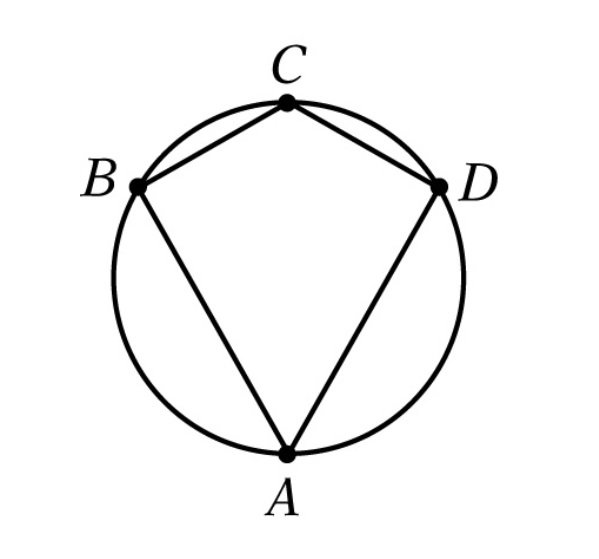
In the figure above, the diameter of the circle is 10.
Quantity A
The area of quadrilateral
Quantity B
40

GMAT-Club-Forum-zv9msszt.jpeg [ 29.63 KiB | Viewed 1472 times ]
In the figure above, the diameter of the circle is 10.
Quantity A
The area of quadrilateral
Quantity B
40
Attachment:
GMAT-Club-Forum-zv9msszt.jpeg [ 29.63 KiB | Viewed 1472 times ]
 19 May 2024, 12:32
Kudos
Bookmarks
First of all, it's important not to read too much into the diagram.
All we can glean from the diagram is that we have a quadrilateral that is inscribed in the circle.
That's it!
So, first recognize that the inscribed quadrilateral COULD be a very very very narrow rectangle like this.
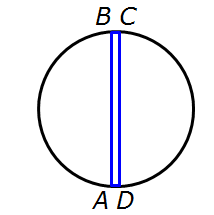
Notice that this quadrilateral COULD be so thin that its area is very very close to zero.
So, for this particular quadrilateral we get:
Quantity A: a very very small area that's close to zero
Quantity B: 40
In this case, Quantity B is greater.
Alternatively, we COULD make the quadrilateral quite large.
In fact, we could make it a SQUARE.
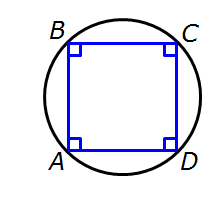
So, if the inscribed quadrilateral is a square, what is its area?
To find out, let's draw a diagonal.
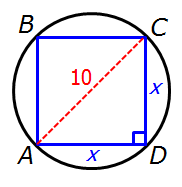
One of our circle properties tells us that this diagonal must be the diameter of the circle, which we know is 10
To find the area of the square, we need to know the length of each side.
So, let's let x = the length of each side.
Since ACD is a RIGHT TRIANGLE, we can apply the Pythagorean Theorem to get: x² + x² = 10²
Simplify to get 2x² = 100
Divide both sides by 2 to get: x² = 50
This means the area of the square = 50
We know this because the area of the square = (x)(x) = x², and we just learned that x² = 50
So, for this particular quadrilateral we get:
Quantity A: 50
Quantity B: 40
In this case, Quantity A is greater.
Answer: D
All we can glean from the diagram is that we have a quadrilateral that is inscribed in the circle.
That's it!
So, first recognize that the inscribed quadrilateral COULD be a very very very narrow rectangle like this.
Notice that this quadrilateral COULD be so thin that its area is very very close to zero.
So, for this particular quadrilateral we get:
Quantity A: a very very small area that's close to zero
Quantity B: 40
In this case, Quantity B is greater.
Alternatively, we COULD make the quadrilateral quite large.
In fact, we could make it a SQUARE.
So, if the inscribed quadrilateral is a square, what is its area?
To find out, let's draw a diagonal.
One of our circle properties tells us that this diagonal must be the diameter of the circle, which we know is 10
To find the area of the square, we need to know the length of each side.
So, let's let x = the length of each side.
Since ACD is a RIGHT TRIANGLE, we can apply the Pythagorean Theorem to get: x² + x² = 10²
Simplify to get 2x² = 100
Divide both sides by 2 to get: x² = 50
This means the area of the square = 50
We know this because the area of the square = (x)(x) = x², and we just learned that x² = 50
So, for this particular quadrilateral we get:
Quantity A: 50
Quantity B: 40
In this case, Quantity A is greater.
Answer: D


 07 Jul 2024, 12:33
Kudos
Bookmarks
Official Explanation
You are given that the circle has a diameter of 10, and from the figure you can assume that points A, B, C, and D lie on the circle in the order shown. However, because figures are not necessarily drawn to scale, you cannot assume anything else about the positions of points A, B, C, and D on the circle. Therefore, to get an idea of how various possible positions of these four points could affect the area of quadrilateral ABCD, it is a good idea to see how the figure can vary but still have points A, B, C, and D in the same order as in the figure above.
One way that you might vary the figure is to evenly space the four points along the circle, as shown below.
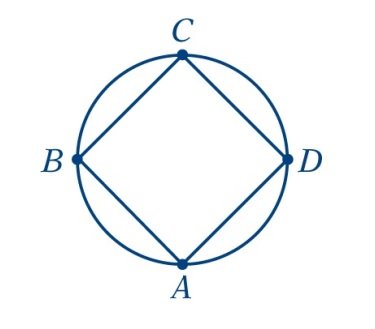
Another way is to draw points A and C opposite each other, with points B and D close to point C, as shown below.
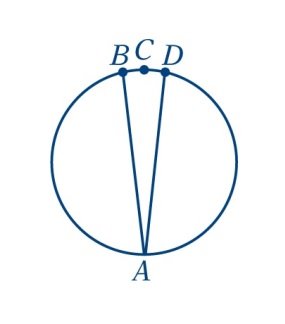
From these figures you can draw some basic conclusions about the area of ABCD.
If points A and C are opposite each other, with points B and D very close to point C, the area of quadrilateral ABCD is very close to 0. Clearly, the area can be less than 40 (Quantity B).
If points A, B, C, and D are evenly spaced, the area is not close to 0. How does the area compare with 40? To calculate the area of ABCD, draw the diameters AC and BD in the figure. The two diameters are perpendicular bisectors of each other, so they divide ABCD into four right triangles, as shown.
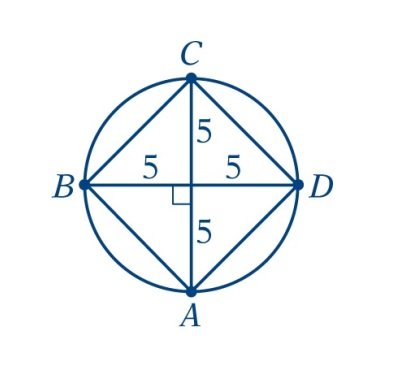
The area of each of the right triangles is \(\frac{1}{2}(5)(5)\), or 12.5. Thus, the area of ABCD is (4)(12.5), or 50.
Since the area of the quadrilateral in the first figure is less than 40 and the area of the quadrilateral in the second figure is greater than 40, the relationship cannot be determined from the information given.
The correct answer is Choice D.
You are given that the circle has a diameter of 10, and from the figure you can assume that points A, B, C, and D lie on the circle in the order shown. However, because figures are not necessarily drawn to scale, you cannot assume anything else about the positions of points A, B, C, and D on the circle. Therefore, to get an idea of how various possible positions of these four points could affect the area of quadrilateral ABCD, it is a good idea to see how the figure can vary but still have points A, B, C, and D in the same order as in the figure above.
One way that you might vary the figure is to evenly space the four points along the circle, as shown below.
Another way is to draw points A and C opposite each other, with points B and D close to point C, as shown below.
From these figures you can draw some basic conclusions about the area of ABCD.
If points A and C are opposite each other, with points B and D very close to point C, the area of quadrilateral ABCD is very close to 0. Clearly, the area can be less than 40 (Quantity B).
If points A, B, C, and D are evenly spaced, the area is not close to 0. How does the area compare with 40? To calculate the area of ABCD, draw the diameters AC and BD in the figure. The two diameters are perpendicular bisectors of each other, so they divide ABCD into four right triangles, as shown.
The area of each of the right triangles is \(\frac{1}{2}(5)(5)\), or 12.5. Thus, the area of ABCD is (4)(12.5), or 50.
Since the area of the quadrilateral in the first figure is less than 40 and the area of the quadrilateral in the second figure is greater than 40, the relationship cannot be determined from the information given.
The correct answer is Choice D.
Attachment:
GMAT-Club-Forum-r12hwevs.jpeg [ 18.61 KiB | Viewed 1418 times ]
Attachment:
GMAT-Club-Forum-lwdj8j4h.jpeg [ 12.5 KiB | Viewed 1411 times ]
Attachment:
GMAT-Club-Forum-yxwzz3ol.jpeg [ 22.99 KiB | Viewed 1362 times ]





