Events & Promotions
| Last visit was: 02 Sep 2026, 08:19 |
It is currently 02 Sep 2026, 08:19 |
|
|

GMAT Club Daily Prep
Thank you for using the timer - this advanced tool can estimate your performance and suggest more practice questions. We have subscribed you to Daily Prep Questions via email.
Customized
for You
Track
Your Progress
Practice
Pays
Not interested in getting valuable practice questions and articles delivered to your email? No problem, unsubscribe here.
 Sep 07
12:01 AM PDT
-11:59 PM PDT
On the 7th, GMAT Club Tests will be Free! Including all the Quizzes, Questions, and Tests. 12 AM - 11:59 PM PDT- Sep 09
07:00 AM PDT
-10:00 AM PDT
Meet AdComs and explore top Master’s programs - MiM, MiF, MSc, MSBA and more. - Application Fee Waivers - Free 1-Week of GMAT Club Tests: - Master's Application Toolkit - Grand Prize Giveaway

 27 Sep 2024, 12:40
Kudos
Bookmarks


Be sure to select an answer first to save it in the Error Log before revealing the correct answer (OA)!
Difficulty:
(N/A)
Question Stats:
33% (03:25) correct 66% (01:27) wrong based on 3 sessions
History
Date
Time
Result
Not Attempted Yet
\(m = 10^{32} + 2\) When m is divided by 11, the remainder is r.
Quantity A
r
Quantity B
3
Quantity A
r
Quantity B
3


 27 Feb 2025, 04:02
Kudos
Bookmarks
OE
Actually dividing \(10^{32} + 2\) by 11 would be very time consuming, so it is worth trying to compare the quantities without actually doing the division. A good approach would be to compute the remainders when \(10^1 + 2, 10^2 + 2, 10^3 + 2, 10^4 + 2,\) etc., are divided by 11 to see if there is a pattern that can help you determine the remainder when \(10^{32} + 2\) is divided by 11. The following table shows the first few cases.
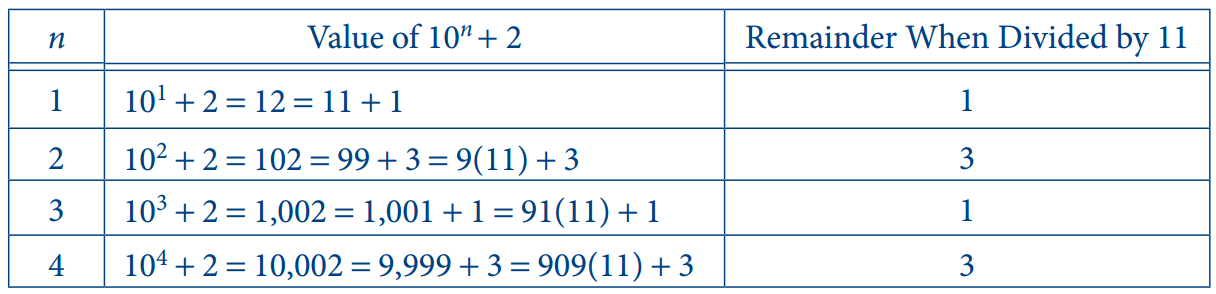
Note that the remainder is 1 when 10 is raised to an odd power, and the remainder is 3 when 10 is raised to an even power. This pattern suggests that since 32 is even, the remainder when \(10^{32} + 2\) is divided by 11 is 3.
To see that this is true, note that the integers 99 and 9,999 in the rows for n = 2 and n = 4, respectively, are multiples of 11. Tat is because they each consist of an even number of consecutive digits of 9. Also, these multiples of 11 are each 3 less than \(10^2 + 2 \) and \(10^4 + 2,\) respectively, so that is why the remainders are 3 when \(10^2 + 2 \) and \(10^4 + 2\) are divided by 11. Similarly, for n = 32, the integer with 32 consecutive digits of 9 is a multiple of 11 because 32 is even. Also, that multiple of 11 is 3 less than \(10^{32} + 2,\) so the remainder is 3 when \(10^{32} + 2\) is divided by 11. Thus the correct answer is Choice C.
Answer: C

GMAT-Club-Forum-82bymjob.png [ 46.28 KiB | Viewed 1171 times ]
Actually dividing \(10^{32} + 2\) by 11 would be very time consuming, so it is worth trying to compare the quantities without actually doing the division. A good approach would be to compute the remainders when \(10^1 + 2, 10^2 + 2, 10^3 + 2, 10^4 + 2,\) etc., are divided by 11 to see if there is a pattern that can help you determine the remainder when \(10^{32} + 2\) is divided by 11. The following table shows the first few cases.
Note that the remainder is 1 when 10 is raised to an odd power, and the remainder is 3 when 10 is raised to an even power. This pattern suggests that since 32 is even, the remainder when \(10^{32} + 2\) is divided by 11 is 3.
To see that this is true, note that the integers 99 and 9,999 in the rows for n = 2 and n = 4, respectively, are multiples of 11. Tat is because they each consist of an even number of consecutive digits of 9. Also, these multiples of 11 are each 3 less than \(10^2 + 2 \) and \(10^4 + 2,\) respectively, so that is why the remainders are 3 when \(10^2 + 2 \) and \(10^4 + 2\) are divided by 11. Similarly, for n = 32, the integer with 32 consecutive digits of 9 is a multiple of 11 because 32 is even. Also, that multiple of 11 is 3 less than \(10^{32} + 2,\) so the remainder is 3 when \(10^{32} + 2\) is divided by 11. Thus the correct answer is Choice C.
Answer: C
Attachment:
GMAT-Club-Forum-82bymjob.png [ 46.28 KiB | Viewed 1171 times ]





