Events & Promotions
|
|

GMAT Club Daily Prep
Thank you for using the timer - this advanced tool can estimate your performance and suggest more practice questions. We have subscribed you to Daily Prep Questions via email.
Customized
for You
Track
Your Progress
Practice
Pays
Not interested in getting valuable practice questions and articles delivered to your email? No problem, unsubscribe here.
 Sep 04
10:00 AM PDT
-11:00 AM PDT
What does test anxiety really look like on the GMAT? For many test takers, it does not look like a panic attack. Instead, it shows up as brain fog, rereading, negative comparisons, mental noise.... Sep 04
10:00 AM EDT
-11:59 PM EDT
We’ve worked incredibly hard to build TTP into the best test prep experience possible, and it would mean a lot to us to win Newsweek’s 2026 Readers’ Choice Award for Best Test Prep. If TTP has helped you, we’d be incredibly grateful for your vote. Sep 02
01:00 PM EDT
-11:59 PM EDT
Take 30% off all study plans with code COURSEWORK - Expires on Monday 9/7 Sep 06
09:30 AM EDT
-12:30 PM EST
Top scores are possible when you enroll in a powerful EA course, taught live online + 6 months access to TTP OnDemand video courses included! Perfect class schedule and easy course access for working professionals. Class starts Sundays Sept. 6, 2026.- Sep 07
12:01 AM PDT
-11:59 PM PDT
On the 7th, GMAT Club Tests will be Free! Including all the Quizzes, Questions, and Tests. 12 AM - 11:59 PM PDT - Sep 07
10:00 AM PDT
-11:00 AM PDT
A complete walkthrough of GMAT Club’s free 12-week GMAT study plan: what you study each week, how progress and goals are tracked, how the error log works, and how your practice unlocks paid tools at no cost. - Sep 09
07:00 AM PDT
-10:00 AM PDT
Meet AdComs and explore top Master’s programs - MiM, MiF, MSc, MSBA and more. - Application Fee Waivers - Free 1-Week of GMAT Club Tests: - Master's Application Toolkit - Grand Prize Giveaway - Sep 09
10:00 AM PDT
-11:00 AM PDT
Three MBA applications. Three rejections. No interview invites. A year later, Aman was admitted to Cambridge Judge, SMU, and IMD. In this episode of MBA Admit Stories, Aman shares how he rebuilt his MBA application...  Sep 15
07:00 PM EDT
-09:00 PM EST
Elite scores are possible when you enroll in a powerful GMAT course, taught live online + 6 months access to TTP OnDemand video courses included! Class starts Tues/Thurs Sept. 15, 2026 - Nov. 15, 2027, 7:00pm-9:00pm EST Sep 21
08:00 PM EDT
-10:00 PM EDT
Boost your GMAT score in less than one month in a live online class + 6 months access to TTP OnDemand video courses included! Class starts Mon, Tues, Wed, Thur, Fri Sept. 21, 2026 - Oct. 9, 2027, 7:00pm-10:00pm EST


Hello, GMAT community,
After months of preparation and two attempts at the GMAT, I finally achieved a 695 (Q88, V85, D81) - a score that tells only part of my story. Like many engineers, I started this journey confident in my quant abilities but soon discovered that the GMAT had much more to teach me about structured thinking and strategic preparation.
My GMAT journey began with a 615(V80,Q86,DI75) in my first mock. While my engineering background gave me a strong foundation in Quant, scoring Q86, I struggled significantly with Verbal and Data Insights. I remember looking at DI questions and feeling completely lost - I wasn't familiar with the questions posed. I wasn't familiar with how to solve or attempt a particular DI question. Some questions I just guessed and moved forward...
FINAL SCORE - 695 (Q88, V85, D81)
After extensive research and going through numerous reviews on various GMAT preparation platforms, I narrowed down the e-GMAT course. What drew me in were the positive reviews and success stories on YouTube.
Verbal improvement to V85
The master comprehension course was eye-opening. It helped me a lot in how to comprehend the sentences, how to read a particular paragraph, and how to infer or get the exact information that is required from that particular paragraph. I discovered that GMAT passages aren't straightforward - information is often twisted, with some details at the start, some at the end, and connectors in between.
The transformation in my verbal performance came down to two game-changing approaches: pre-thinking in Critical Reasoning.
I'll be honest - when I first heard about pre-thinking, I was skeptical. It seemed like an unnecessary extra step that would just slow me down. But my breakthrough came when I stopped seeing it as a rigid process and instead focused on its core purpose - truly understanding what the question was asking before diving into the answer choices. This shift was revolutionary. Before, I would often find myself trapped between two answer choices, relying mostly on instinct and often choosing wrong. But once I started taking those crucial moments to really grasp what the question was looking for, I found myself confidently eliminating incorrect options one by one. It wasn't just about getting to the right answer anymore - I actually understood why other options were wrong, which boosted both my accuracy and my confidence.
The DI Breakthrough to D81
My approach to Data Insights evolved significantly. Initially, I made the mistake of confining myself too strictly to timeframes, which affected my comprehension. Multi-source reasoning (MSR) questions were particularly challenging - If you don't comprehend the phrase...you can get all four questions wrong. I learned to take adequate time with the initial comprehension, which made subsequent questions much easier to tackle.
The improvement from D75 to D81 didn't happen overnight. It came through consistent practice and a fundamental shift in how I viewed time management in DI. Rather than seeing time as a constraint, I started viewing it as a resource to be invested wisely. This mindset shift, combined with focused practice, helped me transform what was initially my weakest section into one where I felt confident and competent.
Maintaining Quant Ability
For Quant, my mentor Abha designed a schedule where I would take sectional mocks every week once. I was revising and attempting the quizzes, and whatever question I was getting wrong, I was going back to my basics and revising from the basics. This systematic approach helped maintain my strong Quant performance throughout.
Evolution of Test Strategy
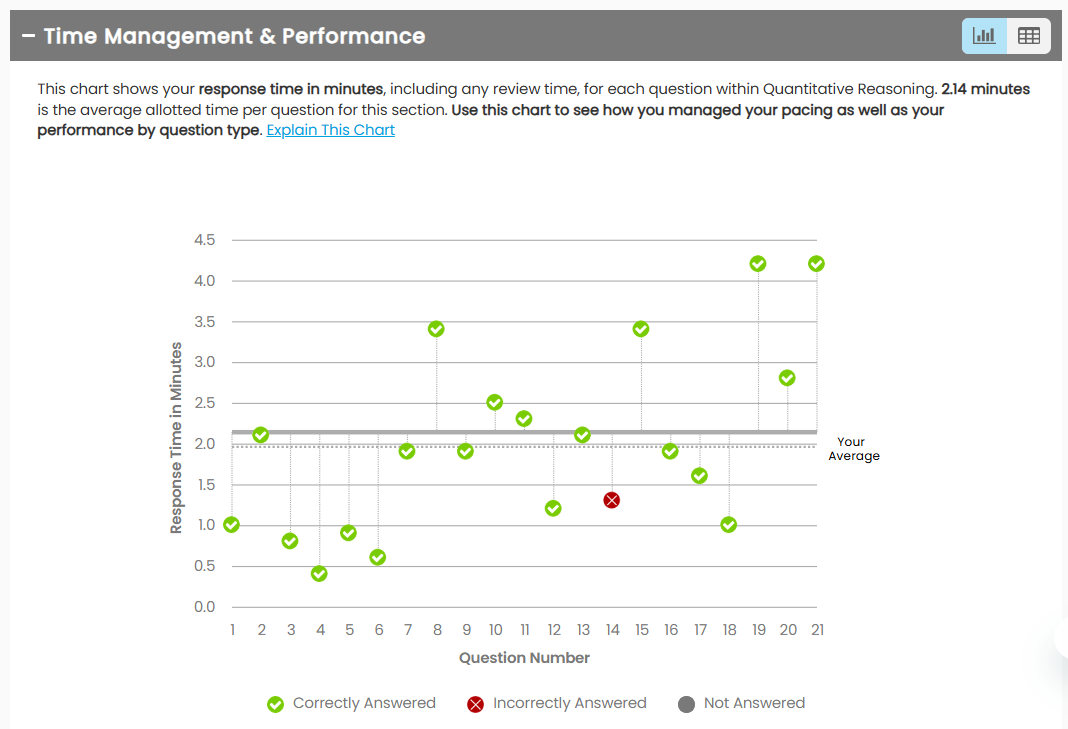
My test-taking strategy underwent significant changes. In early mocks, I was putting way much more time in the initial questions, and at the last 4 or 5 questions I was always running short of time. I learned to make strategic decisions about when to move on from difficult questions. Even if I'm not able to comprehend or I'm not able to get to a particular solution, I would just guess it and move ahead. This approach proved crucial - in my final attempt, I completed all three sections with time to spare.
The Final Test
Test day brought its share of nerves, but they dissipated after the first few questions. The verbal section went smoothly - I felt confident about most of my answers. In DI, while some questions made me skeptical, I stuck to my strategy. The Quant section I completed ahead of time, feeling confident about my performance.
Key Learning
Looking back, I realize the importance of having a clear deadline. As I tell other aspirants, GMAT is a continuous process...you'll practice today and skip tomorrow...so you have to have a particular deadline. Practice is crucial across all sections, even in areas where you feel confident. And most importantly, don't hesitate to seek help when needed.
Remember, GMAT success isn't just about hours invested - it's about structured, consistent preparation and strategic improvement. I hope my experience helps you in your preparation journey.
Feel free to reach out if you have any questions. Best of luck to all test-takers!
This is my personal experience. Your journey may differ, but I hope these insights help you in your preparation.
All the best!!

GMAT-Club-Forum-zgaz8lz6.png [ 98.7 KiB | Viewed 701 times ]
After months of preparation and two attempts at the GMAT, I finally achieved a 695 (Q88, V85, D81) - a score that tells only part of my story. Like many engineers, I started this journey confident in my quant abilities but soon discovered that the GMAT had much more to teach me about structured thinking and strategic preparation.
My GMAT journey began with a 615(V80,Q86,DI75) in my first mock. While my engineering background gave me a strong foundation in Quant, scoring Q86, I struggled significantly with Verbal and Data Insights. I remember looking at DI questions and feeling completely lost - I wasn't familiar with the questions posed. I wasn't familiar with how to solve or attempt a particular DI question. Some questions I just guessed and moved forward...
FINAL SCORE - 695 (Q88, V85, D81)
After extensive research and going through numerous reviews on various GMAT preparation platforms, I narrowed down the e-GMAT course. What drew me in were the positive reviews and success stories on YouTube.
Verbal improvement to V85
The master comprehension course was eye-opening. It helped me a lot in how to comprehend the sentences, how to read a particular paragraph, and how to infer or get the exact information that is required from that particular paragraph. I discovered that GMAT passages aren't straightforward - information is often twisted, with some details at the start, some at the end, and connectors in between.
The transformation in my verbal performance came down to two game-changing approaches: pre-thinking in Critical Reasoning.
I'll be honest - when I first heard about pre-thinking, I was skeptical. It seemed like an unnecessary extra step that would just slow me down. But my breakthrough came when I stopped seeing it as a rigid process and instead focused on its core purpose - truly understanding what the question was asking before diving into the answer choices. This shift was revolutionary. Before, I would often find myself trapped between two answer choices, relying mostly on instinct and often choosing wrong. But once I started taking those crucial moments to really grasp what the question was looking for, I found myself confidently eliminating incorrect options one by one. It wasn't just about getting to the right answer anymore - I actually understood why other options were wrong, which boosted both my accuracy and my confidence.
The DI Breakthrough to D81
My approach to Data Insights evolved significantly. Initially, I made the mistake of confining myself too strictly to timeframes, which affected my comprehension. Multi-source reasoning (MSR) questions were particularly challenging - If you don't comprehend the phrase...you can get all four questions wrong. I learned to take adequate time with the initial comprehension, which made subsequent questions much easier to tackle.
The improvement from D75 to D81 didn't happen overnight. It came through consistent practice and a fundamental shift in how I viewed time management in DI. Rather than seeing time as a constraint, I started viewing it as a resource to be invested wisely. This mindset shift, combined with focused practice, helped me transform what was initially my weakest section into one where I felt confident and competent.
Maintaining Quant Ability
For Quant, my mentor Abha designed a schedule where I would take sectional mocks every week once. I was revising and attempting the quizzes, and whatever question I was getting wrong, I was going back to my basics and revising from the basics. This systematic approach helped maintain my strong Quant performance throughout.
Evolution of Test Strategy
My test-taking strategy underwent significant changes. In early mocks, I was putting way much more time in the initial questions, and at the last 4 or 5 questions I was always running short of time. I learned to make strategic decisions about when to move on from difficult questions. Even if I'm not able to comprehend or I'm not able to get to a particular solution, I would just guess it and move ahead. This approach proved crucial - in my final attempt, I completed all three sections with time to spare.
The Final Test
Test day brought its share of nerves, but they dissipated after the first few questions. The verbal section went smoothly - I felt confident about most of my answers. In DI, while some questions made me skeptical, I stuck to my strategy. The Quant section I completed ahead of time, feeling confident about my performance.
Key Learning
Looking back, I realize the importance of having a clear deadline. As I tell other aspirants, GMAT is a continuous process...you'll practice today and skip tomorrow...so you have to have a particular deadline. Practice is crucial across all sections, even in areas where you feel confident. And most importantly, don't hesitate to seek help when needed.
Remember, GMAT success isn't just about hours invested - it's about structured, consistent preparation and strategic improvement. I hope my experience helps you in your preparation journey.
Feel free to reach out if you have any questions. Best of luck to all test-takers!
This is my personal experience. Your journey may differ, but I hope these insights help you in your preparation.
All the best!!
Attachment:
GMAT-Club-Forum-zgaz8lz6.png [ 98.7 KiB | Viewed 701 times ]


 11 Dec 2024, 08:28
Kudos
Bookmarks
Congrats and all the best going forward...
Can you suggest some materials or sources from where you practiced DI and Quants?
Can you suggest some materials or sources from where you practiced DI and Quants?
11 Dec 2024, 13:21
Kudos
Bookmarks
Thank you! I practiced Quant and DI questions on GMATClub, and later focused on solving OG.
Ayeka










