Events & Promotions
|
|

GMAT Club Daily Prep
Thank you for using the timer - this advanced tool can estimate your performance and suggest more practice questions. We have subscribed you to Daily Prep Questions via email.
Customized
for You
Track
Your Progress
Practice
Pays
Not interested in getting valuable practice questions and articles delivered to your email? No problem, unsubscribe here.
 Sep 02
01:00 PM EDT
-11:59 PM EDT
Take 30% off all study plans with code COURSEWORK - Expires on Monday 9/7 Sep 04
01:30 AM EDT
-02:30 AM EDT
This Labor Day, turn your hard work into real score gains. From 615→715 in 15 days to 705 in 30 days, our students prove what's possible with personalized, expert guidance. Save up to 25% on 1-on-1 tutoring. Sep 04
10:00 AM EDT
-11:59 PM EDT
We’ve worked incredibly hard to build TTP into the best test prep experience possible, and it would mean a lot to us to win Newsweek’s 2026 Readers’ Choice Award for Best Test Prep. If TTP has helped you, we’d be incredibly grateful for your vote. Sep 06
09:30 AM EDT
-12:30 PM EST
Top scores are possible when you enroll in a powerful EA course, taught live online + 6 months access to TTP OnDemand video courses included! Perfect class schedule and easy course access for working professionals. Class starts Sundays Sept. 6, 2026. Sep 07
12:01 AM PDT
-11:59 PM PDT
On the 7th, GMAT Club Tests will be Free! Including all the Quizzes, Questions, and Tests. 12 AM - 11:59 PM PDT Sep 07
12:30 AM EDT
-01:30 AM EDT
Tejas studied hard but kept repeating the same mistakes. After 3 attempts at 645, a focused 4-week strategy helped him identify and fix what was holding him back—leading to a 695 with just 12–15 hours of study per week.- Sep 07
10:00 AM PDT
-11:00 AM PDT
A complete walkthrough of GMAT Club’s free 12-week GMAT study plan: what you study each week, how progress and goals are tracked, how the error log works, and how your practice unlocks paid tools at no cost. - Sep 09
07:00 AM PDT
-10:00 AM PDT
Meet AdComs and explore top Master’s programs - MiM, MiF, MSc, MSBA and more. - Application Fee Waivers - Free 1-Week of GMAT Club Tests: - Master's Application Toolkit - Grand Prize Giveaway - Sep 09
10:00 AM PDT
-11:00 AM PDT
Three MBA applications. Three rejections. No interview invites. A year later, Aman was admitted to Cambridge Judge, SMU, and IMD. In this episode of MBA Admit Stories, Aman shares how he rebuilt his MBA application...  Sep 10
08:00 PM PDT
-09:00 PM PDT
Free- full-length test + 15 concept videos + 150+ short videos + study plan! Sep 15
07:00 PM EDT
-09:00 PM EST
Elite scores are possible when you enroll in a powerful GMAT course, taught live online + 6 months access to TTP OnDemand video courses included! Class starts Tues/Thurs Sept. 15, 2026 - Nov. 15, 2027, 7:00pm-9:00pm EST Sep 21
08:00 PM EDT
-10:00 PM EDT
Boost your GMAT score in less than one month in a live online class + 6 months access to TTP OnDemand video courses included! Class starts Mon, Tues, Wed, Thur, Fri Sept. 21, 2026 - Oct. 9, 2027, 7:00pm-10:00pm EST


 15 Dec 2024, 10:17
Kudos
Bookmarks
Dear GMAT Club Members,
I'm pleased to share my GMAT journey that led to a 110-point improvement. As an engineering student from Lebanon, where we face daily power cuts and infrastructure challenges, I managed to improve from 535 to 645 through structured preparation while balancing university studies.
Studying for the GMAT during Lebanon's ongoing crises presented unique challenges that most test-takers couldn't imagine. With rolling power cuts lasting up to 22 hours a day, I had to strategically plan my study sessions around the brief windows when electricity was available.
Background and Initial Preparation
I began my GMAT journey in January with an initial score of 535, but my early approach of self-studying with just the Official Guide proved insufficient. After thorough research and reviewing various preparation options, I chose e-GMAT for its comprehensive study materials and mentorship support. My serious preparation began in July, and I dedicated about 4-5 months while managing my engineering coursework.
Section-wise Strategy and Improvement
Quant Strategy: 46%ile to 88%ile
My approach to Quant was systematic and focused on building strong fundamentals before attempting advanced questions. I dedicated significant time to developing time-saving techniques through regular practice under timed conditions.
A crucial aspect of my improvement came from detailed error analysis - understanding why I made mistakes rather than just identifying them. I paid special attention to word problems, which were initially my weakness, and gradually with focused practice was able to improve my accuracy.
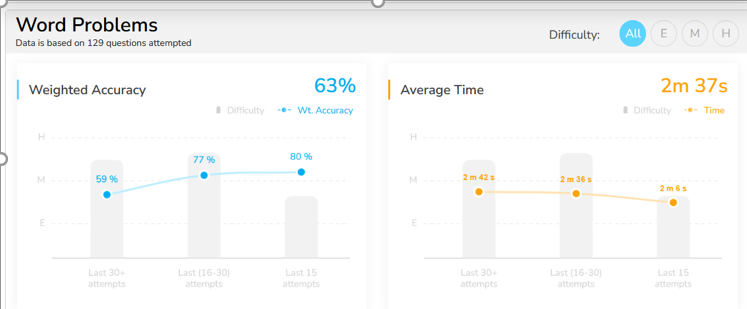
Capture.PNG [ 50.09 KiB | Viewed 1069 times ]
Data Insights 45% to 84%ile
Success in Data Insights came from a thorough approach to understanding each data set before attempting questions. I developed an efficient strategy for Multi-Source Reasoning (MSR) questions, focusing on building speed while maintaining accuracy. Regular practice with full sections helped me recognize patterns across different question types, making the section more manageable on test day.
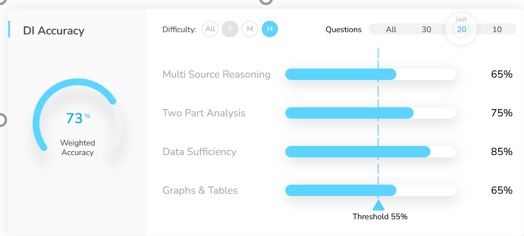
Capture2.PNG [ 36.39 KiB | Viewed 1061 times ]
Time Management Approach
My time management strategy evolved through practice. I implemented a strict 3-minute rule for challenging questions, marking them for review rather than getting stuck. Learning to let go of difficult questions early was crucial - a skill that only came with consistent timed practice. I built my endurance through regular full-length tests, which proved invaluable on test day.
Test-Taking Strategy
On test day, I followed a carefully planned sequence: Quant Section, followed by a short break, then Verbal Section, and finally Data Insights. This sequence aligned well with my energy levels and allowed maximum focus for each section. The breaks between sections were crucial for maintaining mental freshness throughout the test.
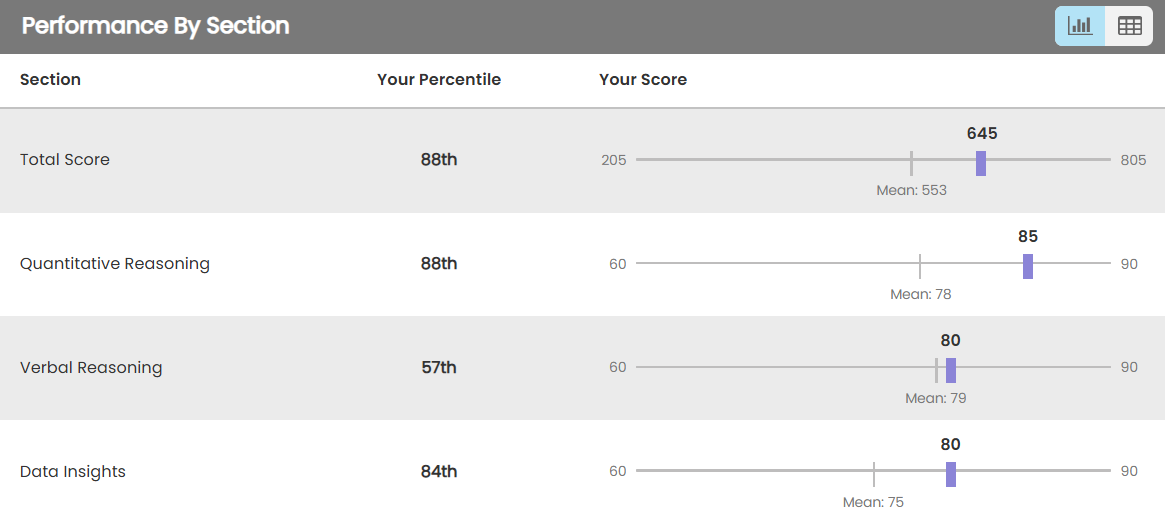
Capture.3PNG.PNG [ 33.63 KiB | Viewed 1052 times ]
Key Learnings and Success Factors
The most significant factor in my improvement was maintaining consistent study habits. I treated GMAT preparation like physical training - regular, focused sessions proved more effective than sporadic intense study periods. Even on busy days with university commitments, I ensured some focused GMAT work.
Another crucial element was my approach to weaknesses. Instead of avoiding challenging areas, I deliberately focused on them. This meant spending extra time on word problems despite being more comfortable with algebra. This approach, though initially uncomfortable, led to substantial score improvements.
Final Thoughts
My journey isn't about natural ability or perfect study conditions - it's about consistency, strategic preparation, and resilience. Despite the challenges of power cuts and a demanding university schedule, maintaining focus on the goal helped me persevere.
I'm pleased to share my GMAT journey that led to a 110-point improvement. As an engineering student from Lebanon, where we face daily power cuts and infrastructure challenges, I managed to improve from 535 to 645 through structured preparation while balancing university studies.
Studying for the GMAT during Lebanon's ongoing crises presented unique challenges that most test-takers couldn't imagine. With rolling power cuts lasting up to 22 hours a day, I had to strategically plan my study sessions around the brief windows when electricity was available.
Background and Initial Preparation
I began my GMAT journey in January with an initial score of 535, but my early approach of self-studying with just the Official Guide proved insufficient. After thorough research and reviewing various preparation options, I chose e-GMAT for its comprehensive study materials and mentorship support. My serious preparation began in July, and I dedicated about 4-5 months while managing my engineering coursework.
Section-wise Strategy and Improvement
Quant Strategy: 46%ile to 88%ile
My approach to Quant was systematic and focused on building strong fundamentals before attempting advanced questions. I dedicated significant time to developing time-saving techniques through regular practice under timed conditions.
A crucial aspect of my improvement came from detailed error analysis - understanding why I made mistakes rather than just identifying them. I paid special attention to word problems, which were initially my weakness, and gradually with focused practice was able to improve my accuracy.
Attachment:
Capture.PNG [ 50.09 KiB | Viewed 1069 times ]
Success in Data Insights came from a thorough approach to understanding each data set before attempting questions. I developed an efficient strategy for Multi-Source Reasoning (MSR) questions, focusing on building speed while maintaining accuracy. Regular practice with full sections helped me recognize patterns across different question types, making the section more manageable on test day.
Attachment:
Capture2.PNG [ 36.39 KiB | Viewed 1061 times ]
Time Management Approach
My time management strategy evolved through practice. I implemented a strict 3-minute rule for challenging questions, marking them for review rather than getting stuck. Learning to let go of difficult questions early was crucial - a skill that only came with consistent timed practice. I built my endurance through regular full-length tests, which proved invaluable on test day.
Test-Taking Strategy
On test day, I followed a carefully planned sequence: Quant Section, followed by a short break, then Verbal Section, and finally Data Insights. This sequence aligned well with my energy levels and allowed maximum focus for each section. The breaks between sections were crucial for maintaining mental freshness throughout the test.
Attachment:
Capture.3PNG.PNG [ 33.63 KiB | Viewed 1052 times ]
The most significant factor in my improvement was maintaining consistent study habits. I treated GMAT preparation like physical training - regular, focused sessions proved more effective than sporadic intense study periods. Even on busy days with university commitments, I ensured some focused GMAT work.
Another crucial element was my approach to weaknesses. Instead of avoiding challenging areas, I deliberately focused on them. This meant spending extra time on word problems despite being more comfortable with algebra. This approach, though initially uncomfortable, led to substantial score improvements.
Final Thoughts
My journey isn't about natural ability or perfect study conditions - it's about consistency, strategic preparation, and resilience. Despite the challenges of power cuts and a demanding university schedule, maintaining focus on the goal helped me persevere.
Moderator:








