Events & Promotions
|
|

GMAT Club Daily Prep
Thank you for using the timer - this advanced tool can estimate your performance and suggest more practice questions. We have subscribed you to Daily Prep Questions via email.
Customized
for You
Track
Your Progress
Practice
Pays
Not interested in getting valuable practice questions and articles delivered to your email? No problem, unsubscribe here.
 Sep 06
09:30 AM EDT
-12:30 PM EST
Top scores are possible when you enroll in a powerful EA course, taught live online + 6 months access to TTP OnDemand video courses included! Perfect class schedule and easy course access for working professionals. Class starts Sundays Sept. 6, 2026. Sep 02
01:00 PM EDT
-11:59 PM EDT
Take 30% off all study plans with code COURSEWORK - Expires on Monday 9/7 Sep 04
10:00 AM EDT
-11:59 PM EDT
We’ve worked incredibly hard to build TTP into the best test prep experience possible, and it would mean a lot to us to win Newsweek’s 2026 Readers’ Choice Award for Best Test Prep. If TTP has helped you, we’d be incredibly grateful for your vote. Sep 07
12:01 AM PDT
-11:59 PM PDT
On the 7th, GMAT Club Tests will be Free! Including all the Quizzes, Questions, and Tests. 12 AM - 11:59 PM PDT- Sep 07
10:00 AM PDT
-11:00 AM PDT
A complete walkthrough of GMAT Club’s free 12-week GMAT study plan: what you study each week, how progress and goals are tracked, how the error log works, and how your practice unlocks paid tools at no cost. - Sep 09
07:00 AM PDT
-10:00 AM PDT
Meet AdComs and explore top Master’s programs - MiM, MiF, MSc, MSBA and more. - Application Fee Waivers - Free 1-Week of GMAT Club Tests: - Master's Application Toolkit - Grand Prize Giveaway - Sep 09
10:00 AM PDT
-11:00 AM PDT
Three MBA applications. Three rejections. No interview invites. A year later, Aman was admitted to Cambridge Judge, SMU, and IMD. In this episode of MBA Admit Stories, Aman shares how he rebuilt his MBA application...  Sep 15
07:00 PM EDT
-09:00 PM EST
Elite scores are possible when you enroll in a powerful GMAT course, taught live online + 6 months access to TTP OnDemand video courses included! Class starts Tues/Thurs Sept. 15, 2026 - Nov. 15, 2027, 7:00pm-9:00pm EST Sep 21
08:00 PM EDT
-10:00 PM EDT
Boost your GMAT score in less than one month in a live online class + 6 months access to TTP OnDemand video courses included! Class starts Mon, Tues, Wed, Thur, Fri Sept. 21, 2026 - Oct. 9, 2027, 7:00pm-10:00pm EST


 21 Dec 2025, 17:05
Kudos
Bookmarks
From Confusion to 100th percentile: How I Scored 735 (Q85/V89/DI86)
I'm Emanuel, and I recently scored a 735 on the GMAT. When the score flashed on my screen, I honestly couldn't believe it. I'd been nervous going into the exam, not sure if I'd hit my goal, but as I worked through the questions and felt confident in my answers, something just clicked. Still, seeing that 735 was surreal—I was literally floating on clouds in that moment.
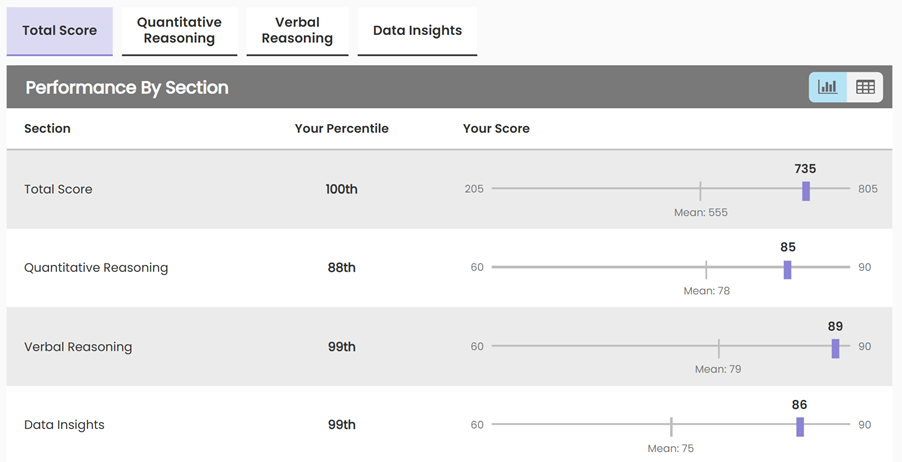
Looking back at my journey, I realize the path to a high score isn't always what you'd expect. My biggest challenge wasn't quant or data insights—it was verbal, which ironically became my strongest section. If you're struggling with sections that "should" be easy for you, or if you're stuck between answer choices that all seem right, this debrief might help.
Initial Challenges
Here's what made verbal so frustrating at first: I knew there was only one right answer, but I'd consistently find myself torn between two or even three options that made perfect sense to me. In quant and DI, I could work toward an exact number or output, even if I made a mistake, there was clarity in the answer. But in verbal? Everything felt similar, and I had no systematic way to tackle questions.
I'd gone through e-GMAT's verbal course modules on Critical Reasoning and Reading Comprehension, learning the concepts and strategies. But when it came to application, actually solving questions under timed conditions, I struggled. The course taught me what to look for, but I wasn't executing the strategies effectively in practice.
The confusion was real. I'd stare at CR and RC questions, read all five answer choices, and feel completely lost. My natural instinct was to try finding the "right" answer immediately, but when multiple options seemed equally valid, I'd spiral. This wasn't just a knowledge gap, it was a fundamental approach problem.
Time management made everything worse. I'm a bit obsessive about finding the right answer, so I'd regularly spend double or triple the recommended time on single questions. I could take 4-6 minutes on a tough CR question, determined to crack it, only to realize I'd sacrificed 5-6 easier questions at the end that I had to guess on with just 30 seconds each. The math was brutal: trying to secure one correct answer cost me multiple questions I could've actually gotten right.
The Turning Point: V89
Stop trying to find the right answer first. Instead, use elimination. Find the wrong answers, cross them out, and narrow your options. This sounds simple, but it was a game-changer. Choosing between two options is infinitely easier than trying to pick the correct one from five confusing choices.
The e-GMAT course modules on pre-thinking really broke this down for me. I learned to follow a structured process: understand what the question is asking, pre-think what kind of answer would make sense, and then systematically eliminate options that don't fit. In CR especially, I'd actively hunt for reasons to eliminate answer choices, looking for scope issues, extreme language, assumptions not supported by the passage, logical gaps. Once I narrowed it down to two options, the decision became way clearer. My accuracy shot up, and more importantly, my confidence grew.
But the elimination strategy alone wasn't enough. I had to develop another crucial skill: learning to LET GO. This was probably the hardest lesson I learned, not only for one section, but also the most valuable for the whole exam. My mentor told me something that stuck: "It's not about trying to get everything correct."
That hit hard. I'd been so focused on perfecting every single question that I was sabotaging my overall performance. I could allocate my time across questions. I learned to bucket questions into three categories:
At first, letting go felt like failure. But then I noticed something incredible—those "easy" questions I'd been rushing through at the end? They were actually easier than the ones I was obsessing over. I was sacrificing 5-6 questions I could confidently answer just to maybe get one difficult question right. The ROI was terrible.
Quant: Building on a Strong Foundation
I started with a decent quant foundation, so my strategy was different from someone building concepts from scratch. I used e-GMAT's Scholaranium cementing quizzes extensively to identify and address specific weak areas rather than reviewing everything.
These weren't just random practice questions— each quiz had 10 questions and were based on difficulty Medium and Hard.
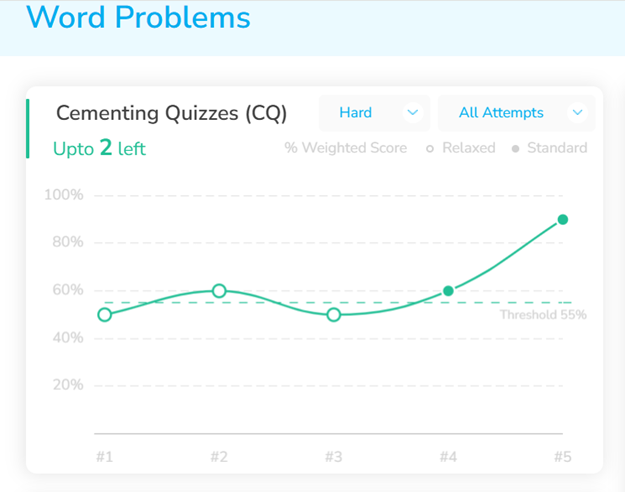
What I loved about the Scholaranium platform was how it tracked everything. After each ability quiz, I could see exactly which sub-topics were giving me trouble. Was I strong in linear equations but struggling with quadratic equations? Did I understand rate problems but mess up work-time problems? The platform broke it down to that granular level.
The course material gave me tons of equations, formulas, and tactical approaches for different question types, all of that was valuable.
Nevertheless, the most important skill I developed was self-awareness: Be honest with yourself. Being sincere about whether I truly understood a concept or was just forcing myself to answer something I didn’t know, helped me focus on the concepts I truly required. The cementing quizzes forced that honesty because they'd expose gaps in my understanding immediately.
Data Insights: DI86
I worked on verbal and quant first, then moved to DI, and honestly, I think that sequence was genius. By the time I hit DI, I already knew how to tackle long, complex statements from verbal. I knew how to break them into digestible pieces, extract key information, and work efficiently.
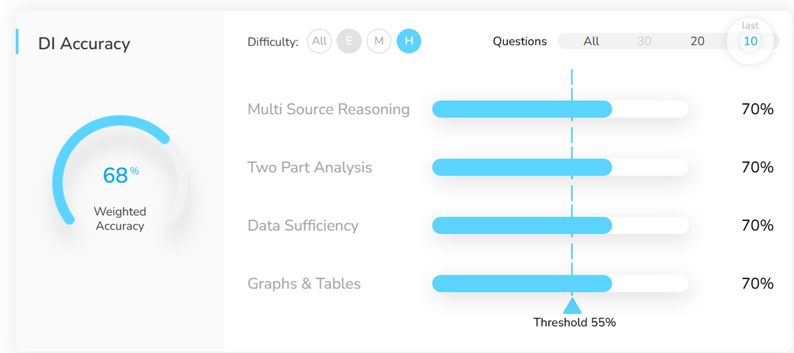
When I first encountered Multi-Source Reasoning questions, you know, those monsters with multiple tabs and seemingly endless information, I was overwhelmed. Long paragraphs, some numeric data, some verbal information, all scattered across different tabs. Where do you even start?
My previous training kicked in, although I still struggle and went through The e-GMAT DI course, specifically modules on MSR strategy. I started using a three-step process for MSR: (1) Quickly scan all tabs to understand the information structure, (2) Take strategic notes on key data points and relationships, and (3) Tackle questions by referencing your notes first, then going back to tabs only when needed.
I approached MSR questions like reading comprehension passages: don't look at the questions first, absorb the information, take notes on what seems important, and then tackle the questions. At first, I'd made the mistake of reading the question first and then hunting for specific information. That was a disaster because each subsequent question would require different information, forcing me to re-read everything multiple times.
The DI cementing quizzes in Scholaranium worked the same way as quant, identify weak question types, practice them in focused bursts, review mistakes, and cement the learning. This kept my prep efficient even as I was learning an entirely new section.
The Power of Focused Practice
In the end I learned one last important lesson: when it comes to mocks, it's NOT a numbers game. I used e-GMAT's Sigma-X mocks, which are designed to closely simulate the actual GMAT experience (although, in my opinion I felt the actual exam easier than those mock tests I previously did).
I made a mistake in my final days before the exam. I had this idea that I should do as many mocks as possible, so I tried to cram three full mocks into my last couple of days. I was exhausted. The last mock went terribly, and I didn't take time to review any of them properly.
Here's the thing about mocks: each one takes 2.5 hours to complete and needs another 2-3 hours for proper review if you want to understand where you went wrong. You're not learning anything if you're just churning through exams without analysis.The mock review reports in Scholaranium were incredibly detailed, they'd show me not just which questions I got wrong, but patterns in my performance. Was I rushing through the end of sections? Was I spending too long on hard questions? Were certain topics consistently tripping me up?
My mentor would review these reports with me during our sessions, and we'd identify strategic adjustments.
I'd take 3-4 well-reviewed mocks over 20 rushed ones any day. Each mock was a learning opportunity, not just a practice run.
After that disastrous final mock session, I received an email from my e-GMAT mentor that put everything in perspective with just one phrase: "An athlete doesn't run a marathon the day before the actual marathon." I'd even started another mock test on my last day, same flawed thinking about quantity over quality. Halfway through, I realized I wasn't focusing on anything and just dropped it.
That advice about the last day before the exam was gold. By that point, you either know the material, or you don't. One more day of cramming won't change that. What you need is mental preparation, take a deep breath before diving into the pool. I spent my final day relaxing, staying calm, and trusting the work I'd already put in. That mental clarity made a huge difference on test day.
The journey to 735 wasn't about working harder, it was about working smarter. It was about developing self-awareness, strategic time management, and the confidence to let go of questions that weren't worth the investment. If you're struggling with sections that "should" be easy or finding yourself paralyzed between answer choices, take a step back and look at your approach, not just your knowledge.
The GMAT isn't just testing what you know, it's testing how you think under pressure, how you manage resources (time, focus and energy), and whether you can be strategic about your efforts. Master those meta-skills, and the score will follow.
Feel free to reach out if you have questions about my preparation approach. Happy to help!

GMAT-Club-Forum-ktfc1gzi.png [ 73.84 KiB | Viewed 613 times ]

GMAT-Club-Forum-qjd474qj.png [ 57.09 KiB | Viewed 593 times ]

GMAT-Club-Forum-pozn5pc6.png [ 64.34 KiB | Viewed 591 times ]
I'm Emanuel, and I recently scored a 735 on the GMAT. When the score flashed on my screen, I honestly couldn't believe it. I'd been nervous going into the exam, not sure if I'd hit my goal, but as I worked through the questions and felt confident in my answers, something just clicked. Still, seeing that 735 was surreal—I was literally floating on clouds in that moment.
Looking back at my journey, I realize the path to a high score isn't always what you'd expect. My biggest challenge wasn't quant or data insights—it was verbal, which ironically became my strongest section. If you're struggling with sections that "should" be easy for you, or if you're stuck between answer choices that all seem right, this debrief might help.
Initial Challenges
Here's what made verbal so frustrating at first: I knew there was only one right answer, but I'd consistently find myself torn between two or even three options that made perfect sense to me. In quant and DI, I could work toward an exact number or output, even if I made a mistake, there was clarity in the answer. But in verbal? Everything felt similar, and I had no systematic way to tackle questions.
I'd gone through e-GMAT's verbal course modules on Critical Reasoning and Reading Comprehension, learning the concepts and strategies. But when it came to application, actually solving questions under timed conditions, I struggled. The course taught me what to look for, but I wasn't executing the strategies effectively in practice.
The confusion was real. I'd stare at CR and RC questions, read all five answer choices, and feel completely lost. My natural instinct was to try finding the "right" answer immediately, but when multiple options seemed equally valid, I'd spiral. This wasn't just a knowledge gap, it was a fundamental approach problem.
Time management made everything worse. I'm a bit obsessive about finding the right answer, so I'd regularly spend double or triple the recommended time on single questions. I could take 4-6 minutes on a tough CR question, determined to crack it, only to realize I'd sacrificed 5-6 easier questions at the end that I had to guess on with just 30 seconds each. The math was brutal: trying to secure one correct answer cost me multiple questions I could've actually gotten right.
The Turning Point: V89
Stop trying to find the right answer first. Instead, use elimination. Find the wrong answers, cross them out, and narrow your options. This sounds simple, but it was a game-changer. Choosing between two options is infinitely easier than trying to pick the correct one from five confusing choices.
The e-GMAT course modules on pre-thinking really broke this down for me. I learned to follow a structured process: understand what the question is asking, pre-think what kind of answer would make sense, and then systematically eliminate options that don't fit. In CR especially, I'd actively hunt for reasons to eliminate answer choices, looking for scope issues, extreme language, assumptions not supported by the passage, logical gaps. Once I narrowed it down to two options, the decision became way clearer. My accuracy shot up, and more importantly, my confidence grew.
But the elimination strategy alone wasn't enough. I had to develop another crucial skill: learning to LET GO. This was probably the hardest lesson I learned, not only for one section, but also the most valuable for the whole exam. My mentor told me something that stuck: "It's not about trying to get everything correct."
That hit hard. I'd been so focused on perfecting every single question that I was sabotaging my overall performance. I could allocate my time across questions. I learned to bucket questions into three categories:
- Questions I could solve confidently within 2 minutes.
- Questions that would take 3+ minutes but I had a clear path to the answer.
- Questions where I was stuck or confused with no clear approach.
At first, letting go felt like failure. But then I noticed something incredible—those "easy" questions I'd been rushing through at the end? They were actually easier than the ones I was obsessing over. I was sacrificing 5-6 questions I could confidently answer just to maybe get one difficult question right. The ROI was terrible.
Quant: Building on a Strong Foundation
I started with a decent quant foundation, so my strategy was different from someone building concepts from scratch. I used e-GMAT's Scholaranium cementing quizzes extensively to identify and address specific weak areas rather than reviewing everything.
These weren't just random practice questions— each quiz had 10 questions and were based on difficulty Medium and Hard.
What I loved about the Scholaranium platform was how it tracked everything. After each ability quiz, I could see exactly which sub-topics were giving me trouble. Was I strong in linear equations but struggling with quadratic equations? Did I understand rate problems but mess up work-time problems? The platform broke it down to that granular level.
The course material gave me tons of equations, formulas, and tactical approaches for different question types, all of that was valuable.
Nevertheless, the most important skill I developed was self-awareness: Be honest with yourself. Being sincere about whether I truly understood a concept or was just forcing myself to answer something I didn’t know, helped me focus on the concepts I truly required. The cementing quizzes forced that honesty because they'd expose gaps in my understanding immediately.
Data Insights: DI86
I worked on verbal and quant first, then moved to DI, and honestly, I think that sequence was genius. By the time I hit DI, I already knew how to tackle long, complex statements from verbal. I knew how to break them into digestible pieces, extract key information, and work efficiently.
When I first encountered Multi-Source Reasoning questions, you know, those monsters with multiple tabs and seemingly endless information, I was overwhelmed. Long paragraphs, some numeric data, some verbal information, all scattered across different tabs. Where do you even start?
My previous training kicked in, although I still struggle and went through The e-GMAT DI course, specifically modules on MSR strategy. I started using a three-step process for MSR: (1) Quickly scan all tabs to understand the information structure, (2) Take strategic notes on key data points and relationships, and (3) Tackle questions by referencing your notes first, then going back to tabs only when needed.
I approached MSR questions like reading comprehension passages: don't look at the questions first, absorb the information, take notes on what seems important, and then tackle the questions. At first, I'd made the mistake of reading the question first and then hunting for specific information. That was a disaster because each subsequent question would require different information, forcing me to re-read everything multiple times.
The DI cementing quizzes in Scholaranium worked the same way as quant, identify weak question types, practice them in focused bursts, review mistakes, and cement the learning. This kept my prep efficient even as I was learning an entirely new section.
The Power of Focused Practice
In the end I learned one last important lesson: when it comes to mocks, it's NOT a numbers game. I used e-GMAT's Sigma-X mocks, which are designed to closely simulate the actual GMAT experience (although, in my opinion I felt the actual exam easier than those mock tests I previously did).
I made a mistake in my final days before the exam. I had this idea that I should do as many mocks as possible, so I tried to cram three full mocks into my last couple of days. I was exhausted. The last mock went terribly, and I didn't take time to review any of them properly.
Here's the thing about mocks: each one takes 2.5 hours to complete and needs another 2-3 hours for proper review if you want to understand where you went wrong. You're not learning anything if you're just churning through exams without analysis.The mock review reports in Scholaranium were incredibly detailed, they'd show me not just which questions I got wrong, but patterns in my performance. Was I rushing through the end of sections? Was I spending too long on hard questions? Were certain topics consistently tripping me up?
My mentor would review these reports with me during our sessions, and we'd identify strategic adjustments.
I'd take 3-4 well-reviewed mocks over 20 rushed ones any day. Each mock was a learning opportunity, not just a practice run.
After that disastrous final mock session, I received an email from my e-GMAT mentor that put everything in perspective with just one phrase: "An athlete doesn't run a marathon the day before the actual marathon." I'd even started another mock test on my last day, same flawed thinking about quantity over quality. Halfway through, I realized I wasn't focusing on anything and just dropped it.
That advice about the last day before the exam was gold. By that point, you either know the material, or you don't. One more day of cramming won't change that. What you need is mental preparation, take a deep breath before diving into the pool. I spent my final day relaxing, staying calm, and trusting the work I'd already put in. That mental clarity made a huge difference on test day.
The journey to 735 wasn't about working harder, it was about working smarter. It was about developing self-awareness, strategic time management, and the confidence to let go of questions that weren't worth the investment. If you're struggling with sections that "should" be easy or finding yourself paralyzed between answer choices, take a step back and look at your approach, not just your knowledge.
The GMAT isn't just testing what you know, it's testing how you think under pressure, how you manage resources (time, focus and energy), and whether you can be strategic about your efforts. Master those meta-skills, and the score will follow.
Feel free to reach out if you have questions about my preparation approach. Happy to help!
Attachment:
GMAT-Club-Forum-ktfc1gzi.png [ 73.84 KiB | Viewed 613 times ]
Attachment:
GMAT-Club-Forum-qjd474qj.png [ 57.09 KiB | Viewed 593 times ]
Attachment:
GMAT-Club-Forum-pozn5pc6.png [ 64.34 KiB | Viewed 591 times ]
 23 Dec 2025, 10:10
Kudos
Bookmarks
Congrats on the 735!! I wish you all the best with your applications.