Events & Promotions
| Last visit was: 02 Sep 2026, 11:06 |
It is currently 02 Sep 2026, 11:06 |
|
|

GMAT Club Daily Prep
Thank you for using the timer - this advanced tool can estimate your performance and suggest more practice questions. We have subscribed you to Daily Prep Questions via email.
Customized
for You
Track
Your Progress
Practice
Pays
Not interested in getting valuable practice questions and articles delivered to your email? No problem, unsubscribe here.
 Sep 02
08:00 PM PDT
-09:00 PM PDT
Video explanations + diagnosis of 10 weakest areas + 150+ short videos + study plan! Sep 03
01:30 AM EDT
-02:30 AM EDT
At one point, she believed GMAT wasn’t for her. After scoring 595, self-doubt crept in and she questioned her potential. But instead of quitting, she made the right strategic changes. The result? A remarkable comeback to 695. Check out how Saakshi did it. Aug 27
10:00 AM EDT
-11:00 AM EDT
We’ve worked incredibly hard to build TTP into the best test prep experience possible, and it would mean a lot to us to win Newsweek’s 2026 Readers’ Choice Award for Best Test Prep. If TTP has helped you, we’d be incredibly grateful for your vote. Sep 02
12:30 AM EDT
-01:30 AM EDT
Thought your job leaves no time for GMAT prep? After multiple GMAT attempts and a demanding consulting job, Kshitij improved to 695 in under 2 months. Learn the mindset shifts, study strategy, and execution changes that made the breakthrough possible. Sep 04
10:00 AM PDT
-11:00 AM PDT
What does test anxiety really look like on the GMAT? For many test takers, it does not look like a panic attack. Instead, it shows up as brain fog, rereading, negative comparisons, mental noise.... Sep 06
09:30 AM EDT
-12:30 PM EST
Top scores are possible when you enroll in a powerful EA course, taught live online + 6 months access to TTP OnDemand video courses included! Perfect class schedule and easy course access for working professionals. Class starts Sundays Sept. 6, 2026.- Sep 07
12:01 AM PDT
-11:59 PM PDT
On the 7th, GMAT Club Tests will be Free! Including all the Quizzes, Questions, and Tests. 12 AM - 11:59 PM PDT - Sep 09
07:00 AM PDT
-10:00 AM PDT
Meet AdComs and explore top Master’s programs - MiM, MiF, MSc, MSBA and more. - Application Fee Waivers - Free 1-Week of GMAT Club Tests: - Master's Application Toolkit - Grand Prize Giveaway  Sep 15
07:00 PM EDT
-09:00 PM EST
Elite scores are possible when you enroll in a powerful GMAT course, taught live online + 6 months access to TTP OnDemand video courses included! Class starts Tues/Thurs Sept. 15, 2026 - Nov. 15, 2027, 7:00pm-9:00pm EST Sep 21
08:00 PM EDT
-10:00 PM EDT
Boost your GMAT score in less than one month in a live online class + 6 months access to TTP OnDemand video courses included! Class starts Mon, Tues, Wed, Thur, Fri Sept. 21, 2026 - Oct. 9, 2027, 7:00pm-10:00pm EST


 27 Dec 2025, 22:24
Kudos
Bookmarks
After months of hovering around Q85-88, I finally broke through to Q90, achieving a 655 overall. The journey taught me that GMAT Quant success is not about mathematical prowess but about understanding what the test actually measures. Here is how I made that final leap.
The Mindset Shift That Changed Everything
Coming from a strong quantitative background with entrance exam experience, I assumed GMAT Quant would be similar. I was wrong. While going through the e-GMAT course, I discovered that GMAT is not checking calculation skills or formula memorization. It tests problem-solving ability. More than half the time should go into understanding the question. Once you truly grasp what they are asking, the calculations are simple.
This realization was transformative. I stopped rushing through questions and started investing time upfront in comprehension. The e-GMAT course introduced me to this approach systematically, with each module designed to target specific question patterns.
Breaking My Biases with Data Analytics
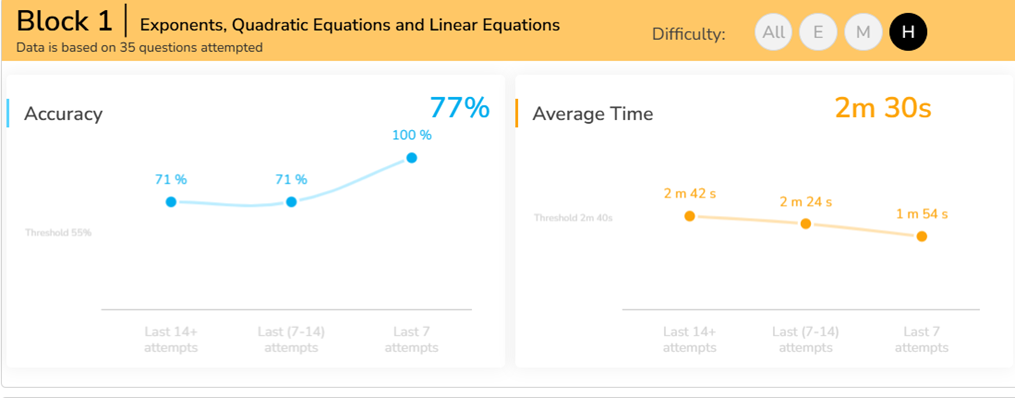
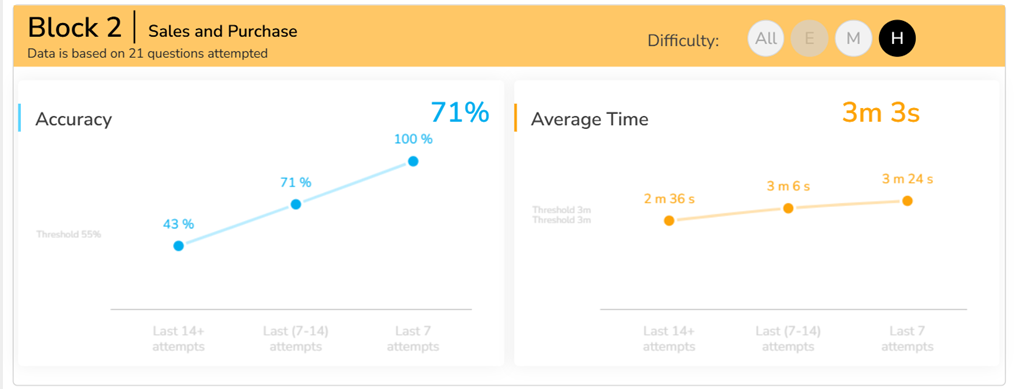
One of the biggest obstacles was my own assumptions about my strengths. I thought certain topics were easy because concepts felt familiar. The e-GMAT Scholaranium analytics completely broke these biases.
After completing questions, I could see detailed bifurcation of accuracy and time efficiency for each topic and subsection. Some areas where I felt confident showed poor performance. Other topics I feared turned out to be strengths once I actually practiced them. This data-driven insight was invaluable for targeted improvement.
The Cementing Stage Approach
The e-GMAT cementing quizzes were crucial for solidifying concepts. Here is my counterintuitive insight: if you score 100% during cementing, you have a bigger problem. You are not identifying your gaps.
My Target Scores
For medium questions, I aimed for 60-70% accuracy. For hard questions, 50-60%. Why? Those missed questions revealed exactly where I needed work. The e-GMAT course structure helped me catch these errors early rather than on test day.
Word Problems and Translation
Word problems challenged me significantly. While going through the e-GMAT course, I discovered that Verbal skills directly complement Quant translation ability. The answer to word problems is usually simple but the translation is difficult. Interestingly, my Verbal preparation improved my ability to parse complex Quant questions.
The Error Log That Made the Difference
The e-GMAT error log was my constant companion. Instead of doing 100 questions daily, I limited myself to 30 questions but spent equal time reviewing them. Every mistake went into my error log with the specific error type identified.
In the final days before my exam, I stopped doing new questions entirely. I just reviewed my error log repeatedly, making myself consciously aware of my patterns. When similar question types appeared on test day, that awareness kicked in automatically.
Test Day Time Management
For Q90, you cannot afford careless errors. I developed a 30-second rule: understand what the question asks within the first 30 seconds, then honestly assess whether I could solve it in the remaining time. If not, I marked it for review and moved on.
The first 10-12 questions tend to be more difficult and time-consuming. Recognizing this trap helped me stay calm and manage time strategically rather than getting stuck early.
Key Takeaways
- Understand the question before solving. Half your time should be comprehension.
- Use analytics to identify hidden weaknesses. Your assumptions may be wrong.
- Welcome mistakes during cementing. They reveal gaps early.
- Quality over quantity. 30 questions with thorough review beats 100 rushed attempts.
- Maintain an error log religiously. Review it before test day.
- Know when to move on. The 30-second assessment rule saves time.
Final Thoughts
The e-GMAT platform is completely self-sufficient. Following the course structure systematically delivers results without needing external help. For working professionals like me, 3-4 months of disciplined preparation with the right approach is enough. Do not overthink before starting, just be disciplined about following the process.
Attachment:
GMAT-Club-Forum-b12qncn6.png [ 64.81 KiB | Viewed 540 times ]
Attachment:
GMAT-Club-Forum-tapzid8d.png [ 57.03 KiB | Viewed 541 times ]
 29 Dec 2025, 12:43
Kudos
Bookmarks
Congrats on the 655! I wish you all the best with your applications.
 29 Dec 2025, 14:33
Kudos
Bookmarks
Hi Dynamo29,
Congratulations on achieving Q90 and a 655 overall! 🎉 This is a phenomenal score, and your journey from the Q85-88 plateau to Q90 is truly inspiring.
Reading through your post, I'm thrilled to see how effectively you leveraged the e-GMAT course to transform your approach. Your key insights align perfectly with the philosophy we've built our program around:
Understanding Over Calculation: You hit the nail on the head when you recognized that GMAT Quant tests problem-solving ability, not calculation speed. The realization that more than half your time should go into comprehension is exactly the mindset shift that separates 85th percentile scorers from 90th+ percentile scorers.
Data-Driven Improvement with Scholaranium:*I'm glad our analytics helped you break through your assumptions about your strengths and weaknesses. Many students fall into the trap of practicing topics they already know while avoiding their true pain points. The detailed bifurcation by accuracy and time efficiency is designed precisely for this purpose.
The Cementing Stage Insight:Your observation about 100% scores during cementing indicating a problem rather than success is brilliant! This counterintuitive insight shows real test-prep maturity.
Error Log Discipline: Limiting yourself to 30 questions daily with equal time for review is exactly the "quality over quantity" approach that drives sustainable improvement. The final days of reviewing error logs rather than doing new questions is a strategy we strongly advocate.
Word Problem Translation:The connection you made between Verbal skills and Quant word problem translation is an advanced insight that many students miss.
Your disciplined approach, combined with the 30-second rule for test day time management, demonstrates the strategic mindset that led to your success.
Wishing you the very best with your MBA applications! Your story will undoubtedly inspire many others on their GMAT journey.
Best,
The e-GMAT Team
Congratulations on achieving Q90 and a 655 overall! 🎉 This is a phenomenal score, and your journey from the Q85-88 plateau to Q90 is truly inspiring.
Reading through your post, I'm thrilled to see how effectively you leveraged the e-GMAT course to transform your approach. Your key insights align perfectly with the philosophy we've built our program around:
Understanding Over Calculation: You hit the nail on the head when you recognized that GMAT Quant tests problem-solving ability, not calculation speed. The realization that more than half your time should go into comprehension is exactly the mindset shift that separates 85th percentile scorers from 90th+ percentile scorers.
Data-Driven Improvement with Scholaranium:*I'm glad our analytics helped you break through your assumptions about your strengths and weaknesses. Many students fall into the trap of practicing topics they already know while avoiding their true pain points. The detailed bifurcation by accuracy and time efficiency is designed precisely for this purpose.
The Cementing Stage Insight:Your observation about 100% scores during cementing indicating a problem rather than success is brilliant! This counterintuitive insight shows real test-prep maturity.
Error Log Discipline: Limiting yourself to 30 questions daily with equal time for review is exactly the "quality over quantity" approach that drives sustainable improvement. The final days of reviewing error logs rather than doing new questions is a strategy we strongly advocate.
Word Problem Translation:The connection you made between Verbal skills and Quant word problem translation is an advanced insight that many students miss.
Your disciplined approach, combined with the 30-second rule for test day time management, demonstrates the strategic mindset that led to your success.
Wishing you the very best with your MBA applications! Your story will undoubtedly inspire many others on their GMAT journey.
Best,
The e-GMAT Team
Moderator:








