Events & Promotions
|
|

GMAT Club Daily Prep
Thank you for using the timer - this advanced tool can estimate your performance and suggest more practice questions. We have subscribed you to Daily Prep Questions via email.
Customized
for You
Track
Your Progress
Practice
Pays
Not interested in getting valuable practice questions and articles delivered to your email? No problem, unsubscribe here.
 Sep 04
10:00 AM PDT
-11:00 AM PDT
What does test anxiety really look like on the GMAT? For many test takers, it does not look like a panic attack. Instead, it shows up as brain fog, rereading, negative comparisons, mental noise.... Sep 02
01:00 PM EDT
-11:59 PM EDT
Take 30% off all study plans with code COURSEWORK - Expires on Monday 9/7 Sep 03
01:30 AM EDT
-02:30 AM EDT
At one point, she believed GMAT wasn’t for her. After scoring 595, self-doubt crept in and she questioned her potential. But instead of quitting, she made the right strategic changes. The result? A remarkable comeback to 695. Check out how Saakshi did it. Sep 06
09:30 AM EDT
-12:30 PM EST
Top scores are possible when you enroll in a powerful EA course, taught live online + 6 months access to TTP OnDemand video courses included! Perfect class schedule and easy course access for working professionals. Class starts Sundays Sept. 6, 2026.- Sep 07
12:01 AM PDT
-11:59 PM PDT
On the 7th, GMAT Club Tests will be Free! Including all the Quizzes, Questions, and Tests. 12 AM - 11:59 PM PDT  Sep 07
12:30 AM EDT
-01:30 AM EDT
Tejas studied hard but kept repeating the same mistakes. After 3 attempts at 645, a focused 4-week strategy helped him identify and fix what was holding him back—leading to a 695 with just 12–15 hours of study per week.- Sep 07
10:00 AM PDT
-11:00 AM PDT
A complete walkthrough of GMAT Club’s free 12-week GMAT study plan: what you study each week, how progress and goals are tracked, how the error log works, and how your practice unlocks paid tools at no cost. - Sep 09
07:00 AM PDT
-10:00 AM PDT
Meet AdComs and explore top Master’s programs - MiM, MiF, MSc, MSBA and more. - Application Fee Waivers - Free 1-Week of GMAT Club Tests: - Master's Application Toolkit - Grand Prize Giveaway - Sep 09
10:00 AM PDT
-11:00 AM PDT
Three MBA applications. Three rejections. No interview invites. A year later, Aman was admitted to Cambridge Judge, SMU, and IMD. In this episode of MBA Admit Stories, Aman shares how he rebuilt his MBA application...  Sep 10
08:00 PM PDT
-09:00 PM PDT
Free- full-length test + 15 concept videos + 150+ short videos + study plan! Sep 15
07:00 PM EDT
-09:00 PM EST
Elite scores are possible when you enroll in a powerful GMAT course, taught live online + 6 months access to TTP OnDemand video courses included! Class starts Tues/Thurs Sept. 15, 2026 - Nov. 15, 2027, 7:00pm-9:00pm EST Sep 21
08:00 PM EDT
-10:00 PM EDT
Boost your GMAT score in less than one month in a live online class + 6 months access to TTP OnDemand video courses included! Class starts Mon, Tues, Wed, Thur, Fri Sept. 21, 2026 - Oct. 9, 2027, 7:00pm-10:00pm EST


 18 Feb 2026, 05:42
Kudos
Bookmarks
When I first took my diagnostic mock, the score hit me like a brick wall: 555. I stared at the screen trying to process how much work lay ahead. Verbal was shockingly low, DI was a complete unknown, and even Quant, which I thought was my strong suit, needed polishing. The hardest part wasn't the score itself; it was the overwhelming question of where to even begin when everything seemed to need fixing.
I knew I needed structure. Self-studying with scattered resources wasn't going to cut it. That's when I switched to e-GMAT, and honestly, the structured course framework changed everything. Instead of drowning in a sea of topics, I finally had a clear path forward.
Verbal: From Weakness to Strength
Critical Reasoning – The Logical Shift
CR was my biggest pain point. I kept getting confused between two answer choices and couldn't figure out why my accuracy was so inconsistent. While going through the e-GMAT course, I discovered that I was approaching CR problems as language exercises rather than logical puzzles. The e-GMAT course introduced me to a structured approach of breaking down arguments into their core components – identifying the conclusion, the evidence, and the gap between them. Once I started looking at each problem purely through a logical lens and stopped getting caught up in grammatical nuances, everything clicked. My accuracy on hard CR questions improved significantly within weeks.
Reading Comprehension – Mental Mapping
For RC, my initial mistake was trying to understand and retain every single word. This killed my reading speed and left me scrambling during passages. The e-GMAT course taught me to build a mental map while reading – focusing on where information lies rather than memorizing details. I stopped reading to understand every sentence and started reading to map the structure: main idea, author's tone, supporting arguments, and paragraph transitions. This approach also built naturally on my improved CR skills, since RC questions often test the same logical reasoning in a longer format.
Quant Mastery – Polishing Strengths to Q88
Quant was my confident zone, but I realized early that being "good" wasn't enough. I needed to be precise. My two weak areas were Word Problems and Advanced Topics like permutation, combination, and probability.
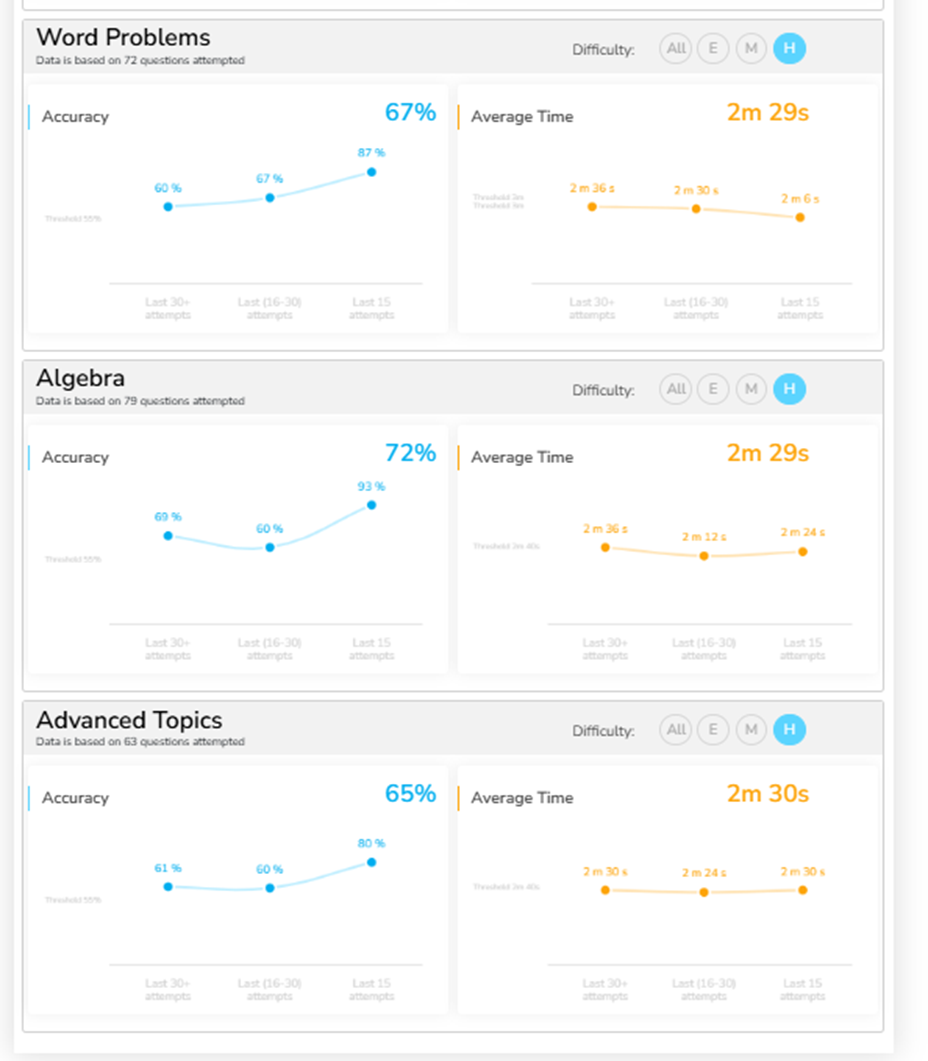
For Word Problems, the e-GMAT course helped me recognize that I was missing hidden constraints in problem stems. I'd read "real numbers" but by the time I reached my answer, I'd forgotten what I was actually solving for. The course drilled the habit of writing down constraints and what the question is actually asking before diving into calculations. My WP accuracy jumped from 60% to 87%, and my time per question dropped from 2:36 to 2:06.
For Advanced Topics, the e-GMAT modules broke down intimidating concepts into digestible building blocks. The variety of questions available on e-GMAT Scholaranium was all-encompassing. Through repeated practice, I identified the 10-12 question patterns that kept recurring and made sure I could nail those consistently. My hard accuracy in algebra climbed from 69% to 93%.
The Bridge: Cementing to Sectional to Full Mocks
One of the trickiest transitions was moving from e-GMAT's Scholaranium cementing quizzes to sectional mocks. During cementing, your brain trains for 25-30 minute bursts. But sectionals demand an hour of sustained focus, and full mocks need two and a half hours. What I really appreciated was how the e-GMAT platform strategically eases you in. I started using NEURON for 15-20 minute warm-up sessions before cementing, gradually building my attention span. For the sectional-to-full-mock jump, I continued this layered approach until sitting for the full duration felt natural.
Key Takeaways
- Consistency beats intensity – even one focused hour daily compounds massively over weeks
- Write down constraints before solving – especially for Word Problems
- Treat CR as pure logic, not a language exercise
- Build endurance gradually – don't jump from 30-minute quizzes to 2.5-hour mocks
- Trust the process and follow the PSP structure
Final Thoughts
Going from 555 to 655 felt impossible at the start, but breaking it into manageable pieces made all the difference. The e-GMAT platform is completely self-sufficient. Following the course structure systematically delivers results without needing external help. The analytics in Scholaranium helped me track exactly where I was improving and where I still had gaps, so I never wasted time on areas that were already strong. If you commit to the process, follow the PSP, and show up consistently even when motivation dips, the scores will follow. Trust the structure, and let consistency do the heavy lifting.
Attachment:
GMAT-Club-Forum-rzat8yq8.png [ 157.64 KiB | Viewed 448 times ]

 18 Feb 2026, 07:00
Kudos
Bookmarks
that is a great progress. I have a question though, are you contend with the marks you got and which school will you be applying
Suhani5236
 19 Feb 2026, 01:21
Kudos
Bookmarks
Congratulations for score all the best with applications