Events & Promotions
|
|

GMAT Club Daily Prep
Thank you for using the timer - this advanced tool can estimate your performance and suggest more practice questions. We have subscribed you to Daily Prep Questions via email.
Customized
for You
Track
Your Progress
Practice
Pays
Not interested in getting valuable practice questions and articles delivered to your email? No problem, unsubscribe here.
 Sep 04
10:00 AM PDT
-11:00 AM PDT
What does test anxiety really look like on the GMAT? For many test takers, it does not look like a panic attack. Instead, it shows up as brain fog, rereading, negative comparisons, mental noise.... Sep 02
01:00 PM EDT
-11:59 PM EDT
Take 30% off all study plans with code COURSEWORK - Expires on Monday 9/7 Sep 04
01:30 AM EDT
-02:30 AM EDT
This Labor Day, turn your hard work into real score gains. From 615→715 in 15 days to 705 in 30 days, our students prove what's possible with personalized, expert guidance. Save up to 25% on 1-on-1 tutoring. Sep 06
09:30 AM EDT
-12:30 PM EST
Top scores are possible when you enroll in a powerful EA course, taught live online + 6 months access to TTP OnDemand video courses included! Perfect class schedule and easy course access for working professionals. Class starts Sundays Sept. 6, 2026.- Sep 07
12:01 AM PDT
-11:59 PM PDT
On the 7th, GMAT Club Tests will be Free! Including all the Quizzes, Questions, and Tests. 12 AM - 11:59 PM PDT  Sep 07
12:30 AM EDT
-01:30 AM EDT
Tejas studied hard but kept repeating the same mistakes. After 3 attempts at 645, a focused 4-week strategy helped him identify and fix what was holding him back—leading to a 695 with just 12–15 hours of study per week.- Sep 07
10:00 AM PDT
-11:00 AM PDT
A complete walkthrough of GMAT Club’s free 12-week GMAT study plan: what you study each week, how progress and goals are tracked, how the error log works, and how your practice unlocks paid tools at no cost. - Sep 09
07:00 AM PDT
-10:00 AM PDT
Meet AdComs and explore top Master’s programs - MiM, MiF, MSc, MSBA and more. - Application Fee Waivers - Free 1-Week of GMAT Club Tests: - Master's Application Toolkit - Grand Prize Giveaway - Sep 09
10:00 AM PDT
-11:00 AM PDT
Three MBA applications. Three rejections. No interview invites. A year later, Aman was admitted to Cambridge Judge, SMU, and IMD. In this episode of MBA Admit Stories, Aman shares how he rebuilt his MBA application...  Sep 10
08:00 PM PDT
-09:00 PM PDT
Free- full-length test + 15 concept videos + 150+ short videos + study plan! Sep 15
07:00 PM EDT
-09:00 PM EST
Elite scores are possible when you enroll in a powerful GMAT course, taught live online + 6 months access to TTP OnDemand video courses included! Class starts Tues/Thurs Sept. 15, 2026 - Nov. 15, 2027, 7:00pm-9:00pm EST Sep 21
08:00 PM EDT
-10:00 PM EDT
Boost your GMAT score in less than one month in a live online class + 6 months access to TTP OnDemand video courses included! Class starts Mon, Tues, Wed, Thur, Fri Sept. 21, 2026 - Oct. 9, 2027, 7:00pm-10:00pm EST



 22 Mar 2026, 03:33
Kudos
Bookmarks
Let me be straight with you: I am not someone who was going to crush the GMAT naturally. I come from Portugal, I studied engineering, and when I first sat down to take an official practice test on my own — zero prep, no plan — I got a 555. That number sat with me for a while.
I told myself it would be a one or two month thing. Intensive prep, done. Easy. I was very, very wrong about that.
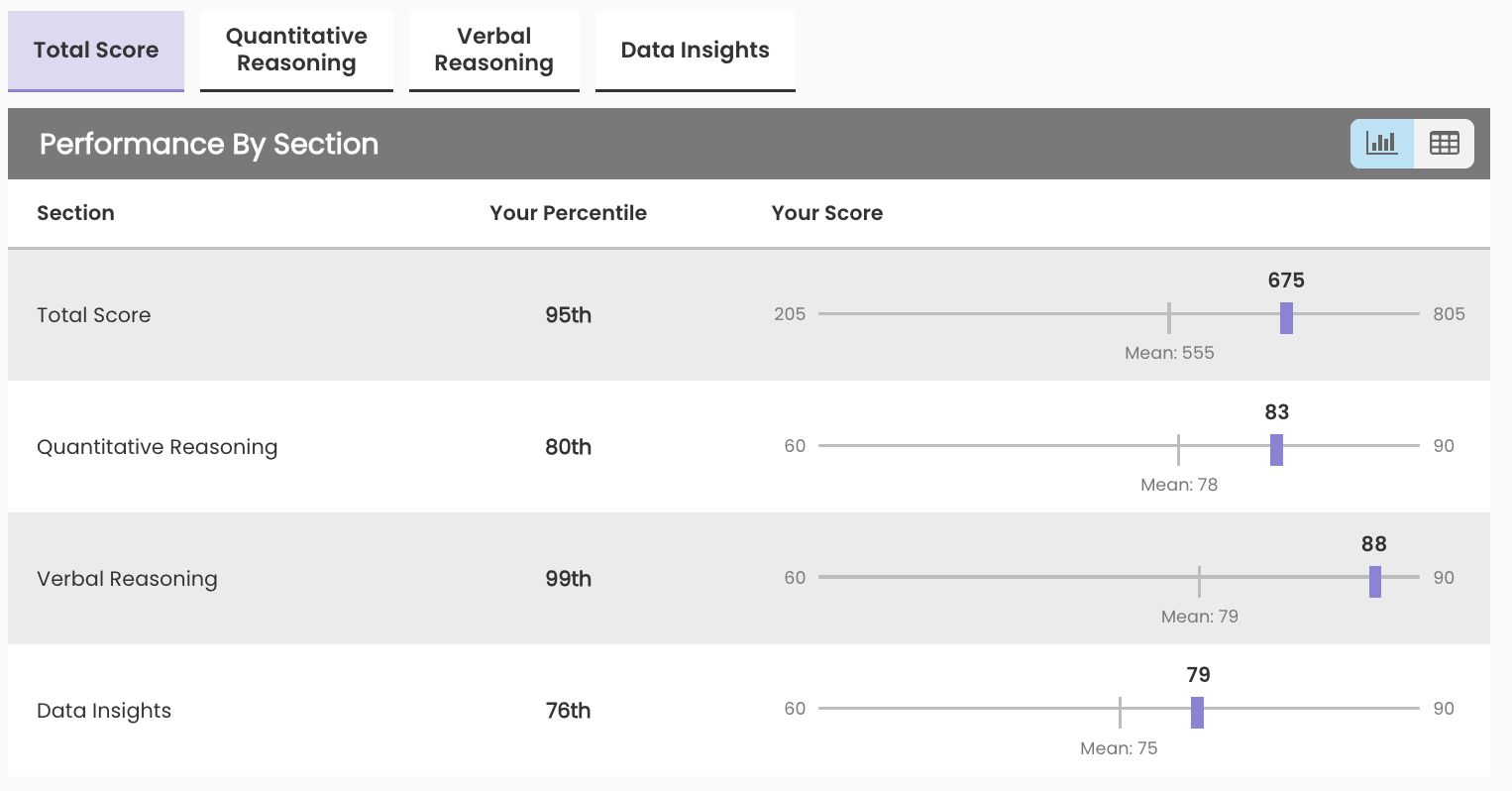
But here I am, six months later, with a 675 (V88,Q83,DI79) and a 95th percentile — and honestly, a lot of the credit goes to understanding one simple thing: the GMAT is not a knowledge test. It's a pattern test. Once I accepted that, everything else started to make sense.
Why I Didn't Try to Figure This Out Alone
I was doing what a lot of people do — preparing by myself using official materials, trying to categorize question types from scratch, building my own system. And I was failing at it. Not because I wasn't working hard, but because I was wasting effort reinventing something that already existed.
Later I actually came across an e-GMAT debrief interview online — someone sharing their story, just like this one — and thought, if they've already mapped all of this out, why am I spending weeks building a system from nothing? That was the moment I signed up.
What I didn't expect was how structured the foundation stage would be. The course doesn't just throw questions at you. It walks you through concepts in bite-sized chunks, then makes you apply each one before moving forward. There's a real logic to the sequence — concept files, then learning activities, then practice. And the learning level grades that come after each module kept me honest about whether I'd actually internalized something or just read it.
The CR Problem — My Worst Nightmare, Eventually My Best Section (100%ile)
I want to talk about CR first because it was genuinely the hardest part of my prep, and also where I changed the most.
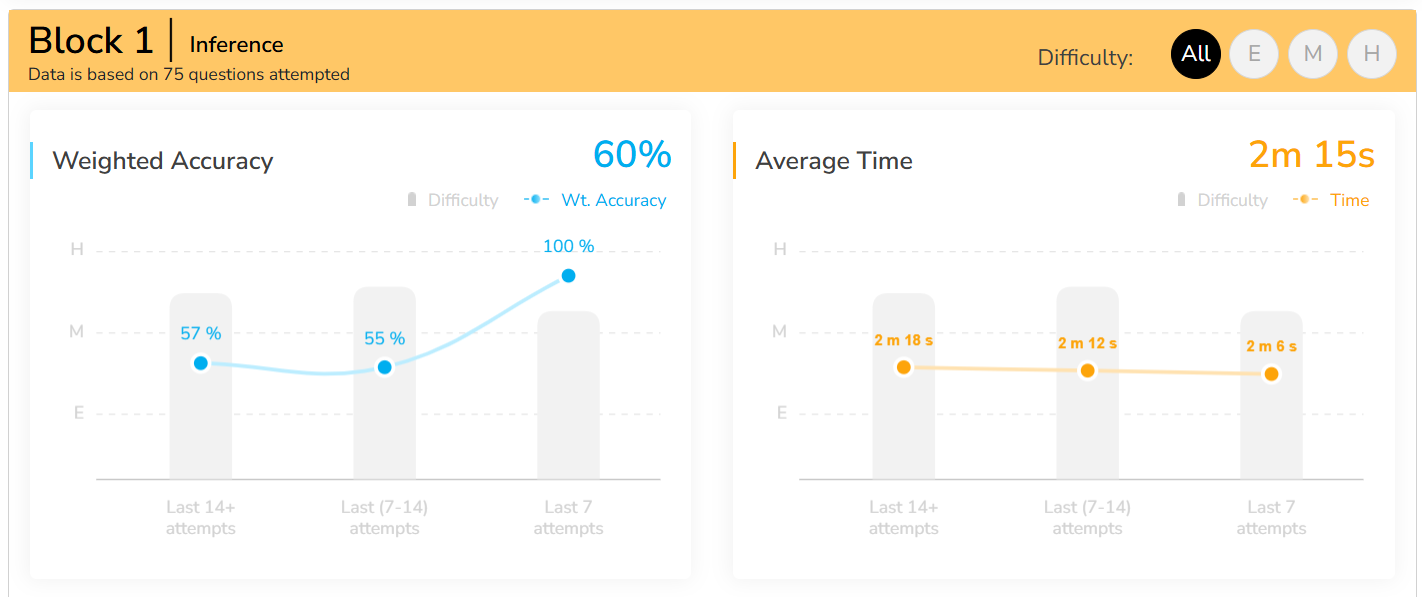
Around November and December, I was stuck. I couldn't pass the medium cementing quizzes on Scholaranium. Stuck at 50% accuracy — on medium questions. Not hard, medium. That is a really demoralizing place to be when you've been studying for weeks. I remember thinking, maybe this is just not for me.
What I did was give myself a break from it. I switched over to quant for a while, let the CR material settle, and when I came back I went through the application files again — slowly. Not to get through them faster, but to actually pay attention to the structure of every argument. What's the conclusion? What's the assumption holding it together? What kind of weakness would break it?
And then something clicked. I genuinely can't explain it better than that. One week I was stuck at 50%, and then I was hitting 70-80% on the hard cementing quizzes. It wasn't that I did anything dramatically different. I think I just spent long enough living inside the material that the patterns became obvious. The words change, the scenarios change — but underneath, it's the same structures repeating themselves.
The pre-thinking framework that e-GMAT teaches for CR was the key tool here. Before looking at the answer choices, I'd force myself to predict what a correct answer would need to do. That single discipline — pausing to think before jumping to the options — probably accounted for most of my improvement on that section.
Quant: Just practice won’t help
I thought quant was going to be my safe section. I was strong in math back in school. But the GMAT has a way of humbling you.
Here's what I did wrong at first: I just did questions. All day. As many as I could. I actually ran out of questions in certain topics — which is saying something given how many e-GMAT has in Scholaranium. And I wasn't improving. I was just doing the same type of wrong thing, faster.
The error log provided on the platform changed that. Not just keeping one, but actually using it. After each wrong answer, I'd sit with it and ask — what type of mistake was this? Was I rushing? Did I miss a constraint? Did I not write out the given information before starting? The pattern I kept seeing was that I was trying to solve problems before I'd fully understood them. I was trying to be fast, and that was making me slow.
The process skill that really stuck with me was simple: read the question, write out the constraints, only then start solving. It sounds obvious. But in test conditions when you're watching the clock, your brain wants to skip that step. Training myself not to skip it was probably the most valuable thing I did for quant.
In my second attempt, I handled quant the same way — calm, methodical, even when I was low on time. Read. Write. Solve. And it held up.
Data Insights — Decent Progress, a Tough Test Day
DI was never my biggest issue. I went through the course content, worked through the Owning the Dataset approach, and got comfortable with the different question types. My average on mocks was consistently around 81-83 for DI, so going into the exam I felt fairly confident there.
On test day, I hit one question that was genuinely hard and it threw me a bit. I think that disrupted my rhythm more than it should have. The score came in lower than my mock average and landed up with DI79, which was frustrating — but it also taught me something. Confidence in a section doesn't mean you're immune to a hard question derailing you mid-section. Managing that moment is its own skill.
The Mock Rollercoaster
My first full mock after completing most of the course: 575-600. I sat there for a moment after seeing that thinking, all that work and I'm basically back where I started.
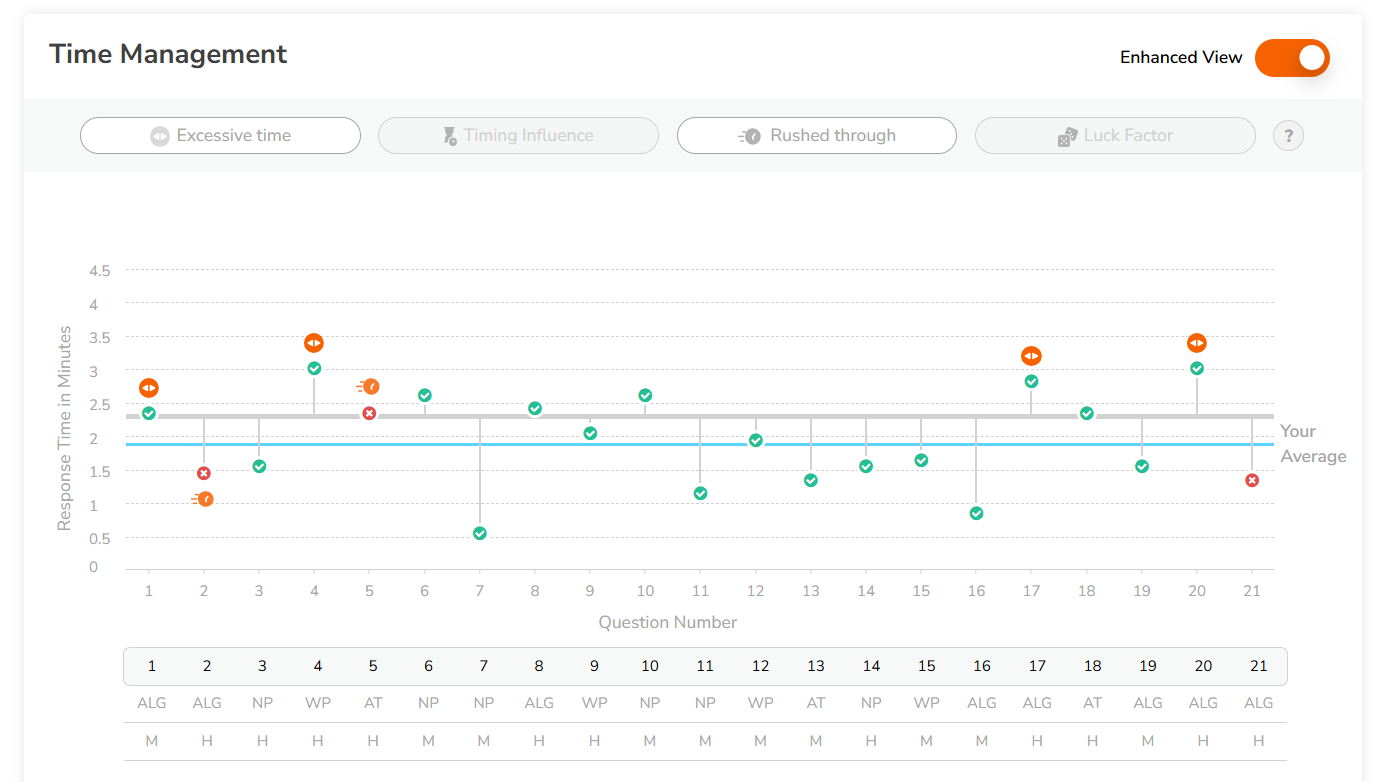
But the scores moved. Slowly and then all at once. The sectional mocks on e-GMAT were where a lot of the foundational work finally showed up — separately testing verbal and quant helped me see where my real weaknesses still were, rather than having them masked by a strong section. The analytics at the end of each test gave me great insights on the type of questions I was getting wrong, if I was overspending time on certain questions, rushing through which helped me improve.
One thing I got wrong early with sectionals was volume. I thought I'd improve faster by doing five or six a day. Instead I was exhausted and sloppy by the third one. Cutting down to one or two per day, with proper rest in between, gave me much better data and kept my stamina intact. More sessions wasn't the answer — better sessions were.
About a week before my second attempt, I took a mock and scored around 80th percentile. That sent me into a spiral. Then I took an official mock and hit 95th percentile. That's the GMAT experience — variance is real, and at some point you just have to make peace with it.
The First Attempt, and What Actually Mattered After It
My first attempt didn't go as planned. One section went sideways, and when that happens on the GMAT it has a way of carrying into the next. I came out knowing I hadn't shown what I'd built.
Here's the thing though — my mentor Abha helped me see that the work was already done. In the two weeks between attempts, we didn't go back to fundamentals or learn anything new. We just did sectionals and full-length mocks, working on test-taking discipline specifically: pacing, mental stamina, switching modes between question types. The foundation was solid. It was the execution that needed calibrating.
That reframe — the work is already there, you just need to show it — made a real difference going into attempt two.
Test Day: Madrid, Coffee, and No Notes
I'm from Portugal, and my nearest test center didn't have open slots, so I traveled to Madrid to take the exam. One hour before it started, I had a coffee — I'd deliberately avoided caffeine in the days leading up so it would hit harder. That's my version of test day prep.
I did verbal first, then quant, then DI. For verbal, I didn't take a single note during the exam. For CR, I ran the pre-thinking process entirely in my head. For RC, I spent real time on the passage upfront and trusted that the detail questions would come faster as a result. That approach worked.
Quant felt uncertain. The first question didn't seem hard, which made me think my verbal had gone terribly. I bookmarked a few questions I wasn't sure about and kept moving. I grabbed food during the break, reset for a few minutes, and went into DI trying not to carry any of the anxiety from earlier sections.
When I saw the results — 675, V88 — I couldn't process it immediately. Six months is a long time to wait for a number.
One suggestion— don't quit after one bad attempt. My first test didn't reflect what I'd built. If I had stopped there, all those months of work would have counted for nothing. The score that ends up on your application is the one you keep going for.

GMAT-Club-Forum-i2ayn9rv.png [ 94.54 KiB | Viewed 728 times ]

GMAT-Club-Forum-j8klp646.png [ 68.46 KiB | Viewed 704 times ]

GMAT-Club-Forum-dmjog8x2.png [ 70.21 KiB | Viewed 650 times ]
I told myself it would be a one or two month thing. Intensive prep, done. Easy. I was very, very wrong about that.
But here I am, six months later, with a 675 (V88,Q83,DI79) and a 95th percentile — and honestly, a lot of the credit goes to understanding one simple thing: the GMAT is not a knowledge test. It's a pattern test. Once I accepted that, everything else started to make sense.
Why I Didn't Try to Figure This Out Alone
I was doing what a lot of people do — preparing by myself using official materials, trying to categorize question types from scratch, building my own system. And I was failing at it. Not because I wasn't working hard, but because I was wasting effort reinventing something that already existed.
Later I actually came across an e-GMAT debrief interview online — someone sharing their story, just like this one — and thought, if they've already mapped all of this out, why am I spending weeks building a system from nothing? That was the moment I signed up.
What I didn't expect was how structured the foundation stage would be. The course doesn't just throw questions at you. It walks you through concepts in bite-sized chunks, then makes you apply each one before moving forward. There's a real logic to the sequence — concept files, then learning activities, then practice. And the learning level grades that come after each module kept me honest about whether I'd actually internalized something or just read it.
The CR Problem — My Worst Nightmare, Eventually My Best Section (100%ile)
I want to talk about CR first because it was genuinely the hardest part of my prep, and also where I changed the most.
Around November and December, I was stuck. I couldn't pass the medium cementing quizzes on Scholaranium. Stuck at 50% accuracy — on medium questions. Not hard, medium. That is a really demoralizing place to be when you've been studying for weeks. I remember thinking, maybe this is just not for me.
What I did was give myself a break from it. I switched over to quant for a while, let the CR material settle, and when I came back I went through the application files again — slowly. Not to get through them faster, but to actually pay attention to the structure of every argument. What's the conclusion? What's the assumption holding it together? What kind of weakness would break it?
And then something clicked. I genuinely can't explain it better than that. One week I was stuck at 50%, and then I was hitting 70-80% on the hard cementing quizzes. It wasn't that I did anything dramatically different. I think I just spent long enough living inside the material that the patterns became obvious. The words change, the scenarios change — but underneath, it's the same structures repeating themselves.
The pre-thinking framework that e-GMAT teaches for CR was the key tool here. Before looking at the answer choices, I'd force myself to predict what a correct answer would need to do. That single discipline — pausing to think before jumping to the options — probably accounted for most of my improvement on that section.
Quant: Just practice won’t help
I thought quant was going to be my safe section. I was strong in math back in school. But the GMAT has a way of humbling you.
Here's what I did wrong at first: I just did questions. All day. As many as I could. I actually ran out of questions in certain topics — which is saying something given how many e-GMAT has in Scholaranium. And I wasn't improving. I was just doing the same type of wrong thing, faster.
The error log provided on the platform changed that. Not just keeping one, but actually using it. After each wrong answer, I'd sit with it and ask — what type of mistake was this? Was I rushing? Did I miss a constraint? Did I not write out the given information before starting? The pattern I kept seeing was that I was trying to solve problems before I'd fully understood them. I was trying to be fast, and that was making me slow.
The process skill that really stuck with me was simple: read the question, write out the constraints, only then start solving. It sounds obvious. But in test conditions when you're watching the clock, your brain wants to skip that step. Training myself not to skip it was probably the most valuable thing I did for quant.
In my second attempt, I handled quant the same way — calm, methodical, even when I was low on time. Read. Write. Solve. And it held up.
Data Insights — Decent Progress, a Tough Test Day
DI was never my biggest issue. I went through the course content, worked through the Owning the Dataset approach, and got comfortable with the different question types. My average on mocks was consistently around 81-83 for DI, so going into the exam I felt fairly confident there.
On test day, I hit one question that was genuinely hard and it threw me a bit. I think that disrupted my rhythm more than it should have. The score came in lower than my mock average and landed up with DI79, which was frustrating — but it also taught me something. Confidence in a section doesn't mean you're immune to a hard question derailing you mid-section. Managing that moment is its own skill.
The Mock Rollercoaster
My first full mock after completing most of the course: 575-600. I sat there for a moment after seeing that thinking, all that work and I'm basically back where I started.
But the scores moved. Slowly and then all at once. The sectional mocks on e-GMAT were where a lot of the foundational work finally showed up — separately testing verbal and quant helped me see where my real weaknesses still were, rather than having them masked by a strong section. The analytics at the end of each test gave me great insights on the type of questions I was getting wrong, if I was overspending time on certain questions, rushing through which helped me improve.
One thing I got wrong early with sectionals was volume. I thought I'd improve faster by doing five or six a day. Instead I was exhausted and sloppy by the third one. Cutting down to one or two per day, with proper rest in between, gave me much better data and kept my stamina intact. More sessions wasn't the answer — better sessions were.
About a week before my second attempt, I took a mock and scored around 80th percentile. That sent me into a spiral. Then I took an official mock and hit 95th percentile. That's the GMAT experience — variance is real, and at some point you just have to make peace with it.
The First Attempt, and What Actually Mattered After It
My first attempt didn't go as planned. One section went sideways, and when that happens on the GMAT it has a way of carrying into the next. I came out knowing I hadn't shown what I'd built.
Here's the thing though — my mentor Abha helped me see that the work was already done. In the two weeks between attempts, we didn't go back to fundamentals or learn anything new. We just did sectionals and full-length mocks, working on test-taking discipline specifically: pacing, mental stamina, switching modes between question types. The foundation was solid. It was the execution that needed calibrating.
That reframe — the work is already there, you just need to show it — made a real difference going into attempt two.
Test Day: Madrid, Coffee, and No Notes
I'm from Portugal, and my nearest test center didn't have open slots, so I traveled to Madrid to take the exam. One hour before it started, I had a coffee — I'd deliberately avoided caffeine in the days leading up so it would hit harder. That's my version of test day prep.
I did verbal first, then quant, then DI. For verbal, I didn't take a single note during the exam. For CR, I ran the pre-thinking process entirely in my head. For RC, I spent real time on the passage upfront and trusted that the detail questions would come faster as a result. That approach worked.
Quant felt uncertain. The first question didn't seem hard, which made me think my verbal had gone terribly. I bookmarked a few questions I wasn't sure about and kept moving. I grabbed food during the break, reset for a few minutes, and went into DI trying not to carry any of the anxiety from earlier sections.
When I saw the results — 675, V88 — I couldn't process it immediately. Six months is a long time to wait for a number.
One suggestion— don't quit after one bad attempt. My first test didn't reflect what I'd built. If I had stopped there, all those months of work would have counted for nothing. The score that ends up on your application is the one you keep going for.
Attachment:
GMAT-Club-Forum-i2ayn9rv.png [ 94.54 KiB | Viewed 728 times ]
Attachment:
GMAT-Club-Forum-j8klp646.png [ 68.46 KiB | Viewed 704 times ]
Attachment:
GMAT-Club-Forum-dmjog8x2.png [ 70.21 KiB | Viewed 650 times ]
 23 Mar 2026, 07:44
Kudos
Bookmarks
Congratulations on the 120-point the score increase! I wish you all the best with your applications.
Moderator:








