Events & Promotions
|
|

GMAT Club Daily Prep
Thank you for using the timer - this advanced tool can estimate your performance and suggest more practice questions. We have subscribed you to Daily Prep Questions via email.
Customized
for You
Track
Your Progress
Practice
Pays
Not interested in getting valuable practice questions and articles delivered to your email? No problem, unsubscribe here.
 Sep 02
12:30 AM EDT
-01:30 AM EDT
Thought your job leaves no time for GMAT prep? After multiple GMAT attempts and a demanding consulting job, Kshitij improved to 695 in under 2 months. Learn the mindset shifts, study strategy, and execution changes that made the breakthrough possible. Sep 02
08:00 PM PDT
-09:00 PM PDT
Video explanations + diagnosis of 10 weakest areas + 150+ short videos + study plan! Aug 27
10:00 AM EDT
-11:00 AM EDT
We’ve worked incredibly hard to build TTP into the best test prep experience possible, and it would mean a lot to us to win Newsweek’s 2026 Readers’ Choice Award for Best Test Prep. If TTP has helped you, we’d be incredibly grateful for your vote. Sep 03
01:30 AM EDT
-02:30 AM EDT
At one point, she believed GMAT wasn’t for her. After scoring 595, self-doubt crept in and she questioned her potential. But instead of quitting, she made the right strategic changes. The result? A remarkable comeback to 695. Check out how Saakshi did it. Sep 04
10:00 AM PDT
-11:00 AM PDT
What does test anxiety really look like on the GMAT? For many test takers, it does not look like a panic attack. Instead, it shows up as brain fog, rereading, negative comparisons, mental noise.... Sep 06
09:30 AM EDT
-12:30 PM EST
Top scores are possible when you enroll in a powerful EA course, taught live online + 6 months access to TTP OnDemand video courses included! Perfect class schedule and easy course access for working professionals. Class starts Sundays Sept. 6, 2026.- Sep 07
12:01 AM PDT
-11:59 PM PDT
On the 7th, GMAT Club Tests will be Free! Including all the Quizzes, Questions, and Tests. 12 AM - 11:59 PM PDT - Sep 09
07:00 AM PDT
-10:00 AM PDT
Meet AdComs and explore top Master’s programs - MiM, MiF, MSc, MSBA and more. - Application Fee Waivers - Free 1-Week of GMAT Club Tests: - Master's Application Toolkit - Grand Prize Giveaway  Sep 15
07:00 PM EDT
-09:00 PM EST
Elite scores are possible when you enroll in a powerful GMAT course, taught live online + 6 months access to TTP OnDemand video courses included! Class starts Tues/Thurs Sept. 15, 2026 - Nov. 15, 2027, 7:00pm-9:00pm EST Sep 21
08:00 PM EDT
-10:00 PM EDT
Boost your GMAT score in less than one month in a live online class + 6 months access to TTP OnDemand video courses included! Class starts Mon, Tues, Wed, Thur, Fri Sept. 21, 2026 - Oct. 9, 2027, 7:00pm-10:00pm EST



 10 Apr 2026, 04:07
Kudos
Bookmarks
The 675 was good. But it wasn't enough — not because schools wouldn't accept it, but because I knew things had gone wrong that day. Careless errors in Quant that had no business being there. Inconsistencies I hadn't ironed out. Once you know there's more in you, it's very difficult to just leave it there. So this is the second chapter of a journey that started from a 455 and ended at a 715 — V84, Q90 (100th percentile), DI83.
The Problem: Good But Not Consistent
Going from 675 to 700+ is a different challenge from anything earlier in the journey. The content knowledge is there. What stood between me and a higher score was inconsistency. I'd sometimes hit Q89 in sectionals, then drop to an 83 or 84. At 700+, the margin for error is almost zero. While going through the e-GMAT course analytics and reviewing my Scholaranium data, I identified two things driving the variance.
The first was execution. In Quant, I was finishing sectionals with 10 to 14 minutes left. The speed came from rushing, and rushing meant skipping words. On one sectional that still haunts me a little, I solved for X when the question asked for 100 minus X. I did the entire problem correctly and still got it wrong. The second was mental — Critical Reasoning had always been a strength, but I started second-guessing answers I'd already correctly solved, talking myself out of the right option.
Fixing the Quant Ceiling
Slowing Down to Speed Up
The first shift was slowing down. While going through the e-GMAT course, I retrained myself to read every word of every problem and write down exactly what the question was asking before solving. That habit specifically made a big difference — when you note "solve for 100 - X" at the top of your scratch work, you can't accidentally answer X at the end.
Surgical Gap Analysis
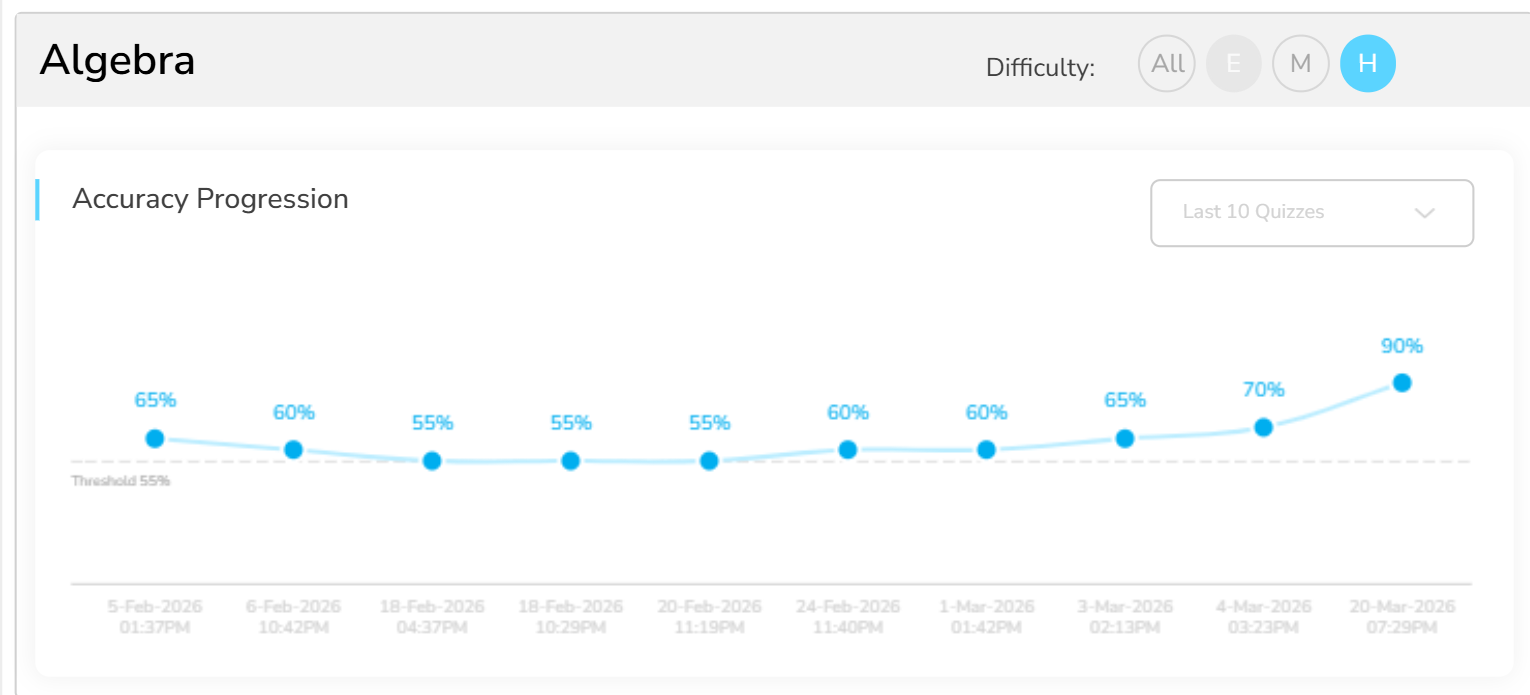
The second shift was targeting weak pockets, not weak sections. The e-GMAT Scholaranium cementing quizzes were crucial here — I built focused sets around precise sub-topic gaps at harder difficulty and drilled them until those mistakes disappeared from my e-GMAT error log. Knowing it's not "Quant" that's the problem, but specifically "this sub-topic in this context," is what separates preparation at this level from everything else. On test day, I got stuck early, flagged the question, finished the section with five minutes left, came back, and changed to the correct answer. Q90.
Data Insights: From Weakness to 100th Percentile on TPA
Two-part analysis had always been my most uncomfortable question type — not because the reasoning was beyond me, but because the time pressure was brutal. What changed was developing a reliable method through the e-GMAT DI course structure — it's brilliantly organized — and committing to it completely. I stopped improvising and set a mental time limit: if I don't see a clear path within a defined window, I move on. That discipline is what allowed me to score 100th percentile on TPA — something I honestly didn't expect. The last five or six DI questions were affected by construction noise outside, and I dropped some points there. But I made a deliberate choice not to let it colour the next section.
The Mock Journey and the Mental Game
This time I stayed consistently in the 700s throughout the final preparation phase — completely different from my previous attempt, where scores were volatile right up to test day. I developed a mental reset technique: slow breath in, a pause of a couple of seconds, then a slow exhale. Whatever question I'd just answered stopped mattering. What I really appreciated was how the e-GMAT platform strategically eases you in — starting with condensed sectional mocks before the full Sigma-X mocks — so this discipline could be built gradually and tested under realistic conditions.
The Last Mile Push: Where It All Came Together
I want to give specific credit to e-GMAT's Last Mile Push (LMP) mentorship program, and to my mentor Dhruv Joshi in particular. The LMP is where the platform's analytics and one-on-one mentoring meet — and for the 675 to 715 phase, that combination was essential. Dhruv was the one who helped me see that my Quant problem wasn't knowledge, it was process. He identified the rushing pattern in my sectional data, pushed me to slow down and write down what each question was asking, and helped me build the sub-topic drill plan that closed my remaining gaps. Beyond the technical work, Dhruv also helped me develop the mental discipline to release difficult questions mid-exam rather than spiralling on them. His weekly reviews ensured I was correcting patterns, not just noting them. If you're in the 650–680 range and know there's more in you, the LMP is the most targeted way to find and fix exactly what's holding you back.
Final Thoughts
A 715 after a 455 is a 260-point improvement. It wasn't a smooth road. The e-GMAT platform is completely self-sufficient — the Scholaranium cementing quizzes, NEURON OG practice, sectional mocks, and Sigma-X full-lengths give you everything you need to find your gaps and close them precisely. The ceiling is usually higher than you think. The 675 felt like the limit for a while. It wasn't. The difference between a 675 and a 715 isn't a different person — it's a more accurate understanding of exactly what needs to change.
Attachment:
GMAT-Club-Forum-ztpu7u6p.png [ 98.54 KiB | Viewed 2016 times ]
 10 Apr 2026, 06:20
Kudos
Bookmarks
Congrats on the 715! I wish you all the best with your applications.
 10 Apr 2026, 09:57
Kudos
Bookmarks
Congratulations and all the best for rest of the journey
giorgiozacheo










