Events & Promotions
| Last visit was: 20 Sep 2026, 18:49 |
It is currently 20 Sep 2026, 18:49 |
|
|

GMAT Club Daily Prep
Thank you for using the timer - this advanced tool can estimate your performance and suggest more practice questions. We have subscribed you to Daily Prep Questions via email.
Customized
for You
Track
Your Progress
Practice
Pays
Not interested in getting valuable practice questions and articles delivered to your email? No problem, unsubscribe here.
 Sep 18
10:00 AM IST
-11:00 PM IST
Start your journey with a fully customized action plan and work with a dedicated mentor to achieve a 735+ score. Sep 21
07:00 PM EDT
-10:00 PM EDT
Boost your GMAT score in less than one month in a live online class + 6 months access to TTP OnDemand video courses included! Sep 26
01:00 PM EDT
-04:00 PM EDT
Top scores are possible when you enroll in a powerful GMAT course, taught live online + 6 months access to TTP OnDemand video courses included. Class starts Saturdays Sept. 26, 2026 - Dec. 19, 2026, 1:00pm-4:00pm ES

 Updated on: 15 Dec 2020, 23:48
Originally posted by guerrero25 on 06 Apr 2013, 05:08.
Last edited by Bunuel on 15 Dec 2020, 23:48, edited 2 times in total.
Last edited by Bunuel on 15 Dec 2020, 23:48, edited 2 times in total.
Renamed the topic and edited the question.
Kudos
Bookmarks


C
Be sure to select an answer first to save it in the Error Log before revealing the correct answer (OA)!
Difficulty:
 45%
(medium)
45%
(medium)
Question Stats:
69% (02:20) correct 31%
(02:09)
wrong
based on 622
sessions
31%
(02:09)
wrong
based on 622
sessions
History
Date
Time
Result
Not Attempted Yet
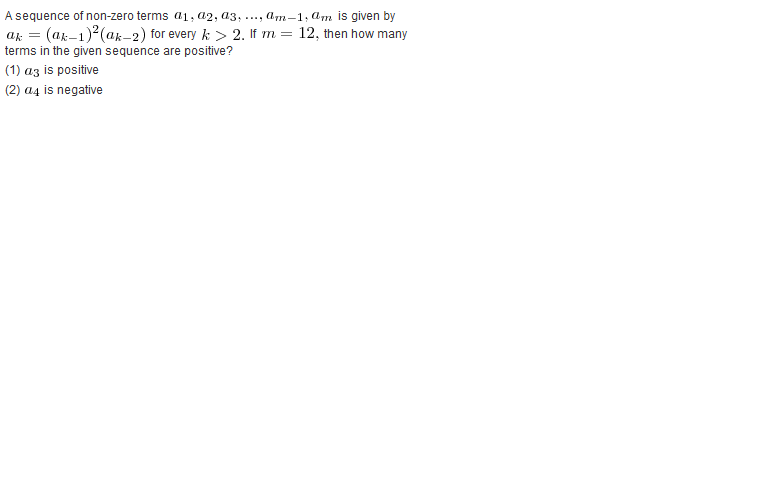
A sequence of non-zero terms \(a_1\), \(a_2\), \(a_3\), ..., \(a_{m-1}\), \(a_m\), is given by \(a_k=(a_{k-1})^2(a_{k-2})\) for every k>2. If m=12, then how many terms in the given sequence are positive?
(1) \(a_3\) is positive
(2) \(a_4\) is positive
(A) Statement 1 alone is sufficient, but statement 2 alone is not.
(B) Statement 2 alone is sufficient, but statement 1 alone is not.
(C) Both statements together are sufficient, but neither alone is sufficient.
(D) Each statement alone is sufficient.
(E) Neither statement is sufficient, even when combined.
Sequence_1.png [ 12.3 KiB | Viewed 10396 times ]
(1) \(a_3\) is positive
(2) \(a_4\) is positive
(A) Statement 1 alone is sufficient, but statement 2 alone is not.
(B) Statement 2 alone is sufficient, but statement 1 alone is not.
(C) Both statements together are sufficient, but neither alone is sufficient.
(D) Each statement alone is sufficient.
(E) Neither statement is sufficient, even when combined.
Attachment:
Sequence_1.png [ 12.3 KiB | Viewed 10396 times ]
Every tricky question should trigger a follow up quiz.
Build that habit with
GMAT Club Forum Quiz →.

 06 Apr 2013, 05:29
Kudos
Bookmarks
A sequence of non-zero terms \(a_1\), \(a_2\), \(a_3\), ..., \(a_{m-1}\), \(a_m\), is given by \(a_k=(a_{k-1})^2(a_{k-2})\) for every k>2. If m=12, then how many terms in the given sequence are positive?
From above:
\(a_3=(a_2)^2*a_1\);
\(a_4=(a_3)^2*a_2\);
...
(1) \(a_3\) is positive --> \(a_3=(a_2)^2*a_1=positive\) --> \(a_1=positive\). Now, if \(a_1=a_2=1\), then ALL 12 terms in the sequence will be positive but if \(a_1=1\), and \(a_2=-1\) (\(a_3=(a_2)^2*a_1=(-1)^2*1=1=positive\)), then not all the terms in the sequence will be positive. Not sufficient.
(2) \(a_4\) is positive --> \(a_4=(a_3)^2*a_2=positive\) --> \(a_2=positive\). The same here: if \(a_1=a_2=1\), then ALL 12 terms in the sequence will be positive but if \(a_1=-1\), and \(a_2=1\) (\(a_3=(a_2)^2*a_1=(1)^2*(-1)=-1\) and \(a_4=(a_3)^2*a_2=(-1)^2*1=1=positive\)), then not all the terms in the sequence will be positive. Not sufficient.
(1)+(2) From above we have that \(a_1=positive\) and \(a_2=positive\). Therefore, all 12 terms of the sequence are positive. Sufficient.
Answer: C.
Hope it's clear.
From above:
\(a_3=(a_2)^2*a_1\);
\(a_4=(a_3)^2*a_2\);
...
(1) \(a_3\) is positive --> \(a_3=(a_2)^2*a_1=positive\) --> \(a_1=positive\). Now, if \(a_1=a_2=1\), then ALL 12 terms in the sequence will be positive but if \(a_1=1\), and \(a_2=-1\) (\(a_3=(a_2)^2*a_1=(-1)^2*1=1=positive\)), then not all the terms in the sequence will be positive. Not sufficient.
(2) \(a_4\) is positive --> \(a_4=(a_3)^2*a_2=positive\) --> \(a_2=positive\). The same here: if \(a_1=a_2=1\), then ALL 12 terms in the sequence will be positive but if \(a_1=-1\), and \(a_2=1\) (\(a_3=(a_2)^2*a_1=(1)^2*(-1)=-1\) and \(a_4=(a_3)^2*a_2=(-1)^2*1=1=positive\)), then not all the terms in the sequence will be positive. Not sufficient.
(1)+(2) From above we have that \(a_1=positive\) and \(a_2=positive\). Therefore, all 12 terms of the sequence are positive. Sufficient.
Answer: C.
Hope it's clear.
General Discussion

marcovg4
Joined: 15 Mar 2012
Last visit: 04 Jan 2017
Posts: 45
Own Kudos:
Given Kudos: 19
Location: United States
Concentration: Marketing, Strategy
Schools: ESADE '15 MBS '16 (A) Erasmus '16
07 Apr 2013, 10:40
Kudos
Bookmarks
Then.. The information for "every k>2" is irrelevant right
Posted from my mobile device
Posted from my mobile device
07 Apr 2013, 22:33
Kudos
Bookmarks
marcovg4
"A sequence ... is given by \(a_k=(a_{k-1})^2(a_{k-2})\) for every k>2" means that the given formula applies for the terms starting \(a_3\).





