Events & Promotions
|
|

GMAT Club Daily Prep
Thank you for using the timer - this advanced tool can estimate your performance and suggest more practice questions. We have subscribed you to Daily Prep Questions via email.
Customized
for You
Track
Your Progress
Practice
Pays
Not interested in getting valuable practice questions and articles delivered to your email? No problem, unsubscribe here.
 Sep 28
07:00 PM EDT
-10:00 PM EDT
Boost your GMAT score in less than one month in a live online class + 6 months access to TTP OnDemand video courses included! Class starts Mon, Tues, Wed, Thur, Fri Sept. 28, 2026 - Oct. 16, 2027, 7:00pm-10:00pm EST Sep 28
12:30 AM EDT
-01:30 AM EDT
Countless GMAT journeys, breakthroughs, and dreams turned into milestones. From 615→715 in 15 days to 705 in 30 days, our students prove what's possible with personalized, expert guidance. Save up to 25% on 1-on-1 tutoring. Sep 29
11:00 AM EDT
-01:00 PM EDT
" Description: Top scores are possible when you enroll in a powerful GMAT course, taught live online + 6 months access to TTP OnDemand video courses included! Class starts Tues/Thur Sept. 29, 2026 - Dec. 3, 2026, 11:00am-1:00pm EST Oct 01
02:00 AM EDT
-03:00 AM EDT
Tejas studied hard but kept repeating the same mistakes. After 3 attempts at 645, a focused 4-week strategy helped him identify and fix what was holding him back—leading to a 695 with just 12–15 hours of study per week. Oct 01
07:00 AM BST
-08:00 AM GMT
Welcome to the GMAT Club's Free Interview Prep Event for Top MBA Programs! Buy tickets - Virtual series that’s all set to equip you to -excel in your MBA interviews. Oct 03
01:00 PM EDT
-04:00 PM EDT
Top scores are possible when you enroll in a powerful GMAT course, taught live online + 6 months access to TTP OnDemand video courses included! Class starts Saturdays Oct. 3, 2026 - Dec. 26, 2026, 1:00pm-4:00pm EST Oct 04
08:00 PM PDT
-09:00 PM PDT
15 Full-length GMAT FE mocks with insightful analytics, weakness diagnosis, and video explanations!


 12 Mar 2024, 02:10
Kudos
Bookmarks


D
Be sure to select an answer first to save it in the Error Log before revealing the correct answer (OA)!
Difficulty:
 65%
(hard)
65%
(hard)
Question Stats:
64% (02:23) correct 36%
(02:25)
wrong
based on 1197
sessions
36%
(02:25)
wrong
based on 1197
sessions
History
Date
Time
Result
Not Attempted Yet
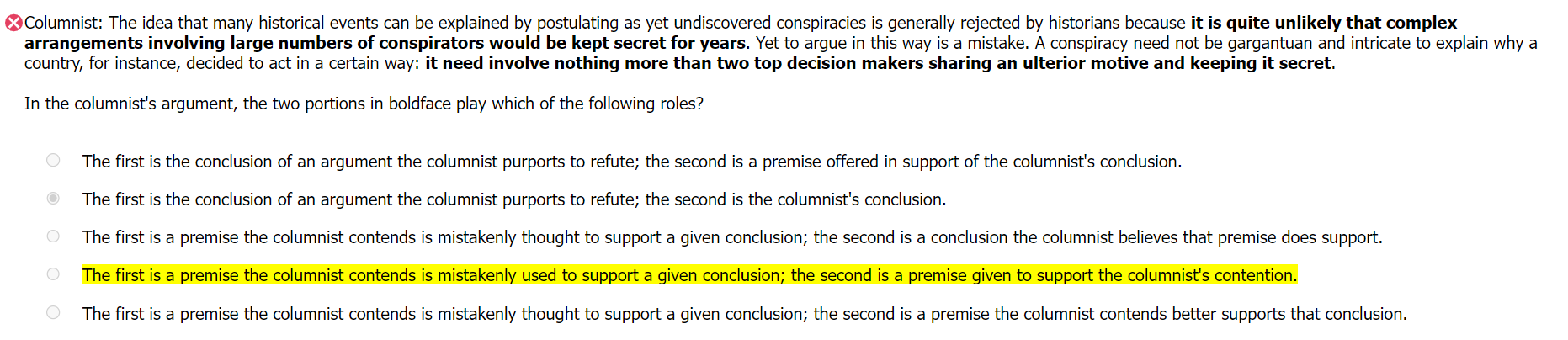
Columnist: The idea that many historical events can be explained by postulating as yet undiscovered conspiracies is generally rejected by historians because it is quite unlikely that complex arrangements involving large numbers of conspirators would be kept secret for years. Yet to argue in this way is a mistake. A conspiracy need not be gargantuan and intricate to explain why a country, for instance, decided to act in a certain way: it need involve nothing more than two top decision makers sharing an ulterior motive and keeping it secret.
In the columnist’s argument, the two portions in boldface play which of the following roles?
A. The first is the conclusion of an argument the columnist purports to refute; the second is a premise offered in support of the columnist’s conclusion.
B. The first is the conclusion of an argument the columnist purports to refute; the second is the columnist’s conclusion.
C. The first is a premise the columnist contends is mistakenly thought to support a given conclusion; the second is a conclusion the columnist believes that premise does support.
D. The first is a premise the columnist contends is mistakenly used to support a given conclusion; the second is a premise given to support the columnist’s contention.
E. The first is a premise the columnist contends is mistakenly thought to support a given conclusion; the second is a premise the columnist contends better supports that conclusion.
GMAT-Club-Forum-ydiaedok.png [ 119.99 KiB | Viewed 4975 times ]
In the columnist’s argument, the two portions in boldface play which of the following roles?
A. The first is the conclusion of an argument the columnist purports to refute; the second is a premise offered in support of the columnist’s conclusion.
B. The first is the conclusion of an argument the columnist purports to refute; the second is the columnist’s conclusion.
C. The first is a premise the columnist contends is mistakenly thought to support a given conclusion; the second is a conclusion the columnist believes that premise does support.
D. The first is a premise the columnist contends is mistakenly used to support a given conclusion; the second is a premise given to support the columnist’s contention.
E. The first is a premise the columnist contends is mistakenly thought to support a given conclusion; the second is a premise the columnist contends better supports that conclusion.
Attachment:
GMAT-Club-Forum-ydiaedok.png [ 119.99 KiB | Viewed 4975 times ]
Using official mocks already?
Add GMAT Club Tests for harder practice, analytics, and explanations without overlapping Official Guide or official mock questions.
Try it now →
Try it now →
 17 Mar 2024, 07:23
Kudos
Bookmarks
Columnist: The idea that many historical events can be explained by postulating as yet undiscovered conspiracies is generally rejected by historians because it is quite unlikely that complex arrangements involving large numbers of conspirators would be kept secret for years. Yet to argue in this way is a mistake. A conspiracy need not be gargantuan and intricate to explain why a country, for instance, decided to act in a certain way: it need involve nothing more than two top decision makers sharing an ulterior motive and keeping it secret.
Analysis of the passage
The passage opens by presenting an idea:
The idea that many historical events can be explained by postulating as yet undiscovered conspiracies
It then presents what is basically a conclusion about that idea, that it makes sense to reject it:
is generally rejected by historians
Next comes historians' support for rejecting the idea:
it is quite unlikely that complex arrangements involving large numbers of conspirators would be kept secret for years
At this point, the passage states the columnist's main conclusion:
to argue in this way is a mistake
"This way" in the main conclusion refers to the way historians support their conclusion that it makes sense to reject the idea.
The last part of the passage provides support for the main conclusion:
A conspiracy need not be gargantuan and intricate to explain why a country, for instance, decided to act in a certain way: it need involve nothing more than two top decision makers sharing an ulterior motive and keeping it secret.
In the columnist’s argument, the two portions in boldface play which of the following roles?
The correct answer will accurately describe the roles of the two boldfaced portions.
A. The first is the conclusion of an argument the columnist purports to refute; the second is a premise offered in support of the columnist’s conclusion.
The second part of this choice is correct because the second boldfaced portion does support the columnist's main conclusion.
However, this choice is incorrect because the first boldfaced portion is not a conclusion. Rather it's support for historians' conclusion that it makes sense to reject the idea.
Eliminate.
B. The first is the conclusion of an argument the columnist purports to refute; the second is the columnist’s conclusion.
This choice is completely incorrect because neither boldfaced portion states a conclusion. Rather, each provides support for a conclusion: the first provides support for historians' rejection of the idea, and the second supports the main conclusion.
Eliminate.
C. The first is a premise the columnist contends is mistakenly thought to support a given conclusion; the second is a conclusion the columnist believes that premise does support.
The first part of this choice is correct since the first boldfaced portion is what the historians' use to support their conclusion that it makes sense to reject the idea and since the columnist says that their doing so is "a mistake."
However, the second boldfaced portion is not a conclusion. It's a premise that supports the columnist's main conclusion.
Eliminate.
D. The first is a premise the columnist contends is mistakenly used to support a given conclusion; the second is a premise given to support the columnist’s contention.
The first part of this choice is correct since the first boldfaced portion is what the historians' use to support their conclusion that it makes sense to reject the idea and since the columnist says that their doing so is "a mistake."
The second part of this choice is also correct because the second boldfaced portion is a premise given to support the columnist's main conclusion, or "contention."
Keep.
E. The first is a premise the columnist contends is mistakenly thought to support a given conclusion; the second is a premise the columnist contends better supports that conclusion.
The first part of this choice is correct since the first boldfaced portion is what the historians' use to support their conclusion that it makes sense to reject the idea and since the columnist says that their doing so is "a mistake."
However, the second part of this choice is incorrect because the second boldfaced portion doesn't support historians' conclusion but rather supports the columnist's conclusion that historians are mistaken.
Eliminate.
Correct answer: D
Analysis of the passage
The passage opens by presenting an idea:
The idea that many historical events can be explained by postulating as yet undiscovered conspiracies
It then presents what is basically a conclusion about that idea, that it makes sense to reject it:
is generally rejected by historians
Next comes historians' support for rejecting the idea:
it is quite unlikely that complex arrangements involving large numbers of conspirators would be kept secret for years
At this point, the passage states the columnist's main conclusion:
to argue in this way is a mistake
"This way" in the main conclusion refers to the way historians support their conclusion that it makes sense to reject the idea.
The last part of the passage provides support for the main conclusion:
A conspiracy need not be gargantuan and intricate to explain why a country, for instance, decided to act in a certain way: it need involve nothing more than two top decision makers sharing an ulterior motive and keeping it secret.
In the columnist’s argument, the two portions in boldface play which of the following roles?
The correct answer will accurately describe the roles of the two boldfaced portions.
A. The first is the conclusion of an argument the columnist purports to refute; the second is a premise offered in support of the columnist’s conclusion.
The second part of this choice is correct because the second boldfaced portion does support the columnist's main conclusion.
However, this choice is incorrect because the first boldfaced portion is not a conclusion. Rather it's support for historians' conclusion that it makes sense to reject the idea.
Eliminate.
B. The first is the conclusion of an argument the columnist purports to refute; the second is the columnist’s conclusion.
This choice is completely incorrect because neither boldfaced portion states a conclusion. Rather, each provides support for a conclusion: the first provides support for historians' rejection of the idea, and the second supports the main conclusion.
Eliminate.
C. The first is a premise the columnist contends is mistakenly thought to support a given conclusion; the second is a conclusion the columnist believes that premise does support.
The first part of this choice is correct since the first boldfaced portion is what the historians' use to support their conclusion that it makes sense to reject the idea and since the columnist says that their doing so is "a mistake."
However, the second boldfaced portion is not a conclusion. It's a premise that supports the columnist's main conclusion.
Eliminate.
D. The first is a premise the columnist contends is mistakenly used to support a given conclusion; the second is a premise given to support the columnist’s contention.
The first part of this choice is correct since the first boldfaced portion is what the historians' use to support their conclusion that it makes sense to reject the idea and since the columnist says that their doing so is "a mistake."
The second part of this choice is also correct because the second boldfaced portion is a premise given to support the columnist's main conclusion, or "contention."
Keep.
E. The first is a premise the columnist contends is mistakenly thought to support a given conclusion; the second is a premise the columnist contends better supports that conclusion.
The first part of this choice is correct since the first boldfaced portion is what the historians' use to support their conclusion that it makes sense to reject the idea and since the columnist says that their doing so is "a mistake."
However, the second part of this choice is incorrect because the second boldfaced portion doesn't support historians' conclusion but rather supports the columnist's conclusion that historians are mistaken.
Eliminate.
Correct answer: D
General Discussion

Fish181
Joined: 13 Dec 2023
Last visit: 10 Aug 2026
Posts: 125
Given Kudos: 53
Status:Applying in R1 of 2024 to t15
Affiliations: University of Tennessee
Location: United States (CO)
Concentration: Strategy, Finance
GMAT Focus 1: 605 Q76 V84 DI80 
GMAT Focus 2: 615 Q78 V86 DI78
GPA: 3.62
WE:Analyst (Consumer Packaged Goods)
GMAT Focus 2: 615 Q78 V86 DI78
Posts: 125
17 Mar 2024, 10:14
Kudos
Bookmarks
Boldface is always tricky! I got this one correct because I properly identified the two different portions of the boldface. And eliminated all answer choices that didn't match what I identified.
Boldface 1: "because it is quite unlikely that complex arrangements involving large numbers of conspirators would be kept secret for years."
The word "because" should flag whatever proceeds as the premise or evidence for a given conclusion. Therefore, any answer choice that states that boldface 1 is a conclusion, cross it out.
Boldface 2: "it need involve nothing more than two top decision makers sharing an ulterior motive and keeping it secret."
This is a little more tricky but you should identify that this boldface is evidence/ a premise to support an alternative conclusion said by the columnist. That "A conspiracy need not be gargantuan and intricate to explain why a country, for instance, decided to act in a certain way." If you have a hard time seeing that, add the word "because" where the semi colon is and then it's the same thing as boldface 1.
Cross out anything that mentions boldface two as a conclusion.
This leaves you with D or E.
E says: "The first is a premise the columnist contends is mistakenly thought to support a given conclusion; the second is a premise the columnist contends better supports that conclusion."
The bolded text is why this answer is incorrect. The columnist is not supporting the original conclusion that conspiracy theories are too complex to work. The columnist is supporting a different conclusion that they actually are possible.
Therefore, with all else eliminated, answer choice D.
Boldface 1: "because it is quite unlikely that complex arrangements involving large numbers of conspirators would be kept secret for years."
The word "because" should flag whatever proceeds as the premise or evidence for a given conclusion. Therefore, any answer choice that states that boldface 1 is a conclusion, cross it out.
Boldface 2: "it need involve nothing more than two top decision makers sharing an ulterior motive and keeping it secret."
This is a little more tricky but you should identify that this boldface is evidence/ a premise to support an alternative conclusion said by the columnist. That "A conspiracy need not be gargantuan and intricate to explain why a country, for instance, decided to act in a certain way." If you have a hard time seeing that, add the word "because" where the semi colon is and then it's the same thing as boldface 1.
Cross out anything that mentions boldface two as a conclusion.
This leaves you with D or E.
E says: "The first is a premise the columnist contends is mistakenly thought to support a given conclusion; the second is a premise the columnist contends better supports that conclusion."
The bolded text is why this answer is incorrect. The columnist is not supporting the original conclusion that conspiracy theories are too complex to work. The columnist is supporting a different conclusion that they actually are possible.
Therefore, with all else eliminated, answer choice D.





