Events & Promotions
|
|

GMAT Club Daily Prep
Thank you for using the timer - this advanced tool can estimate your performance and suggest more practice questions. We have subscribed you to Daily Prep Questions via email.
Customized
for You
Track
Your Progress
Practice
Pays
Not interested in getting valuable practice questions and articles delivered to your email? No problem, unsubscribe here.
 Aug 26
10:00 AM EDT
-11:59 PM EDT
Save up to $1,000 on select GMAT prep now. This Fall, achieve your most ambitious goals with millions of student success stories behind you. Aug 27
10:00 AM EDT
-11:00 AM EDT
We’ve worked incredibly hard to build TTP into the best test prep experience possible, and it would mean a lot to us to win Newsweek’s 2026 Readers’ Choice Award for Best Test Prep. If TTP has helped you, we’d be incredibly grateful for your vote. Sep 06
09:30 AM EDT
-12:30 PM EST
Top scores are possible when you enroll in a powerful EA course, taught live online + 6 months access to TTP OnDemand video courses included! Perfect class schedule and easy course access for working professionals. Class starts Sept. 6, 9:30am-12:30pm EST Sep 09
07:00 AM PDT
-10:00 AM PDT
Meet AdComs and explore top Master’s programs - MiM, MiF, MSc, MSBA and more. - Application Fee Waivers - Free 1-Week of GMAT Club Tests: - Master's Application Toolkit - Grand Prize Giveaway Sep 15
07:00 PM EDT
-09:00 PM EST
Elite scores are possible when you enroll in a powerful GMAT course, taught live online + 6 months access to TTP OnDemand video courses included! Class starts Tues/Thurs Sept. 15, 2026 - Nov. 15, 2027, 7:00pm-9:00pm EST Sep 21
08:00 PM EDT
-10:00 PM EDT
Elite scores are possible when you enroll in a powerful GMAT course, taught live online + 6 months access to TTP OnDemand video courses included! Class starts Tues/Thurs Oct. 13, 2026 - Jan. 7, 2027, 8:00pm-10:00pm EST

 26 Oct 2021, 04:36
Kudos
Bookmarks
Executive Assessment Scoring
Although the Executive Assessment (EA) is similar to the GMAT in many respects, Executive Assessment scores look very different from their GMAT counterparts and are calculated using a method that is unique to the Executive Assessment test.In this article, I’ll explain how the Executive Assessment is scored, including what the EA score scale is, how section adaptivity affects your score, how you receive and send EA scores, and what we know about Executive Assessment score percentiles. I’ll also give you some tips on determining what EA score you may need for your desired programs and a few strategies for maximizing your score potential.
Before we jump into any EA score specifics, it’s important to review the basic structure of the exam. Let’s take a look.
Executive Assessment Test Structure
The Executive Assessment is made up of three sections: Integrated Reasoning (IR), Verbal Reasoning, and Quantitative Reasoning appearing in that order. Each section is divided into 2 “modules” of equal size, and you have a total of 30 minutes to complete the section. In other words, although the sections are broken in half, you can allocate your total section time of 30 minutes in any way you like. Check out the chart below for a closer look at the test structure.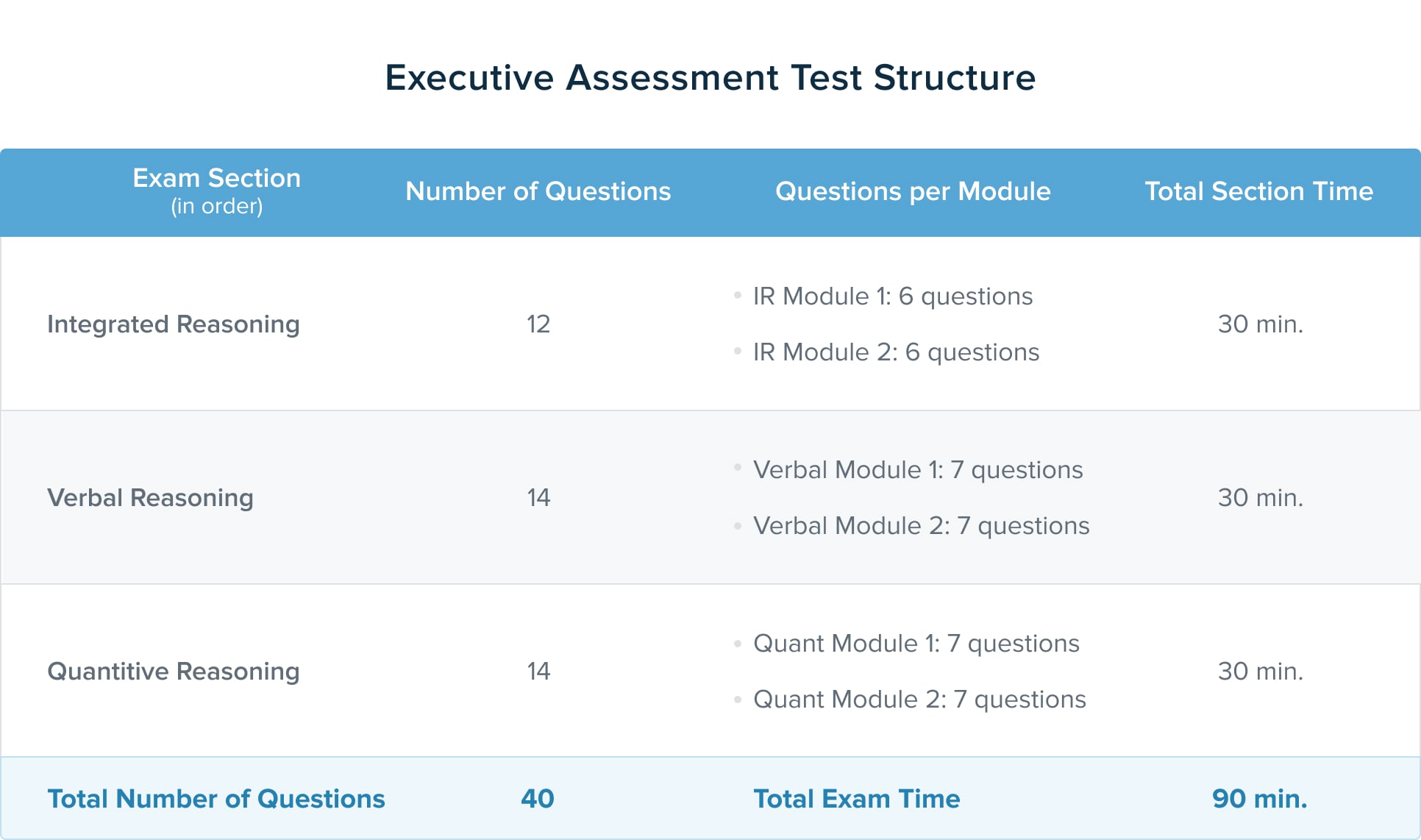
Now, let’s talk about why this module structure is important to your score.
EA Section Adaptivity: Why It Matters
One thing that makes the Executive Assessment test unique is its module structure. This structure allows the EA to be computer-adaptive not at a question level like the GMAT, or at a section level like the GRE, but at the module level. In other words, the Executive Assessment adapts its difficulty from one section module to the next, based on your performance.Interestingly, although all 3 exam sections are divided into 2 modules each, only the Verbal and Quant modules are computer-adaptive. The IR modules are not adaptive. Furthermore, the adaptability of the modules is contained within each section; there is no “cross-pollination” between Quant and Verbal. So, your performance on the Quant modules does not affect the difficulty level you see in the Verbal modules, and vice versa.
So, what exactly does it mean that the Executive Assessment is adaptive at a module level? Well, every EA test-taker begins the Quant and Verbal sections seeing questions that the test rates as “medium” difficulty. Your performance on Quant module 1 (i.e., those medium-level questions) influences the difficulty level of the questions you see in Quant module 2. Likewise, your performance on Verbal module 1 influences the difficulty level of the questions you see in Verbal module 2.
So, if for example you perform well on Quant module 1, the questions you see in Quant module 2 should be more difficult overall than those you saw in Quant module 1. There will still be some “easier” questions, which are needed for calibration, so not every single question will be harder in module 2, but taken as a whole, module 2 will be more difficult than module 1. On the other hand, let’s say your performance isn’t so great on Verbal module 1. In that case, the questions you see in Verbal module 2 should be a bit less difficult overall than those you saw in Verbal module 1.
The upshot for your score is that if you perform well in the first module of the Quant or Verbal section, you’ll have more opportunities to drive up your score in the second module, because you’ll see more of the questions that are considered “hard” level, and thus are high-value. If you underperform on the initial modules, you won’t have as many opportunities to drive up your score, because you won’t see as many high-value questions in the second modules of the sections.
We’ll delve a little deeper into the intricacies of how the Executive Assessment is scored later on, but for now, let’s take a look at another important aspect of the module structure: the review screens.
Module Review Screens: A Blessing and a Curse
One perk of the Executive Assessment’s unique section structure is that test-takers are given the opportunity to review and edit their work at the end of each module. So, let’s take the Verbal section as an example. You are presented with 7 questions in the first Verbal module and 7 questions in the second Verbal module. After completing the 7 questions that make up the first Verbal module, you’re presented with a review screen from which you can check and change your responses or return to any questions that you may have skipped within the module.Of course, the review option isn’t all wine and roses. For one, once you move on from the first review screen to the second module, you can no longer go back and edit or add any answers in the first module, even though you’re still technically in the same section. (And, you certainly can’t return to a previous section once you’ve moved on to the next one.)
Furthermore, the clock doesn’t stop when you’re on a review screen. So, any time you spend reviewing answers in module 1 of a section will take away from the time you have to work on and review your answers in module 2. Keep in mind that if you perform well in module 1, you’ll probably need a bit more time to accurately answer the questions in module 2 than you needed to answer the module 1 questions, because you’ll be seeing more difficult questions.
So, on the one hand, you may want to check all of your work to make sure you have as many correct answers as possible in module 1, so you have the opportunity to see higher-value questions in module 2. However, on the other hand, you won’t want to overinvest section time on the review screen for module 1, because doing so will chip away at the time you have remaining to answer potentially tougher, more time-consuming questions in module 2. You didn’t expect the exam to make things too easy for you, did you?
Of course, if you are well-prepared for the Executive Assessment test, then hopefully you’ll be able to get through module 1 Quant and Verbal questions relatively efficiently, and you’ll naturally need less time to complete those easier-level questions that you would need to complete hard-level ones. Moreover, you’ll hopefully have less need to return to unanswered questions or review answers you were unsure about. In that case, you’ll naturally leave yourself a slightly larger proportion of your 30-minute section time to work on the second module. But, as you can see, making use of the review screens is a bit of a balancing act, so you’ll want to have some sort of strategy for how to prioritize your work.
For example, say you get to the review screen of the second Verbal module and see that you left 3 of the 7 questions blank. Which question do you return to first? Are you going to choose at random? You have a limited amount of time left in the section — was there one question that you felt like you might be able to answer, while the other two seemed like questions you would have a very low probability of answering correctly? It would be very helpful to jot down that question number on your whiteboard as you’re going through the test, so when you get to the review screen, you know exactly which question is the priority to return to with your remaining time.
Or let’s say you’ve selected answers to all of the questions in the module, but you weren’t 100% sure about 2 of those answers. Did you jot down those question numbers as you went? If you have time to return to those 2 questions and double-check your selections, now is your chance. Another reason to jot down the question numbers for answers you were unsure of is because you don’t want to find yourself in a panic at the end of a module, second-guessing all of your answers and changing answers that really don’t need to be changed.
You also need to keep in mind that it will be easier to prioritize what (if anything) to review at the end of a section’s second module, because when the clock runs out for that section, you’ll have no choice but to move on. However, when you get to the review screen of a section’s first module, you’ll need to weigh the amount of time you have remaining to complete the second module against the number of blank or guessed answers in module 1. Perhaps you’ll determine that you don’t have any time to spare to return to questions in module 1, and you’ll simply have to move on to module 2. Or maybe you’ll determine that, although you probably could spend another minute or two on module 1, the guesses you initially made were your best guesses, or the question you left blank was one you truly did not know how to answer, so it would be more strategic for you to move on to module 2 with that extra cushion of time.
Unfortunately, there is no straightforward calculation for how to use the review screens. In some cases, you may just have to go with your gut. The important thing is not to panic, to work through each section, each module, and each question methodically, and to have some basic parameters in mind for how you want to allocate your time and energy as you work through the exam. When you reach the review screen, you should have a good sense of which questions you want to take a second look at or make another attempt on.
Note also that although the Integrated Reasoning section does not adapt from one module to the next, you will see the review screen at the end of each IR module, so you can still check your work or return to unanswered questions in IR.
Now that we understand the basic structure and adaptive nature of the exam, let’s get into how the Executive Assessment is scored.
To read the complete article, view my full article on Target Test Prep’s blog.

 28 Dec 2021, 04:23
Kudos
Bookmarks
Dear All,
I took my EA today and I want to take the test again. I want to understand what happens to the existing score if I get it again? Does it automatically gets cancel or I will still have choice to use the best of the two?
Thanks in advance.
Suravi
I took my EA today and I want to take the test again. I want to understand what happens to the existing score if I get it again? Does it automatically gets cancel or I will still have choice to use the best of the two?
Thanks in advance.
Suravi

 28 Dec 2021, 14:30
Kudos
Bookmarks
Hi Suravi,
I've sent you a PM with some notes and additional questions.
EA/GMAT assassins aren't born, they're made,
Rich
Contact Rich at: [email protected]
I've sent you a PM with some notes and additional questions.
EA/GMAT assassins aren't born, they're made,
Rich
Contact Rich at: [email protected]








