Events & Promotions
|
|

GMAT Club Daily Prep
Thank you for using the timer - this advanced tool can estimate your performance and suggest more practice questions. We have subscribed you to Daily Prep Questions via email.
Customized
for You
Track
Your Progress
Practice
Pays
Not interested in getting valuable practice questions and articles delivered to your email? No problem, unsubscribe here.
 Sep 06
09:30 AM EDT
-12:30 PM EST
Top scores are possible when you enroll in a powerful EA course, taught live online + 6 months access to TTP OnDemand video courses included! Perfect class schedule and easy course access for working professionals. Class starts Sundays Sept. 6, 2026. Sep 02
01:00 PM EDT
-11:59 PM EDT
Take 30% off all study plans with code COURSEWORK - Expires on Monday 9/7 Sep 04
01:30 AM EDT
-02:30 AM EDT
This Labor Day, turn your hard work into real score gains. From 615→715 in 15 days to 705 in 30 days, our students prove what's possible with personalized, expert guidance. Save up to 25% on 1-on-1 tutoring. Sep 04
10:00 AM EDT
-11:59 PM EDT
We’ve worked incredibly hard to build TTP into the best test prep experience possible, and it would mean a lot to us to win Newsweek’s 2026 Readers’ Choice Award for Best Test Prep. If TTP has helped you, we’d be incredibly grateful for your vote. Sep 07
12:01 AM PDT
-11:59 PM PDT
On the 7th, GMAT Club Tests will be Free! Including all the Quizzes, Questions, and Tests. 12 AM - 11:59 PM PDT Sep 07
12:30 AM EDT
-01:30 AM EDT
Tejas studied hard but kept repeating the same mistakes. After 3 attempts at 645, a focused 4-week strategy helped him identify and fix what was holding him back—leading to a 695 with just 12–15 hours of study per week.- Sep 07
10:00 AM PDT
-11:00 AM PDT
A complete walkthrough of GMAT Club’s free 12-week GMAT study plan: what you study each week, how progress and goals are tracked, how the error log works, and how your practice unlocks paid tools at no cost. - Sep 09
07:00 AM PDT
-10:00 AM PDT
Meet AdComs and explore top Master’s programs - MiM, MiF, MSc, MSBA and more. - Application Fee Waivers - Free 1-Week of GMAT Club Tests: - Master's Application Toolkit - Grand Prize Giveaway - Sep 09
10:00 AM PDT
-11:00 AM PDT
Three MBA applications. Three rejections. No interview invites. A year later, Aman was admitted to Cambridge Judge, SMU, and IMD. In this episode of MBA Admit Stories, Aman shares how he rebuilt his MBA application...  Sep 10
08:00 PM PDT
-09:00 PM PDT
Free- full-length test + 15 concept videos + 150+ short videos + study plan! Sep 15
07:00 PM EDT
-09:00 PM EST
Elite scores are possible when you enroll in a powerful GMAT course, taught live online + 6 months access to TTP OnDemand video courses included! Class starts Tues/Thurs Sept. 15, 2026 - Nov. 15, 2027, 7:00pm-9:00pm EST Sep 21
08:00 PM EDT
-10:00 PM EDT
Boost your GMAT score in less than one month in a live online class + 6 months access to TTP OnDemand video courses included! Class starts Mon, Tues, Wed, Thur, Fri Sept. 21, 2026 - Oct. 9, 2027, 7:00pm-10:00pm EST


 23 Aug 2025, 05:40
Kudos
Bookmarks
Hi everyone,
I recently scored a 675 on the GMAT (Q84, V84, DI82) after an intense two-week sprint following a disappointing 635. I wanted to share my journey because I know there are others out there facing tight deadlines who might benefit from knowing that rapid improvement is possible.
I'm a consultant, who had been preparing for the GMAT for a few months. Before my first official attempt, I was consistently scoring 655-675 on practice tests, which gave me confidence that I was ready. However, test day had other plans - I walked out with a 635.
That evening, sitting with my disappointing score report, I faced a harsh reality: with my work schedule, there would be no possibility of another attempt for months. I needed to act fast.
That same evening of getting the 635, I reached out to e-GMAT. I'd seen their reviews online and decided I needed expert help. Within hours, I was enrolled in their course and their Last Mile Push program. Looking back, this immediate action was crucial - I didn't waste a single day wallowing in disappointment.
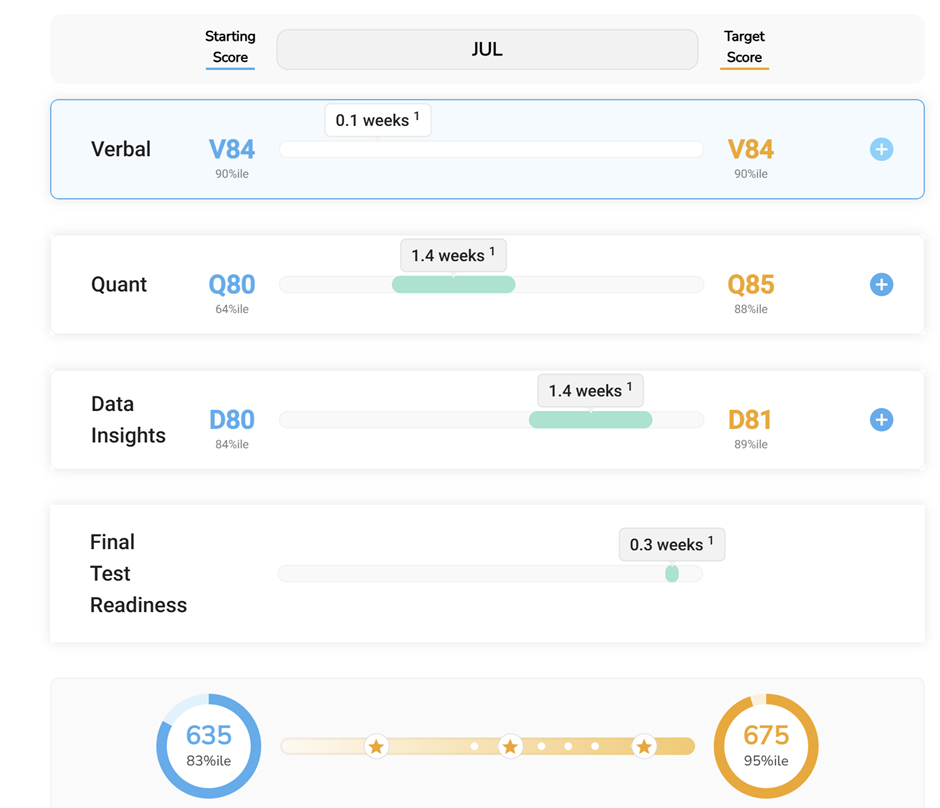
Quant: From Conceptual Gaps to Q84
My Quant fundamentals were decent, but I had specific blind spots that were killing my score. The diagnostic quizzes immediately identified these gaps without making me waste time reviewing everything I already knew.
The game-changer? Learning the Wavy Line method for absolute value questions. I remember thinking, "Wavy Line method? What's that?" I'd never heard of it before. But after learning it through e-GMAT's video lecture, I found myself applying it everywhere - even to questions I'd previously solved differently. Suddenly, I was getting answers much more quickly and accurately.
Other critical areas identified were:
Verbal: Maintaining V84 Through Consistent Practice
Verbal was relatively strong for me but maintaining it while focusing on Quant was crucial. My strategy was simple but effective: sectional mocks every two days.
These mocks revealed an important pattern - my scores would fluctuate (82, 84, 85, 86, back to 82), and the culprit was always the same: concentration, especially in RC.
The breakthrough came when I realized I was reading passively. CR passages are short - I could focus and power through them. But RC passages, especially the longer ones, require active engagement.
The constant practice with fresh questions from e-GMAT's question bank (different from the OG questions I'd already seen) kept my verbal skills sharp while I focused primarily on Quant.
Data Insights: Maintaining DI82
DI required consistent practice to maintain my level. The integration of verbal and quant skills in this section meant that improvements in both areas naturally helped my DI performance. I focused on time management and not getting stuck on complex data sets.
The Last Mile Push Program:
I cannot overstate how crucial having a mentor was for my success. Rashmi and I exchanged emails daily - she'd analyze my performance data, identify patterns I couldn't see, and create targeted action plans.
Here's what made the difference:
Mock Test Strategy
I took one official mock two days before the test and scored 675. This was huge for my confidence, though I still had doubts. The e-GMAT mocks, I learned, are actually quite representative of the real test - if not slightly harder.
The key learning: The mock wasn't just about the score but about proving to myself that the improvements were real and sustainable.
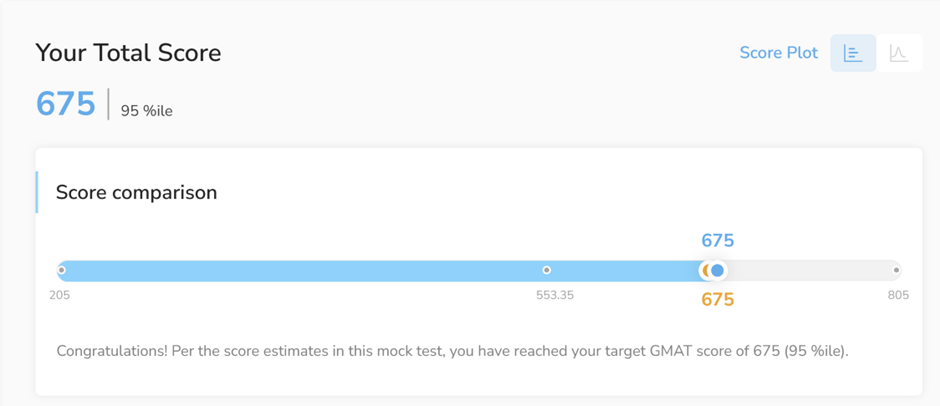
Test Day: The Difference Between 635 and 675
Walking into the test center for the second time in two weeks was surreal. But this time, I had advantages:
Key Takeaways for the Community
Feel free to ask me any questions about the two-week sprint, specific strategies, or anything else about my journey.
Best of luck to everyone!

GMAT-Club-Forum-ey4q8wca.png [ 89.58 KiB | Viewed 1150 times ]

GMAT-Club-Forum-lf8ld7aa.png [ 38.14 KiB | Viewed 1136 times ]
I recently scored a 675 on the GMAT (Q84, V84, DI82) after an intense two-week sprint following a disappointing 635. I wanted to share my journey because I know there are others out there facing tight deadlines who might benefit from knowing that rapid improvement is possible.
I'm a consultant, who had been preparing for the GMAT for a few months. Before my first official attempt, I was consistently scoring 655-675 on practice tests, which gave me confidence that I was ready. However, test day had other plans - I walked out with a 635.
That evening, sitting with my disappointing score report, I faced a harsh reality: with my work schedule, there would be no possibility of another attempt for months. I needed to act fast.
That same evening of getting the 635, I reached out to e-GMAT. I'd seen their reviews online and decided I needed expert help. Within hours, I was enrolled in their course and their Last Mile Push program. Looking back, this immediate action was crucial - I didn't waste a single day wallowing in disappointment.
Quant: From Conceptual Gaps to Q84
My Quant fundamentals were decent, but I had specific blind spots that were killing my score. The diagnostic quizzes immediately identified these gaps without making me waste time reviewing everything I already knew.
The game-changer? Learning the Wavy Line method for absolute value questions. I remember thinking, "Wavy Line method? What's that?" I'd never heard of it before. But after learning it through e-GMAT's video lecture, I found myself applying it everywhere - even to questions I'd previously solved differently. Suddenly, I was getting answers much more quickly and accurately.
Other critical areas identified were:
- Specific gaps in number properties
- Some word problem concepts I'd forgotten
- Process skill issues that were causing silly mistakes
Verbal: Maintaining V84 Through Consistent Practice
Verbal was relatively strong for me but maintaining it while focusing on Quant was crucial. My strategy was simple but effective: sectional mocks every two days.
These mocks revealed an important pattern - my scores would fluctuate (82, 84, 85, 86, back to 82), and the culprit was always the same: concentration, especially in RC.
The breakthrough came when I realized I was reading passively. CR passages are short - I could focus and power through them. But RC passages, especially the longer ones, require active engagement.
The constant practice with fresh questions from e-GMAT's question bank (different from the OG questions I'd already seen) kept my verbal skills sharp while I focused primarily on Quant.
Data Insights: Maintaining DI82
DI required consistent practice to maintain my level. The integration of verbal and quant skills in this section meant that improvements in both areas naturally helped my DI performance. I focused on time management and not getting stuck on complex data sets.
The Last Mile Push Program:
I cannot overstate how crucial having a mentor was for my success. Rashmi and I exchanged emails daily - she'd analyze my performance data, identify patterns I couldn't see, and create targeted action plans.
Here's what made the difference:
- Data Analysis: Rashmi could look at my performance data in 10-15 minutes and extract insights that would have taken me hours to identify
- Daily Accountability: I literally asked her to "assign things, push me to complete them" because I knew I needed that external pressure
- Behavioral Issue Identification: She helped me categorize my mistakes into conceptual gaps vs. behavioral gaps, which completely changed how I approached practice
- Mental Support: When sectional mock scores fluctuated, she was there to remind me that one bad performance doesn't define capability
Mock Test Strategy
I took one official mock two days before the test and scored 675. This was huge for my confidence, though I still had doubts. The e-GMAT mocks, I learned, are actually quite representative of the real test - if not slightly harder.
The key learning: The mock wasn't just about the score but about proving to myself that the improvements were real and sustainable.
Test Day: The Difference Between 635 and 675
Walking into the test center for the second time in two weeks was surreal. But this time, I had advantages:
- Familiarity: I knew the center, the process, the computer setup
- Targeted Preparation: Every weakness from my 635 attempt had been addressed
- Mental Preparation: I knew I just needed to stay as relaxed as I was during home practice
Key Takeaways for the Community
- Time isn't always the constraint we think it is: With focused effort and the right guidance, significant improvement can happen quickly
- Immediate action matters: I reached out for help the same evening I got my disappointing score. Don't waste time feeling sorry for yourself.
- Diagnostic-driven learning is crucial: Don't review everything - identify and attack specific gaps
- You need a support system: Whether it's a mentor, study buddy, or family support. My mom was constantly encouraging me when I wanted to give up.
- Behavioral issues are real: At higher scores, it's often not about what you know but how you execute under pressure
- Trust the process: When you have limited time, you need to trust expert guidance rather than second-guessing every decision
Feel free to ask me any questions about the two-week sprint, specific strategies, or anything else about my journey.
Best of luck to everyone!
Attachment:
GMAT-Club-Forum-ey4q8wca.png [ 89.58 KiB | Viewed 1150 times ]
Attachment:
GMAT-Club-Forum-lf8ld7aa.png [ 38.14 KiB | Viewed 1136 times ]

 23 Aug 2025, 06:34
Kudos
Bookmarks
Congratulations for score all the best with applications
 23 Aug 2025, 06:54
Kudos
Bookmarks
This was really inspiring too read and I'm so happy for you! Thank you for all the tips and best of luck for your future!!










