Events & Promotions
|
|

GMAT Club Daily Prep
Thank you for using the timer - this advanced tool can estimate your performance and suggest more practice questions. We have subscribed you to Daily Prep Questions via email.
Customized
for You
Track
Your Progress
Practice
Pays
Not interested in getting valuable practice questions and articles delivered to your email? No problem, unsubscribe here.
 Sep 24
01:30 AM EDT
-01:30 AM EDT
Tejas studied hard but kept repeating the same mistakes. After 3 attempts at 645, a focused 4-week strategy helped him identify and fix what was holding him back—leading to a 695 with just 12–15 hours of study per week. Sep 24
08:00 AM EDT
-08:30 AM EDT
Meet Tuck at an informal student or staff-hosted coffee chat in a city near you! Sep 23
12:30 AM EDT
-01:30 AM EDT
Learn how Keshav, a Chartered Accountant, scored an impressive 705 on GMAT in just 30 days with GMATWhiz's expert guidance. In this video, he shares preparation tips and strategies that worked for him, including the mock, time management, and more Sep 26
01:00 PM EDT
-04:00 PM EDT
Top scores are possible when you enroll in a powerful GMAT course, taught live online + 6 months access to TTP OnDemand video courses included. Class starts Saturdays Sept. 26, 2026 - Dec. 19, 2026, 1:00pm-4:00pm ES Sep 26
06:00 PM PDT
-07:00 PM PDT
Free- full-length test + 15 concept videos + 150+ short videos + study plan! Sep 29
11:00 AM EDT
-01:00 PM EDT
" Description: Top scores are possible when you enroll in a powerful GMAT course, taught live online + 6 months access to TTP OnDemand video courses included! Class starts Tues/Thur Sept. 29, 2026 - Dec. 3, 2026, 11:00am-1:00pm EST Oct 01
07:00 AM BST
-08:00 AM GMT
Welcome to the GMAT Club's Free Interview Prep Event for Top MBA Programs! Buy tickets - Virtual series that’s all set to equip you to -excel in your MBA interviews.


 Updated on: 12 Mar 2026, 06:29
Originally posted by RonPurewal on 19 Feb 2026, 22:39.
Last edited by Bunuel on 12 Mar 2026, 06:29, edited 1 time in total.
Last edited by Bunuel on 12 Mar 2026, 06:29, edited 1 time in total.
Kudos
Bookmarks


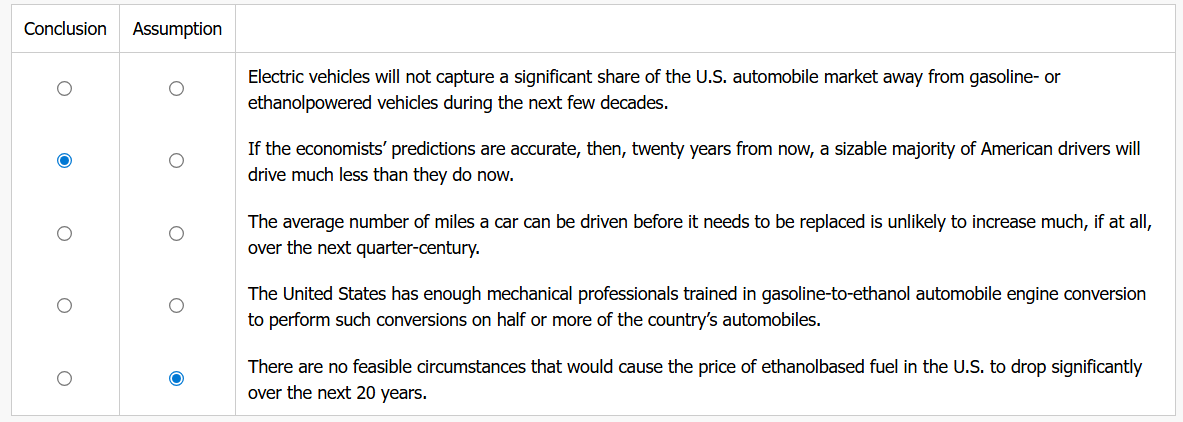
Conclusion: If the economists’ predictions are accurate, then, twenty years from now, a sizable majority of American drivers will drive much less than they do now.
Assumption: There are no feasible circumstances that would cause the price of ethanolbased fuel in the U.S. to drop significantly over the next 20 years.
Be sure to select an answer first to save it in the Error Log before revealing the correct answer (OA)!
Difficulty:
 85%
(hard)
85%
(hard)
Question Stats:
57% (02:34) correct 43%
(02:51)
wrong
based on 462
sessions
43%
(02:51)
wrong
based on 462
sessions
History
Date
Time
Result
Not Attempted Yet
Gasoline-powered automobiles can undergo engine conversion to run on “gasohol”—a fuel consisting primarily of ethanol—on which they get a comparable mileage per gallon of fuel. In the United States, however, ethanol is several times as expensive as gasoline, so gasohol is not economically viable at present as a fuel for Americans’ vehicles. Some economists predict, however, that the increasing scarcity of petroleum itself, paired with escalating environmental and climate concerns, will drive U.S. gasoline prices permanently higher than those of ethanol-based fuels within a couple of decades—causing gasohol to gradually overtake gasoline as the fuel powering a majority of U.S. automobiles. Very few Americans, however, could afford to drive anywhere near as much as they do now if they were forced to purchase fuel at the current price point of gasohol.
Mark the Conclusion column for the statement below that is most strongly supported as a conclusion of the statements above. For the argument consisting of the above statements together with your chosen conclusion, mark the Assumption column for the statement upon whose truth the validity of that argument depends. Pick only two choices, one in each column.
Mark the Conclusion column for the statement below that is most strongly supported as a conclusion of the statements above. For the argument consisting of the above statements together with your chosen conclusion, mark the Assumption column for the statement upon whose truth the validity of that argument depends. Pick only two choices, one in each column.
| Conclusion | Assumption | |
| Electric vehicles will not capture a significant share of the U.S. automobile market away from gasoline- or ethanolpowered vehicles during the next few decades. | ||
| If the economists’ predictions are accurate, then, twenty years from now, a sizable majority of American drivers will drive much less than they do now. | ||
| The average number of miles a car can be driven before it needs to be replaced is unlikely to increase much, if at all, over the next quarter-century. | ||
| The United States has enough mechanical professionals trained in gasoline-to-ethanol automobile engine conversion to perform such conversions on half or more of the country’s automobiles. | ||
| There are no feasible circumstances that would cause the price of ethanolbased fuel in the U.S. to drop significantly over the next 20 years. |
ShowHide Answer
Official Answer
Conclusion: If the economists’ predictions are accurate, then, twenty years from now, a sizable majority of American drivers will drive much less than they do now.
Assumption: There are no feasible circumstances that would cause the price of ethanolbased fuel in the U.S. to drop significantly over the next 20 years.
I32-03
24 Feb 2026, 04:15
Kudos
Bookmarks
Gasoline-powered automobiles can undergo engine conversion to run on “gasohol”—a fuel consisting primarily of ethanol—on which they get a comparable mileage per gallon of fuel. In the United States, however, ethanol is several times as expensive as gasoline, so gasohol is not economically viable at present as a fuel for Americans’ vehicles. Some economists predict, however, that the increasing scarcity of petroleum itself, paired with escalating environmental and climate concerns, will drive U.S. gasoline prices permanently higher than those of ethanol-based fuels within a couple of decades—causing gasohol to gradually overtake gasoline as the fuel powering a majority of U.S. automobiles. Very few Americans, however, could afford to drive anywhere near as much as they do now if they were forced to purchase fuel at the current price point of gasohol.
Mark the Conclusion column for the statement below that is most strongly supported as a conclusion of the statements above. For the argument consisting of the above statements together with your chosen conclusion, mark the Assumption column for the statement upon whose truth the validity of that argument depends. Pick only two choices, one in each column.
Official Explanation:
The conclusion, as always, needs to be something we can say as a result of the other given statements—in other words, a consequence of those statements (...though not a formally/logically rigorous consequence; in other words, the conclusion isn’t going to be something we can strictly PROVE from the statements, as it normally is in CR “draw a conclusion” problems. In this case, we know with absolute certainty that we won’t be rigorously proving anything, because the other half of the problem has us identifying a questionable assumption!)
Briefly summarizing the content of the existing statements can often help us predict conclusions. To this end, here’s a brief summary of the existing
statements here:
Like any other BRIEF summary, this one leaves out some of the finer details—e.g., the fact that drivers won’t necessarily have to buy a new car to switch fuels, as they could have their current car’s engine converted instead—but includes a few of them, such as the timeframe of “within a couple decades” (which is worth keeping because it’s the timeframe on which the entire argument/narrative operates). Lean mostly on your intuition to decide which details to ignore when making a brief summary; when in doubt, try to keep only those details that are pertinent to large chunks of the passage (like the “couple decades” into the near future here).
If this is an argument, where is it headed?
Well, according to the engineers, most American drivers will soon switch to a fuel that, at current price points, will make it unaffordable to continue driving the way they do now. Putting these ideas together, the natural conclusion here is that most American drivers will soon have to make major reductions to their volume of driving (since they’ll no longer be able to afford NOT making those changes).
That’s the second choice: If the economists’ predictions are accurate, then, twenty years from now, a sizable majority of American drivers will drive much less than they do now. This is the Conclusion (first column).
As an alternative approach to trying to predict the Conclusion—or if we tried to predict it, without success—we can go through the choices and eliminate the statements that CAN’T possibly be the Conclusion. The most straightforward such eliminations are statements that talk about completely new ideas (= that weren’t mentioned, or even hinted at, anywhere in the passage).
The passage says nothing at all about electric vehicles (first choice), functional lives of vehicles on the road (third choice), or potential changes in the price of ethanol/gasohol (fifth choice)—so, clearly, none of these statements can possibly be a consequence (Conclusion) of those statements. Quickly eliminate all of these.
That leaves only the second and fourth choices. The fourth choice, however, is framed in the present (“The U.S. HAS enough mechanical professionals...”)—which makes no sense at all, since the current level of demand for gasohol engine conversions in the U.S., with the market conditions and price points as described, is going to be literally zero.
The other immediately clear issue with the fourth choice is that it’s about mechanical work, to which only the first line of the passage has any relevance whatsoever. The Conclusion of a passage—no matter how shaky, and no matter how many questionable assumptions it may depend on—will NEVER ignore 95% of the argument and be based only on some random 5% of it.
That’s four black-and-white eliminations, leaving only the second choice as a possible Conclusion.
Here’s the whole argument in brief form—adding this Conclusion onto our Brief Summary above:
“The engineers’ predictions” is annoyingly vague. Let’s (at least mentally) replace this with the engineers’ actual predictions—which place crucial boundaries on the argument (we’re concerned ONLY with situations in which those predictions come true; any situation in which the engineers turned out to be wrong about anything is irrelevant).
The underlined part contains the actual predictions, thus expressing the argument properly in terms of specifics:
If you can perceive the ‘hole’ in the reasoning that needs to be patched by an assumption here, great! If not, use the trusty backup method for assumptions:
• Negate each possible assumption;
• See how that negation affects the argument;
• If the negation destroys the logic of the argument, then the original (not negated) statement is an Assumption.
Let’s use this method on all four of the remaining choices.
First choice:
The negation of this choice is, “Electric vehicles WILL capture a significant share of the U.S. vehicle market within the next few decades.” On the surface this choice may seem promising (“Look, the gasohol cars have competition”)—but, as emphasized above, we are concerned ONLY with what will happen if the engineers’ predictions are correct—i.e., if a majority of U.S. drivers switch to gasohol.
Whether EVs manage to capture a “significant” chunk of the remaining minority of vehicles is irrelevant.
The timeframe of this choice—“the next few decades”, a longer timeline than “the next couple decades”—is also a problem; obviously we don’t need to make any assumptions about what will happen beyond the timeframe we’re actually considering here.
Third choice:
The negation of this choice is “The average number of miles a car can be driven in its useful life will probably increase significantly over the next 25 years.” It could be argued that this negation slightly weakens the argument—by introducing a factor that make driving at least incrementally more affordable in the coming decades—but it does nothing whatsoever to invalidate the logic of the argument itself, which is based on the projected unaffordability of future fuel costs.
Fourth choice:
The negation here is “The U.S. does not [currently] have enough properly trained mechanics to convert ≥50% of all vehicles on American roads from gasoline-powered to gasohol-powered”. ...Okay? Of course there aren’t enough mechanics now to do this, since literally nobody in the country would want this conversion done on their vehicle at present (“Would you like to quintuple your fuel costs and also make it almost impossible to find the fuel you need?” “Um... no.” “Okay.”)
In sum, this negation describes something that any reasonable person would EXPECT to be TRUE at present... so the negation most certainly does not destroy the argument.
Fifth choice:
The negation here is “The price of ethanol-based fuel COULD feasibly decrease by a significant amount over the coming decades.” In order to claim that Americans’ current driving habits will shortly become unaffordable, the argument projects the CURRENT (extremely high) price of ethanol/gasohol into the next couple of decades—saying that drivers will have to pay THIS MUCH (pointing at present gasohol/ethanol prices) per gallon of fuel. But if there’s actually a reasonable possibility that the price of ethanol fuel could plummet back down (towards what drivers are currently paying for gasoline), then American drivers might be able to switch to gasohol but keep their current driving habits on the whole. Since the negation of this choice invalidates the argument, THIS choice —There are no feasible circumstances that would cause the price of ethanol-based fuel in the U.S. to decrease significantly over the next 20 years—is the required Assumption here.

GMAT-Club-Forum-vuexr2ol.png [ 63.34 KiB | Viewed 1882 times ]
Mark the Conclusion column for the statement below that is most strongly supported as a conclusion of the statements above. For the argument consisting of the above statements together with your chosen conclusion, mark the Assumption column for the statement upon whose truth the validity of that argument depends. Pick only two choices, one in each column.
Official Explanation:
The conclusion, as always, needs to be something we can say as a result of the other given statements—in other words, a consequence of those statements (...though not a formally/logically rigorous consequence; in other words, the conclusion isn’t going to be something we can strictly PROVE from the statements, as it normally is in CR “draw a conclusion” problems. In this case, we know with absolute certainty that we won’t be rigorously proving anything, because the other half of the problem has us identifying a questionable assumption!)
Briefly summarizing the content of the existing statements can often help us predict conclusions. To this end, here’s a brief summary of the existing
statements here:
Some engineers think gasoline prices will soon (≤20 years) shoot up until they’re higher than ethanol/gasohol prices. At that point, they say, most American drivers will switch to gasohol. But gasohol costs so much that most American drivers couldn’t afford their current driving habits anymore with a gasohol-powered car.
Like any other BRIEF summary, this one leaves out some of the finer details—e.g., the fact that drivers won’t necessarily have to buy a new car to switch fuels, as they could have their current car’s engine converted instead—but includes a few of them, such as the timeframe of “within a couple decades” (which is worth keeping because it’s the timeframe on which the entire argument/narrative operates). Lean mostly on your intuition to decide which details to ignore when making a brief summary; when in doubt, try to keep only those details that are pertinent to large chunks of the passage (like the “couple decades” into the near future here).
If this is an argument, where is it headed?
Well, according to the engineers, most American drivers will soon switch to a fuel that, at current price points, will make it unaffordable to continue driving the way they do now. Putting these ideas together, the natural conclusion here is that most American drivers will soon have to make major reductions to their volume of driving (since they’ll no longer be able to afford NOT making those changes).
That’s the second choice: If the economists’ predictions are accurate, then, twenty years from now, a sizable majority of American drivers will drive much less than they do now. This is the Conclusion (first column).
As an alternative approach to trying to predict the Conclusion—or if we tried to predict it, without success—we can go through the choices and eliminate the statements that CAN’T possibly be the Conclusion. The most straightforward such eliminations are statements that talk about completely new ideas (= that weren’t mentioned, or even hinted at, anywhere in the passage).
The passage says nothing at all about electric vehicles (first choice), functional lives of vehicles on the road (third choice), or potential changes in the price of ethanol/gasohol (fifth choice)—so, clearly, none of these statements can possibly be a consequence (Conclusion) of those statements. Quickly eliminate all of these.
That leaves only the second and fourth choices. The fourth choice, however, is framed in the present (“The U.S. HAS enough mechanical professionals...”)—which makes no sense at all, since the current level of demand for gasohol engine conversions in the U.S., with the market conditions and price points as described, is going to be literally zero.
The other immediately clear issue with the fourth choice is that it’s about mechanical work, to which only the first line of the passage has any relevance whatsoever. The Conclusion of a passage—no matter how shaky, and no matter how many questionable assumptions it may depend on—will NEVER ignore 95% of the argument and be based only on some random 5% of it.
That’s four black-and-white eliminations, leaving only the second choice as a possible Conclusion.
Here’s the whole argument in brief form—adding this Conclusion onto our Brief Summary above:
Some engineers think gasoline prices will soon (≤20 years) shoot up until they’re higher than ethanol/gasohol prices. At that point, they say, most American drivers will switch to gasohol. But gasohol costs so much that most American drivers couldn’t afford their current driving habits anymore with a gasohol-powered car. Therefore, if the engineers’ predictions are correct, within at most 20 years most American drivers will have to cut back significantly on their driving.
“The engineers’ predictions” is annoyingly vague. Let’s (at least mentally) replace this with the engineers’ actual predictions—which place crucial boundaries on the argument (we’re concerned ONLY with situations in which those predictions come true; any situation in which the engineers turned out to be wrong about anything is irrelevant).
The underlined part contains the actual predictions, thus expressing the argument properly in terms of specifics:
Some engineers think gasoline prices will soon (≤20 years) shoot up until they’re higher than ethanol/gasohol prices. At that point, they say, most American drivers will switch to gasohol. But gasohol costs so much that most American drivers couldn’t afford their current driving habits anymore with a gasohol-powered car. Therefore, if gasoline becomes more expensive than ethanol/gasohol and most American drivers therefore switch to ethanol/gasohol, within at most 20 years most American drivers will have to cut back significantly on their driving.
If you can perceive the ‘hole’ in the reasoning that needs to be patched by an assumption here, great! If not, use the trusty backup method for assumptions:
• Negate each possible assumption;
• See how that negation affects the argument;
• If the negation destroys the logic of the argument, then the original (not negated) statement is an Assumption.
Let’s use this method on all four of the remaining choices.
First choice:
The negation of this choice is, “Electric vehicles WILL capture a significant share of the U.S. vehicle market within the next few decades.” On the surface this choice may seem promising (“Look, the gasohol cars have competition”)—but, as emphasized above, we are concerned ONLY with what will happen if the engineers’ predictions are correct—i.e., if a majority of U.S. drivers switch to gasohol.
Whether EVs manage to capture a “significant” chunk of the remaining minority of vehicles is irrelevant.
The timeframe of this choice—“the next few decades”, a longer timeline than “the next couple decades”—is also a problem; obviously we don’t need to make any assumptions about what will happen beyond the timeframe we’re actually considering here.
Third choice:
The negation of this choice is “The average number of miles a car can be driven in its useful life will probably increase significantly over the next 25 years.” It could be argued that this negation slightly weakens the argument—by introducing a factor that make driving at least incrementally more affordable in the coming decades—but it does nothing whatsoever to invalidate the logic of the argument itself, which is based on the projected unaffordability of future fuel costs.
Fourth choice:
The negation here is “The U.S. does not [currently] have enough properly trained mechanics to convert ≥50% of all vehicles on American roads from gasoline-powered to gasohol-powered”. ...Okay? Of course there aren’t enough mechanics now to do this, since literally nobody in the country would want this conversion done on their vehicle at present (“Would you like to quintuple your fuel costs and also make it almost impossible to find the fuel you need?” “Um... no.” “Okay.”)
In sum, this negation describes something that any reasonable person would EXPECT to be TRUE at present... so the negation most certainly does not destroy the argument.
Fifth choice:
The negation here is “The price of ethanol-based fuel COULD feasibly decrease by a significant amount over the coming decades.” In order to claim that Americans’ current driving habits will shortly become unaffordable, the argument projects the CURRENT (extremely high) price of ethanol/gasohol into the next couple of decades—saying that drivers will have to pay THIS MUCH (pointing at present gasohol/ethanol prices) per gallon of fuel. But if there’s actually a reasonable possibility that the price of ethanol fuel could plummet back down (towards what drivers are currently paying for gasoline), then American drivers might be able to switch to gasohol but keep their current driving habits on the whole. Since the negation of this choice invalidates the argument, THIS choice —There are no feasible circumstances that would cause the price of ethanol-based fuel in the U.S. to decrease significantly over the next 20 years—is the required Assumption here.
Attachment:
GMAT-Club-Forum-vuexr2ol.png [ 63.34 KiB | Viewed 1882 times ]
General Discussion
 20 Feb 2026, 05:27
Kudos
Bookmarks
Two-Part Analysis CR questions are the most underexplained question type on the GMAT Focus, so let me walk through the method here. The key is that you're solving two linked sub-questions simultaneously — and the two answers have to work together.
Key concept being tested: Two-Part Analysis — identifying a Conclusion and its supporting Assumption
The argument in plain terms:
1. Gasohol = ethanol-based fuel. Same mileage as gas, but currently much more expensive in the US.
2. Therefore gasohol isn't economically viable right now.
3. BUT: economists predict petroleum scarcity + climate concerns will push US gas prices permanently above ethanol prices within decades.
4. Therefore gasohol will gradually take over as the primary fuel for US cars.
5. Final twist: at current gasohol prices, very few Americans could afford to drive as much as they do now.
The task: Find one statement that is the best-supported Conclusion, and one statement the argument Assumes (without which the conclusion falls apart).
Working through the choices:
(A) "Electric vehicles will not capture a significant share of the US automobile market..." → This is an assumption the argument silently makes — if EVs dominate instead, gasohol never takes over. Strong Assumption candidate.
(B) "Twenty years from now, a sizable majority of American drivers will drive much less than they do now." → This follows directly from premises 4 and 5 — if gasohol takes over and it's too expensive to drive as much, people will drive less. Strong Conclusion candidate.
(C) "The average miles per car before replacement is unlikely to increase..." → Irrelevant to the core logic. Not the best fit for either column.
(D) "The US has enough mechanics trained for engine conversion to cover half or more of the country's automobiles." → The argument assumes gasohol adoption but doesn't depend on conversion infrastructure. Not a required assumption.
(E) "There are no feasible circumstances that would cause ethanol prices to drop significantly over the next 20 years." → This weakens a potential counterargument but isn't what the argument itself assumes.
Answer: Conclusion = (B), Assumption = (A)
Common trap: Students try to find the best conclusion in isolation first, then find the assumption. The right method is to evaluate them together — the assumption must specifically support the conclusion you chose, forming one coherent argument. If your Conclusion and Assumption don't reinforce each other, at least one of your picks is wrong.
Takeaway: In Two-Part Analysis CR, always test your pair by asking: if I remove this assumption, does my chosen conclusion fall apart? If yes, you have the right combination.
Key concept being tested: Two-Part Analysis — identifying a Conclusion and its supporting Assumption
The argument in plain terms:
1. Gasohol = ethanol-based fuel. Same mileage as gas, but currently much more expensive in the US.
2. Therefore gasohol isn't economically viable right now.
3. BUT: economists predict petroleum scarcity + climate concerns will push US gas prices permanently above ethanol prices within decades.
4. Therefore gasohol will gradually take over as the primary fuel for US cars.
5. Final twist: at current gasohol prices, very few Americans could afford to drive as much as they do now.
The task: Find one statement that is the best-supported Conclusion, and one statement the argument Assumes (without which the conclusion falls apart).
Working through the choices:
(A) "Electric vehicles will not capture a significant share of the US automobile market..." → This is an assumption the argument silently makes — if EVs dominate instead, gasohol never takes over. Strong Assumption candidate.
(B) "Twenty years from now, a sizable majority of American drivers will drive much less than they do now." → This follows directly from premises 4 and 5 — if gasohol takes over and it's too expensive to drive as much, people will drive less. Strong Conclusion candidate.
(C) "The average miles per car before replacement is unlikely to increase..." → Irrelevant to the core logic. Not the best fit for either column.
(D) "The US has enough mechanics trained for engine conversion to cover half or more of the country's automobiles." → The argument assumes gasohol adoption but doesn't depend on conversion infrastructure. Not a required assumption.
(E) "There are no feasible circumstances that would cause ethanol prices to drop significantly over the next 20 years." → This weakens a potential counterargument but isn't what the argument itself assumes.
Answer: Conclusion = (B), Assumption = (A)
Common trap: Students try to find the best conclusion in isolation first, then find the assumption. The right method is to evaluate them together — the assumption must specifically support the conclusion you chose, forming one coherent argument. If your Conclusion and Assumption don't reinforce each other, at least one of your picks is wrong.
Takeaway: In Two-Part Analysis CR, always test your pair by asking: if I remove this assumption, does my chosen conclusion fall apart? If yes, you have the right combination.






