Events & Promotions
|
|

GMAT Club Daily Prep
Thank you for using the timer - this advanced tool can estimate your performance and suggest more practice questions. We have subscribed you to Daily Prep Questions via email.
Customized
for You
Track
Your Progress
Practice
Pays
Not interested in getting valuable practice questions and articles delivered to your email? No problem, unsubscribe here.
 Sep 04
10:00 AM PDT
-11:00 AM PDT
What does test anxiety really look like on the GMAT? For many test takers, it does not look like a panic attack. Instead, it shows up as brain fog, rereading, negative comparisons, mental noise.... Sep 02
01:00 PM EDT
-11:59 PM EDT
Take 30% off all study plans with code COURSEWORK - Expires on Monday 9/7 Sep 06
09:30 AM EDT
-12:30 PM EST
Top scores are possible when you enroll in a powerful EA course, taught live online + 6 months access to TTP OnDemand video courses included! Perfect class schedule and easy course access for working professionals. Class starts Sundays Sept. 6, 2026.- Sep 07
12:01 AM PDT
-11:59 PM PDT
On the 7th, GMAT Club Tests will be Free! Including all the Quizzes, Questions, and Tests. 12 AM - 11:59 PM PDT - Sep 07
10:00 AM PDT
-11:00 AM PDT
A complete walkthrough of GMAT Club’s free 12-week GMAT study plan: what you study each week, how progress and goals are tracked, how the error log works, and how your practice unlocks paid tools at no cost. - Sep 09
07:00 AM PDT
-10:00 AM PDT
Meet AdComs and explore top Master’s programs - MiM, MiF, MSc, MSBA and more. - Application Fee Waivers - Free 1-Week of GMAT Club Tests: - Master's Application Toolkit - Grand Prize Giveaway - Sep 09
10:00 AM PDT
-11:00 AM PDT
Three MBA applications. Three rejections. No interview invites. A year later, Aman was admitted to Cambridge Judge, SMU, and IMD. In this episode of MBA Admit Stories, Aman shares how he rebuilt his MBA application...  Sep 15
07:00 PM EDT
-09:00 PM EST
Elite scores are possible when you enroll in a powerful GMAT course, taught live online + 6 months access to TTP OnDemand video courses included! Class starts Tues/Thurs Sept. 15, 2026 - Nov. 15, 2027, 7:00pm-9:00pm EST Sep 21
08:00 PM EDT
-10:00 PM EDT
Boost your GMAT score in less than one month in a live online class + 6 months access to TTP OnDemand video courses included! Class starts Mon, Tues, Wed, Thur, Fri Sept. 21, 2026 - Oct. 9, 2027, 7:00pm-10:00pm EST



 Updated on: 16 Aug 2025, 04:21
Originally posted by vivek_singh on 16 Aug 2025, 02:04.
Last edited by vivek_singh on 16 Aug 2025, 04:21, edited 1 time in total.
Last edited by vivek_singh on 16 Aug 2025, 04:21, edited 1 time in total.
Kudos
Bookmarks
Hi GMAT Club Members!
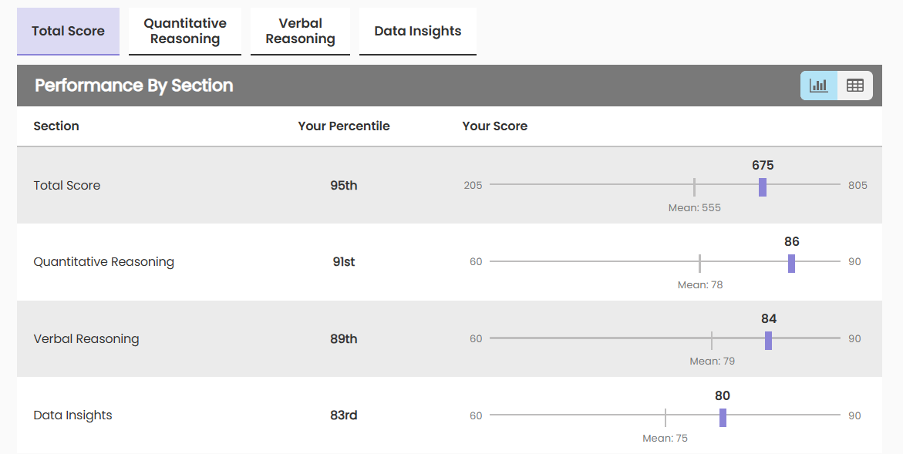
I'm Vivek, and I recently scored a 675 (Q86, V84, DI80) on my second GMAT attempt, improving from my initial score of 645. I wanted to share my journey because it taught me some hard lessons about the difference between working hard and working smart on the GMAT.
My target is top Indian MBA colleges like ISB and IIM A,B,C so I knew I needed to push beyond the 645 I scored on my first attempt.
The Reality Check: When 20 Mocks Don't Help
Let me start with a confession that might make some of you laugh - before joining e-GMAT, I gave 18-20 mocks. Yes, you read that right. Twenty mocks! I thought volume would somehow magically improve my score.
My scores kept fluctuating between 615-655, and I couldn't figure out why. I was stuck in this cycle of taking mock after mock, getting frustrated with inconsistent scores, and then taking another mock hoping things would change. It was like being on a hamster wheel - lots of movement, zero progress.
The problem wasn't that I wasn't working hard enough. The problem was that I had no systematic approach to improvement.
Finding Structure: e-GMAT Course
After my disappointing first attempt, I knew I needed help. I researched various options and came across through YouTube videos and Reddit discussions (this community, actually!). What drew me to e-GMAT was their Last Mile Push program was the promise of personalized mentorship and structured preparation.
I scheduled a consultation call where Amruth from e-GMAT analysed my performance and explained how they could help me improve systematically. The idea of having a dedicated mentor who could guide me through my weak areas was exactly what I felt I needed.
Verbal: From Guessing to Methodology (V84)
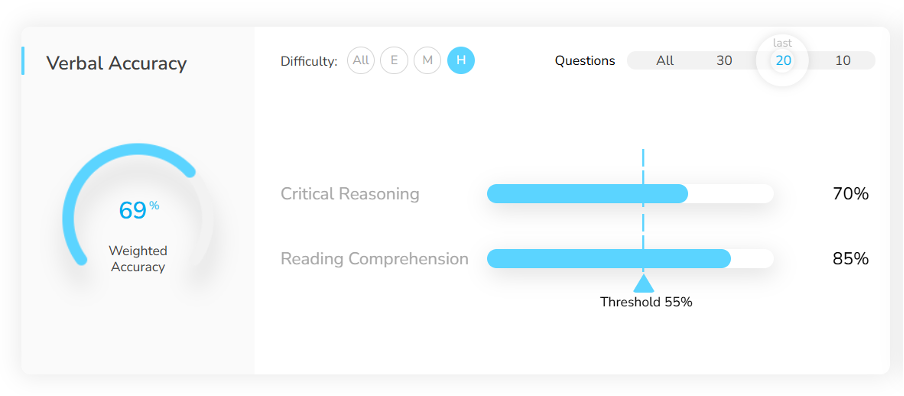
Verbal was my weakest section, and honestly, my approach was embarrassing. I'd read the argument, read the question, go through all five answer choices, and then... guess between the two that seemed "most likely." Every. Single. Time.
I was consistently getting stuck between two options in CR, and my RC approach was basically hoping for the best after a quick skim.
The Master Comprehension Foundation
Before jumping into CR and RC, e-GMAT had me complete their Master Comprehension course. This was a game-changer that I didn't even know I needed. The course taught me fundamental reading skills - how to break down complex sentences, understand author intent, and process information efficiently.
This foundation course improved my reading and information processing abilities, which made a significant difference in how I approached question stems across all verbal sections. I realized I wasn't just weak in CR or RC - I had fundamental comprehension gaps that were affecting everything.
The Pre-thinking Revolution in CR
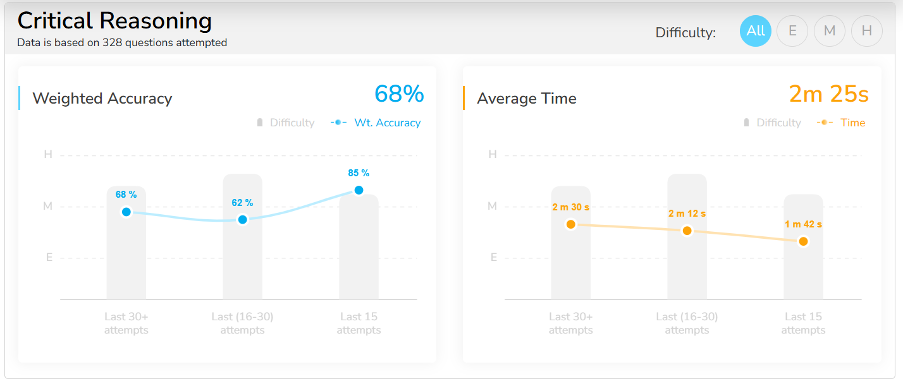
The game-changer was learning e-GMAT's pre-thinking approach in Critical Reasoning. This wasn't just another technique - it completely transformed how I approached CR questions.
Instead of jumping straight to answer choices, I started having a conversation with myself after reading each question:
Reading Comprehension: Structured Reading Strategy
My RC transformation came from e-GMAT's structured reading approach. Instead of trying to memorize every detail, I learned to read "like an author trying to convince someone else."
The course taught me:
Quant: PACE Engine and Smart Practice (Q86)
Quant was always my stronger section, but I was making the same volume-over-strategy mistake here too.
The PACE Engine Advantage
e-GMAT's PACE engine was incredibly valuable for quant. Instead of going through every single concept lesson, PACE helped me identify exactly what I needed to focus on. It showed me that my concepts were generally solid, but I had specific application gaps in topics like permutations and combinations, and mixtures and allegations.
Cementing Process and Scholaranium
The cementing quizzes were eye opener. These weren't easy confidence-building questions - they were challenging, GMAT-style questions that exposed my behavioural errors. I realized I was solving questions correctly but marking wrong answers, or misreading what questions were actually asking.
e-GMAT's Scholaranium platform provided detailed analytics showing exactly where I was making mistakes. Was I making calculation errors? Misreading questions? Choosing wrong answer choices despite solving correctly? The pattern recognition was invaluable.
Data Insights
DI was initially intimidating because my previous coaching had very limited DI content. e-GMAT's DI course was comprehensive - covering everything from basic graph analysis to advanced multi-source reasoning, two-part analysis, and data sufficiency with verbal elements.
Understanding Question Variety
The course opened my eyes to the variety within each DI subsection. I learned about different types of graphs, correlation analysis (strong vs. weak correlations), and various table interpretation techniques. These fundamentals were crucial - without knowing these minute concepts, you either spend too much time figuring things out or mark wrong answers.

Leveraging Verbal Skills in DI
What really helped was understanding that DI improvement wasn't separate from verbal improvement. As my RC skills got stronger through the Master Comprehension course, I could handle Multi-Source Reasoning questions much better because I could process and organize information from multiple sources effectively.
The DI course also included DI-specific verbal questions, which bridged my improving verbal skills with quantitative reasoning.
The Last Mile Push Program: Personalized Mentorship
I can't overstate how valuable the Last Mile Push program was. My mentor Abha guided me through every step of the process, from identifying my specific weaknesses to creating targeted practice plans.
The Feedback Loop Process
Without mentorship, I would have continued my old pattern of blindly solving questions without understanding my mistakes. This systematic approach replaced my previous scattershot method, this time around I had a clear path to follow for each section and when I faltered and did not meet the desired metrics Abha would pitch in and help with improvement steps that got me to 80% accuracy on Medium and 70% on Hard questions.
Mock Test Strategy: Sigma-X
My mock strategy completely transformed with e-GMAT's approach.
Quality Over Quantity
Instead of my previous 20 random mocks, I focused on:
The Sigma-X mocks were challenging and closely resembled the actual GMAT. My scores improved from the 615-655 range to 715, showing genuine improvement rather than random fluctuation.
The detailed analytics after each mock showed exactly where I was making mistakes and how to improve. The mock reports integrated with my overall Scholaranium progress tracking.
Test Day: Managing the Unexpected
Test day taught me another crucial lesson: expect the unexpected and trust your preparation.
My quant section went smoothly using the systematic approach I'd learned. Verbal also went well using my pre-thinking methodology and structured reading.
But DI threw me a curveball. I got 5-6 Data Sufficiency questions in a row, which made me panic thinking something was wrong with my performance. The key lesson: don't overthink the question selection algorithm. You have a question in front of you - solve it with the methodology you've practiced.
Despite making more errors in DI (10 vs 8 in my first attempt), my score actually improved from DI77 to DI80 because the questions were likely more challenging.
Final Advice
If you're scoring in the 645-655 range and feeling stuck, don't fall into the trap I did of thinking more practice alone will help. You need:
Thanks.

GMAT-Club-Forum-weq8brym.png [ 66.64 KiB | Viewed 776 times ]

GMAT-Club-Forum-g7mmeysv.png [ 65.14 KiB | Viewed 779 times ]

GMAT-Club-Forum-v4upflv5.png [ 66.19 KiB | Viewed 772 times ]

GMAT-Club-Forum-6d5mswfo.png [ 55.49 KiB | Viewed 760 times ]
I'm Vivek, and I recently scored a 675 (Q86, V84, DI80) on my second GMAT attempt, improving from my initial score of 645. I wanted to share my journey because it taught me some hard lessons about the difference between working hard and working smart on the GMAT.
My target is top Indian MBA colleges like ISB and IIM A,B,C so I knew I needed to push beyond the 645 I scored on my first attempt.
The Reality Check: When 20 Mocks Don't Help
Let me start with a confession that might make some of you laugh - before joining e-GMAT, I gave 18-20 mocks. Yes, you read that right. Twenty mocks! I thought volume would somehow magically improve my score.
My scores kept fluctuating between 615-655, and I couldn't figure out why. I was stuck in this cycle of taking mock after mock, getting frustrated with inconsistent scores, and then taking another mock hoping things would change. It was like being on a hamster wheel - lots of movement, zero progress.
The problem wasn't that I wasn't working hard enough. The problem was that I had no systematic approach to improvement.
Finding Structure: e-GMAT Course
After my disappointing first attempt, I knew I needed help. I researched various options and came across through YouTube videos and Reddit discussions (this community, actually!). What drew me to e-GMAT was their Last Mile Push program was the promise of personalized mentorship and structured preparation.
I scheduled a consultation call where Amruth from e-GMAT analysed my performance and explained how they could help me improve systematically. The idea of having a dedicated mentor who could guide me through my weak areas was exactly what I felt I needed.
Verbal: From Guessing to Methodology (V84)
Verbal was my weakest section, and honestly, my approach was embarrassing. I'd read the argument, read the question, go through all five answer choices, and then... guess between the two that seemed "most likely." Every. Single. Time.
I was consistently getting stuck between two options in CR, and my RC approach was basically hoping for the best after a quick skim.
The Master Comprehension Foundation
Before jumping into CR and RC, e-GMAT had me complete their Master Comprehension course. This was a game-changer that I didn't even know I needed. The course taught me fundamental reading skills - how to break down complex sentences, understand author intent, and process information efficiently.
This foundation course improved my reading and information processing abilities, which made a significant difference in how I approached question stems across all verbal sections. I realized I wasn't just weak in CR or RC - I had fundamental comprehension gaps that were affecting everything.
The Pre-thinking Revolution in CR
The game-changer was learning e-GMAT's pre-thinking approach in Critical Reasoning. This wasn't just another technique - it completely transformed how I approached CR questions.
Instead of jumping straight to answer choices, I started having a conversation with myself after reading each question:
- "Okay, they want me to strengthen this argument. What would actually make this argument stronger?"
- "This is asking for an assumption. What must be true for this conclusion to hold?"
- "They want me to weaken this. What would create doubt about this conclusion?"
Reading Comprehension: Structured Reading Strategy
My RC transformation came from e-GMAT's structured reading approach. Instead of trying to memorize every detail, I learned to read "like an author trying to convince someone else."
The course taught me:
- How to identify the author's main point and supporting arguments
- How to create mental roadmaps of passages for quick question navigation
Quant: PACE Engine and Smart Practice (Q86)
Quant was always my stronger section, but I was making the same volume-over-strategy mistake here too.
The PACE Engine Advantage
e-GMAT's PACE engine was incredibly valuable for quant. Instead of going through every single concept lesson, PACE helped me identify exactly what I needed to focus on. It showed me that my concepts were generally solid, but I had specific application gaps in topics like permutations and combinations, and mixtures and allegations.
Cementing Process and Scholaranium
The cementing quizzes were eye opener. These weren't easy confidence-building questions - they were challenging, GMAT-style questions that exposed my behavioural errors. I realized I was solving questions correctly but marking wrong answers, or misreading what questions were actually asking.
e-GMAT's Scholaranium platform provided detailed analytics showing exactly where I was making mistakes. Was I making calculation errors? Misreading questions? Choosing wrong answer choices despite solving correctly? The pattern recognition was invaluable.
Data Insights
DI was initially intimidating because my previous coaching had very limited DI content. e-GMAT's DI course was comprehensive - covering everything from basic graph analysis to advanced multi-source reasoning, two-part analysis, and data sufficiency with verbal elements.
Understanding Question Variety
The course opened my eyes to the variety within each DI subsection. I learned about different types of graphs, correlation analysis (strong vs. weak correlations), and various table interpretation techniques. These fundamentals were crucial - without knowing these minute concepts, you either spend too much time figuring things out or mark wrong answers.
Leveraging Verbal Skills in DI
What really helped was understanding that DI improvement wasn't separate from verbal improvement. As my RC skills got stronger through the Master Comprehension course, I could handle Multi-Source Reasoning questions much better because I could process and organize information from multiple sources effectively.
The DI course also included DI-specific verbal questions, which bridged my improving verbal skills with quantitative reasoning.
The Last Mile Push Program: Personalized Mentorship
I can't overstate how valuable the Last Mile Push program was. My mentor Abha guided me through every step of the process, from identifying my specific weaknesses to creating targeted practice plans.
The Feedback Loop Process
Without mentorship, I would have continued my old pattern of blindly solving questions without understanding my mistakes. This systematic approach replaced my previous scattershot method, this time around I had a clear path to follow for each section and when I faltered and did not meet the desired metrics Abha would pitch in and help with improvement steps that got me to 80% accuracy on Medium and 70% on Hard questions.
Mock Test Strategy: Sigma-X
My mock strategy completely transformed with e-GMAT's approach.
Quality Over Quantity
Instead of my previous 20 random mocks, I focused on:
- 5 Sigma-X mocks from e-GMAT
- 2 official MBA dot com mocks
- Thorough analysis of every single mock
The Sigma-X mocks were challenging and closely resembled the actual GMAT. My scores improved from the 615-655 range to 715, showing genuine improvement rather than random fluctuation.
The detailed analytics after each mock showed exactly where I was making mistakes and how to improve. The mock reports integrated with my overall Scholaranium progress tracking.
Test Day: Managing the Unexpected
Test day taught me another crucial lesson: expect the unexpected and trust your preparation.
My quant section went smoothly using the systematic approach I'd learned. Verbal also went well using my pre-thinking methodology and structured reading.
But DI threw me a curveball. I got 5-6 Data Sufficiency questions in a row, which made me panic thinking something was wrong with my performance. The key lesson: don't overthink the question selection algorithm. You have a question in front of you - solve it with the methodology you've practiced.
Despite making more errors in DI (10 vs 8 in my first attempt), my score actually improved from DI77 to DI80 because the questions were likely more challenging.
Final Advice
If you're scoring in the 645-655 range and feeling stuck, don't fall into the trap I did of thinking more practice alone will help. You need:
- Strong foundations
- Systematic methodologies
- Smart practice tools (PACE, cementing, custom quizzes)
- Analytics to track progress
- Expert guidance (mentorship to avoid wasted effort)
Thanks.
Attachment:
GMAT-Club-Forum-weq8brym.png [ 66.64 KiB | Viewed 776 times ]
Attachment:
GMAT-Club-Forum-g7mmeysv.png [ 65.14 KiB | Viewed 779 times ]
Attachment:
GMAT-Club-Forum-v4upflv5.png [ 66.19 KiB | Viewed 772 times ]
Attachment:
GMAT-Club-Forum-6d5mswfo.png [ 55.49 KiB | Viewed 760 times ]




vivek_singh
This is a great point. Tactics and tricks can only carry a test taker so far if the foundational skills are not solid.
vivek_singh
And/or maybe there are a few experimental questions in there that are not scored.
Thanks for the detail debrief.









