Events & Promotions
|
|

GMAT Club Daily Prep
Thank you for using the timer - this advanced tool can estimate your performance and suggest more practice questions. We have subscribed you to Daily Prep Questions via email.
Customized
for You
Track
Your Progress
Practice
Pays
Not interested in getting valuable practice questions and articles delivered to your email? No problem, unsubscribe here.
 Sep 15
07:00 PM EDT
-09:00 PM EST
Elite scores are possible when you enroll in a powerful GMAT course, taught live online + 6 months access to TTP OnDemand video courses included! Class starts Tues/Thurs Sept. 15, 2026 - Nov. 15, 2027, 7:00pm-9:00pm EST Sep 21
07:00 PM EDT
-10:00 PM EDT
Boost your GMAT score in less than one month in a live online class + 6 months access to TTP OnDemand video courses included! Class starts Mon, Tues, Wed, Thur, Fri Sept. 21, 2026 - Oct. 9, 2027, 7:00pm-10:00pm EST

 31 Jul 2021, 10:51
Kudos
Bookmarks
GMAT Scores for Top Business Schools
So, you know you want to apply to top MBA programs, and you know you need a good GMAT score to stand out in the highly competitive business school admissions process. But what exactly is a good GMAT score when it comes to top schools?In this article, we’ll take a look at the average GMAT scores for top business schools in the US, using the 2022 MBA rankings by US News & World Report as our guide for which schools currently make the top 10. We’ll also look at the GMAT score range for top business schools and discuss how to determine where you need to fall in that range in order to get your MBA application noticed.
First things first, let’s take a look at which schools ranked in the top 10 in US News’ 2022 list of the Best Business Schools (there are actually more than 10) and just how competitive these schools are.
MBA Admissions at the Top Business Schools
Getting a seat at a top-ranked business school is no easy feat, even for those who are used to being at the head of the class. The top schools in the US are — no surprise here — generally the most competitive, with low acceptance rates and all-star MBA classes boasting high GMAT test scores, near-perfect GPAs, and other stellar stats.So, let’s take a look at just how stiff the competition was for a spot in the class of 2022 at a top 10 school.
The Class of 2022 at the Top 10 Schools
The table below provides key stats including each full-time MBA program’s 2022 US News ranking, the number of applications received for enrollment in fall 2020, the percentage of applicants accepted, and the average GPA and years of work experience of the enrolled class.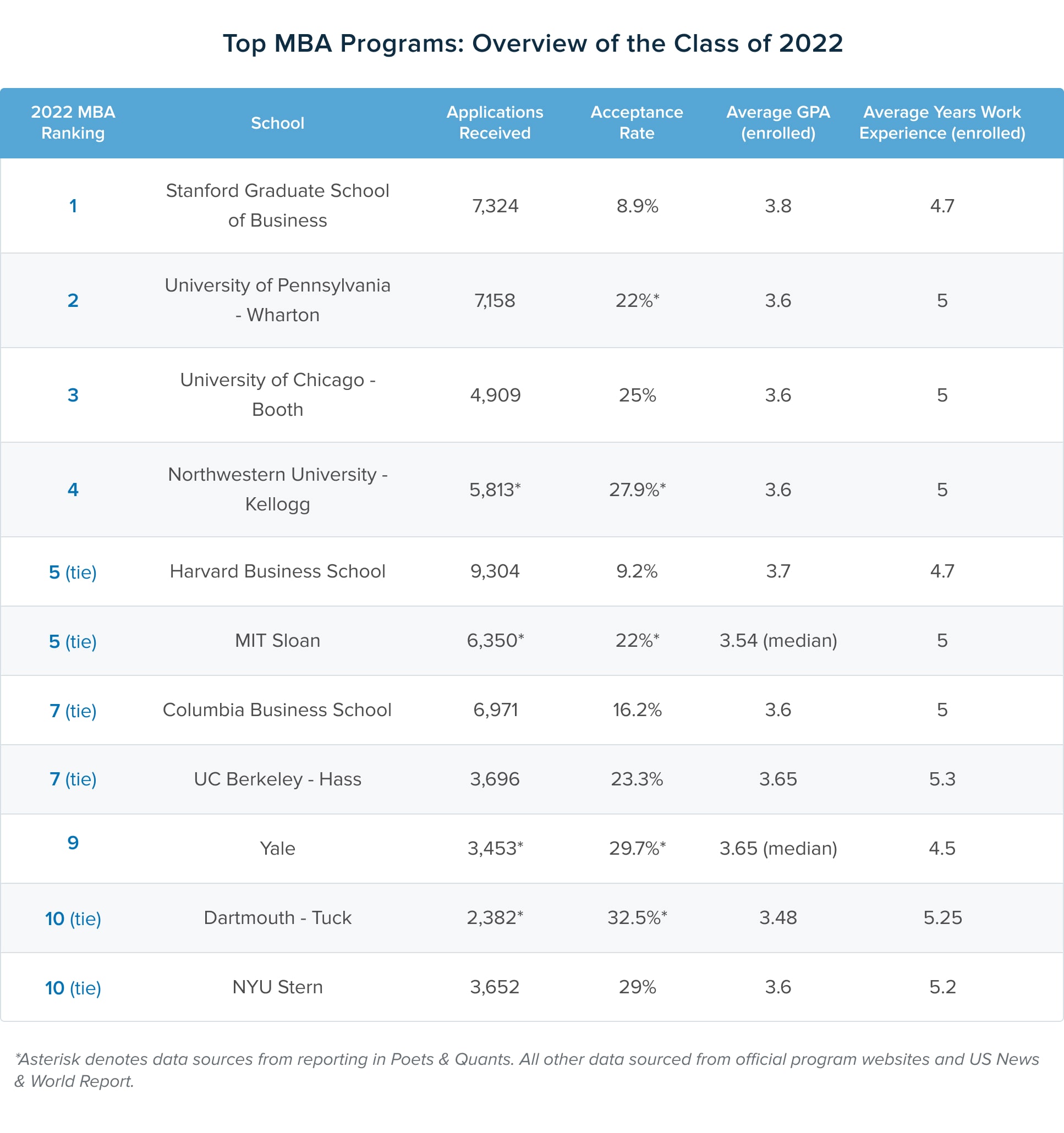
More importantly, we can see that having a relatively low acceptance rate and a relatively high average GPA doesn’t necessarily place a school near the top of the list. Harvard Business School is a prime example: with a razor-thin acceptance rate of 9.2% and a top-notch GPA of 3.7, we might expect HBS to land in the #2 spot, right below Stanford, whose acceptance rate and average GPA of 8.9% and 3.8, respectively, are pretty comparable to HBS’s. Yet, Harvard ties in the #5 spot with MIT, which has a significantly higher (though still formidable) acceptance rate of 22% and a somewhat lower GPA of 3.54 (note that this is a median, not an average).
The fact is, MBA rankings are not as cut-and-dried as whose acceptance rate is the lowest and GPA is the highest — though Stanford does beat the competition on both counts. MBA rankings are calculated taking numerous factors into account, everything from acceptance rates and academic stats to the average salaries of program graduates and even the perception of programs by peers in academia.
In short, these calculations are not straightforward, and these rankings are, to some degree, subjective. This point becomes quite clear if you’ve ever compared annual rankings from multiple publications — no two lists are exactly alike. Nevertheless, you will notice many of the same schools popping up on every list, though their ranks are likely to shift depending on the source. For instance, the Financial Times’ 2021 Global MBA Ranking put Yale in the #5 spot; Yale sits at #9 on US News’ list. Similarly, NYU Stern, which ties with Dartmouth at #10 on the US News list, sits in the #4 spot on The Economist’s 2021 ranking of full-time MBA programs.
So, there are no hard and fast rules when it comes to MBA rankings. However, if you’re interested in applying to top business schools, whether top 5, M7, or top 10 schools, there is some useful information to glean from our table above. Let’s dive into some of the highlights to keep in mind before we get to the meat of our discussion: GMAT scores.
Evaluating Top 10 MBA Admissions Stats
There are a few important general conclusions we can reach based on the data we saw in the table above.First, we can conclude that, generally speaking, top 10 MBA programs accept less than 1/3 of applicants. In fact, nearly all of these top schools accept less than 30%, with Dartmouth being the exception. (Note that according to the data we found, the average acceptance rate of the top schools was 22.34%). So, all else equal, we have a general sense of any student’s chances of gaining admittance to a top business school.
Secondly, all else equal, we can say that a GPA above 3.5, and between 4.5 and 5 years of work experience, is likely to put you in line with the average accepted student at these top 10 schools. These averages are especially important to keep in mind because if you fall below them, you will need to make up for those deficits in other aspects of your applicant profile in order to remain competitive.
Of course, one great way to put that extra shine on your application is with an impressive GMAT score. So, before we discuss how to set your unique score goal for a top business school, let’s take a look at what the GMAT score ranges and average GMAT scores for top schools are.
To read the complete article, view my full article on Target Test Prep’s blog.

Moderator:






