Events & Promotions
|
|

GMAT Club Daily Prep
Thank you for using the timer - this advanced tool can estimate your performance and suggest more practice questions. We have subscribed you to Daily Prep Questions via email.
Customized
for You
Track
Your Progress
Practice
Pays
Not interested in getting valuable practice questions and articles delivered to your email? No problem, unsubscribe here.
 Aug 27
10:00 AM EDT
-11:00 AM EDT
We’ve worked incredibly hard to build TTP into the best test prep experience possible, and it would mean a lot to us to win Newsweek’s 2026 Readers’ Choice Award for Best Test Prep. If TTP has helped you, we’d be incredibly grateful for your vote. Sep 02
01:00 PM EDT
-11:59 PM EDT
Take 30% off all study plans with code COURSEWORK - Expires on Monday 9/7 Sep 04
10:00 AM PDT
-11:00 AM PDT
What does test anxiety really look like on the GMAT? For many test takers, it does not look like a panic attack. Instead, it shows up as brain fog, rereading, negative comparisons, mental noise.... Sep 06
09:30 AM EDT
-12:30 PM EST
Top scores are possible when you enroll in a powerful EA course, taught live online + 6 months access to TTP OnDemand video courses included! Perfect class schedule and easy course access for working professionals. Class starts Sundays Sept. 6, 2026.- Sep 07
12:01 AM PDT
-11:59 PM PDT
On the 7th, GMAT Club Tests will be Free! Including all the Quizzes, Questions, and Tests. 12 AM - 11:59 PM PDT - Sep 09
07:00 AM PDT
-10:00 AM PDT
Meet AdComs and explore top Master’s programs - MiM, MiF, MSc, MSBA and more. - Application Fee Waivers - Free 1-Week of GMAT Club Tests: - Master's Application Toolkit - Grand Prize Giveaway  Sep 15
07:00 PM EDT
-09:00 PM EST
Elite scores are possible when you enroll in a powerful GMAT course, taught live online + 6 months access to TTP OnDemand video courses included! Class starts Tues/Thurs Sept. 15, 2026 - Nov. 15, 2027, 7:00pm-9:00pm EST Sep 21
08:00 PM EDT
-10:00 PM EDT
Boost your GMAT score in less than one month in a live online class + 6 months access to TTP OnDemand video courses included! Class starts Mon, Tues, Wed, Thur, Fri Sept. 21, 2026 - Oct. 9, 2027, 7:00pm-10:00pm EST

 28 Jul 2021, 10:59
Kudos
Bookmarks
GMAT Topics: Which Are Most Common?
There is no getting around the fact that scoring high on the GMAT requires a substantial amount of study time for the vast majority of test-takers. A big part of the reason why GMAT prep requires so much time and effort is not that GMAT content is so hard to learn, but that there is so much of it to learn.Understandably, then, pretty much all GMAT students wonder whether they can make their GMAT prep more strategic by spending the majority of their study time on certain topics and not worrying so much about other topics. In fact, one of the most common questions I hear from my students is, Which GMAT topics and question types am I most likely to see in the Quant and Verbal sections?
In this article, we’ll take a look at what the GMAT topics are and examine why the popular question of how common each topic is doesn’t have such a clear-cut answer. Most importantly, we’ll discuss why trying to find a concrete answer to that question is actually a poor use of your time.
First, let’s review what we can say for sure about the topics tested in the Verbal and Quantitative sections of the GMAT.
GMAT Topics: What We Know For Sure
First, we know that, on any given GMAT exam, you’re going to see only 31 Quant questions and 36 Verbal questions, including experimental (unscored) questions. Let’s review the question types you’ll see in each of those sections of the GMAT.The GMAT Quant Section
In the Quant section, about 2/3 of the questions you see will be Problem Solving (PS) questions (questions in which you must actually solve the problem). The other roughly 1/3 of the questions you see will be Data Sufficiency (DS) questions (questions in which you must determine whether you have enough information to solve the problem). So, you can expect about 20 or 21 of the Quant questions you see on the exam to be PS questions and about 10 or 11 to be DS questions.In the broadest sense, these questions will cover concepts related to arithmetic, algebra, and geometry. These 3 broad categories are encompassed by 21 major GMAT Quant topics:
- Basic Arithmetic
- Linear and Quadratic Equations
- Number Properties
- Roots
- Exponents
- Inequalities
- Absolute Values
- General Word Problems
- Rates
- Work Problems
- Unit Conversions
- Ratios
- Percents
- Statistics
- Overlapping Sets
- Combinations and Permutations
- Probability
- Geometry
- Coordinate Geometry
- Sequences
- Functions
Each of these 21 topics break down into various subtopics, encompassing hundreds of concepts. For instance, within Number Properties, you have to learn about even and odd numbers, divisibility, remainders, units digit patterns, least common multiple, greatest common factor, and more. Number Properties happens to be the most wide-ranging topic tested in the GMAT Quant section, but make no mistake: every Quant topic contains multiple subtopics, any of which could pop up on your exam. For Linear and Quadratic Equations, you’ll need to study solving for one variable, solving for two variables, factoring, FOILing, the difference of squares, and more. For Rates questions, you’ll need to study average rates, converging rates, diverging rates, catch-up rates, catch-up and pass, and more. The list goes on.
We’ll talk more about what the wide range of concepts tested means in terms of strategically focusing your GMAT study. For now, let’s take a look at what we know about the GMAT Verbal section topics.
The GMAT Verbal Section
The GMAT Verbal section tests your skills in effective use of language, logical reasoning, and reading comprehension using 3 question types: Sentence Correction (SC), Critical Reasoning (CR), and [url=GMAT Reading Comprehension Tips: Top 8 DOs and DON’Ts]Reading Comprehension (RC)[/url]. Each of these question types comprises approximately 1/3 of the Verbal questions you will see on the exam, give or take. For instance, you could see 10 CR questions on your exam, or you could see 13. As we’ll discuss further in this article, nothing about the makeup of anyone GMAT exam is entirely predictable!The concepts tested in Verbal section can be categorized into 23 major topics:
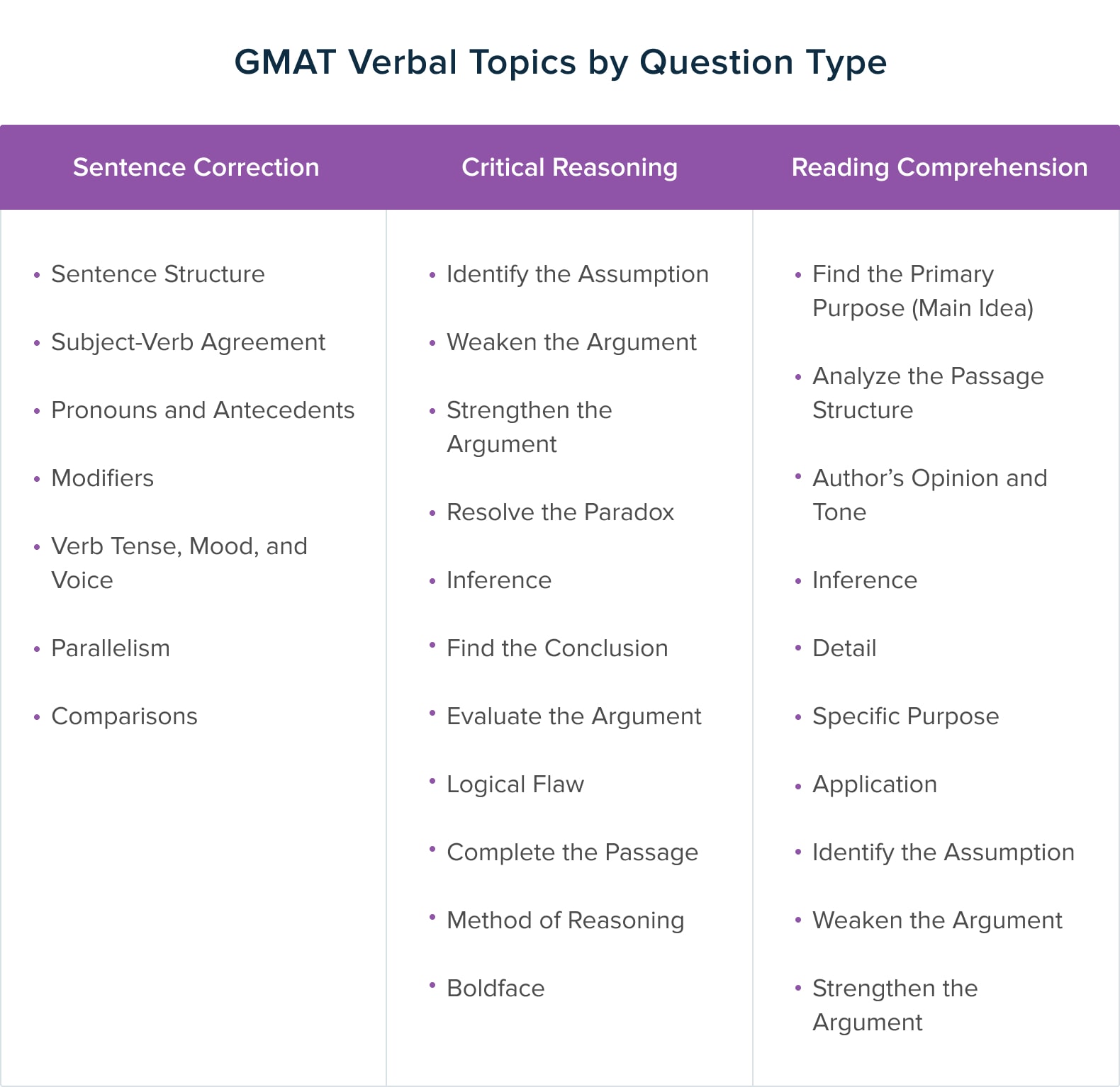
As with Quant, the major topics that are tested in the Verbal section break down into multiple subtopics involving numerous concepts. For instance, when studying Pronouns and Antecedents in SC, you’ll need to learn about pronoun-antecedent agreement, multiple antecedents, missing antecedents, possessive antecedents, and more.
When studying Weaken the Argument questions in CR, you’ll need to learn about assumptions as weakeners, false dichotomies, cause-and-effect, pseudo-weakeners, weakening the wrong conclusion, and more.
When learning how to analyze passage structure in RC, you’ll need to learn about structural keywords, how sentences relate within a paragraph, how different paragraphs relate to each other, and more.
You’ll notice that there is some overlap in the CR and RC topics (duplicate topics were not counted twice in the total). Interestingly, although the skills you need are fundamentally the same for overlapping topics in CR and RC, the frequency with which you see those topics tested in CR and RC type may differ.
For instance, in Critical Reasoning, Weaken, Strengthen, and Assumption questions are the most common question types, whereas in Reading Comprehension, those question types are rare. (Primary Purpose questions are, generally speaking, the most common question type in RC.)
Now, what does this knowledge about Weaken, Strengthen, and Assumption questions in CR vs. RC tell us on a practical level? In other words, in what way would we change our study plan in light of the fact that these question types are common in CR but not in RC? After all, if for example, we were to see 2 Weaken, 2 Assumption, and 1 Strengthen question in CR, and just 1 Assumption question in RC, we still needed to hone our skills in all of these question types to be prepared for GMAT Verbal, didn’t we? Would you say that you wasted your time studying Strengthen questions because you happened to see only 1 on your exam?
Had the dice rolled a different way, you could’ve easily seen a total of 3 Strengthen questions between CR and RC. In that case, wouldn’t you be glad you didn’t neglect that topic in your GMAT prep?
Let’s explore this last point further because it’s an incredibly important one.
To read the complete article, view my full article on Target Test Prep’s blog.


 28 Jul 2021, 19:27
Kudos
Bookmarks
Great post! I have done some analysis of the Official Guide and GMAT Prep. You can see that there are noticeable difference between the 2
here is what I found:
Quant: https://gmatclub.com/forum/gmat-prep-vs ... 47092.html
Verbal: https://gmatclub.com/forum/hardest-verbal-questions-tested-on-the-gmat-prep-software-345076.html
here is what I found:
Quant: https://gmatclub.com/forum/gmat-prep-vs ... 47092.html
Verbal: https://gmatclub.com/forum/hardest-verbal-questions-tested-on-the-gmat-prep-software-345076.html
Moderators:
229 posts








