Events & Promotions
|
|

GMAT Club Daily Prep
Thank you for using the timer - this advanced tool can estimate your performance and suggest more practice questions. We have subscribed you to Daily Prep Questions via email.
Customized
for You
Track
Your Progress
Practice
Pays
Not interested in getting valuable practice questions and articles delivered to your email? No problem, unsubscribe here.
 Sep 04
10:00 AM PDT
-11:00 AM PDT
What does test anxiety really look like on the GMAT? For many test takers, it does not look like a panic attack. Instead, it shows up as brain fog, rereading, negative comparisons, mental noise.... Sep 02
01:00 PM EDT
-11:59 PM EDT
Take 30% off all study plans with code COURSEWORK - Expires on Monday 9/7 Sep 06
09:30 AM EDT
-12:30 PM EST
Top scores are possible when you enroll in a powerful EA course, taught live online + 6 months access to TTP OnDemand video courses included! Perfect class schedule and easy course access for working professionals. Class starts Sundays Sept. 6, 2026.- Sep 07
12:01 AM PDT
-11:59 PM PDT
On the 7th, GMAT Club Tests will be Free! Including all the Quizzes, Questions, and Tests. 12 AM - 11:59 PM PDT - Sep 07
10:00 AM PDT
-11:00 AM PDT
A complete walkthrough of GMAT Club’s free 12-week GMAT study plan: what you study each week, how progress and goals are tracked, how the error log works, and how your practice unlocks paid tools at no cost. - Sep 09
07:00 AM PDT
-10:00 AM PDT
Meet AdComs and explore top Master’s programs - MiM, MiF, MSc, MSBA and more. - Application Fee Waivers - Free 1-Week of GMAT Club Tests: - Master's Application Toolkit - Grand Prize Giveaway - Sep 09
10:00 AM PDT
-11:00 AM PDT
Three MBA applications. Three rejections. No interview invites. A year later, Aman was admitted to Cambridge Judge, SMU, and IMD. In this episode of MBA Admit Stories, Aman shares how he rebuilt his MBA application...  Sep 15
07:00 PM EDT
-09:00 PM EST
Elite scores are possible when you enroll in a powerful GMAT course, taught live online + 6 months access to TTP OnDemand video courses included! Class starts Tues/Thurs Sept. 15, 2026 - Nov. 15, 2027, 7:00pm-9:00pm EST Sep 21
08:00 PM EDT
-10:00 PM EDT
Boost your GMAT score in less than one month in a live online class + 6 months access to TTP OnDemand video courses included! Class starts Mon, Tues, Wed, Thur, Fri Sept. 21, 2026 - Oct. 9, 2027, 7:00pm-10:00pm EST


 30 May 2024, 06:03
Kudos
Bookmarks
Hi everyone, I’m Akash, and I recently scored 695 on the GMAT with a Q90, D83, and V81. It’s been an incredible journey, starting from a 615 and improving by 80 points in three months. I hope sharing my experience will inspire and guide you on your path to success.
So here we go:
When I started my GMAT journey, my first mock score was 615. It was evident that my Verbal and DI sections needed a lot of work. I had timing and accuracy issues, and I wasn't sure where to begin. A friend recommended e-GMAT, and after reading reviews about it, I decided to give it a try.
As I started with a 615, I was onboarded into the Last Mile Push (LMP) program of e-GMAT. The LMP program provided structured metrics and personalized guidance, which were instrumental in my success. The program helped me set clear targets, such as Q90, DI82, and V83, with an overall goal of achieving a score of 695-705. My entire journey was broken down into 7 milestones, which included fine-tuning my skills in Verbal, DI, and Quant, followed by the test readiness phase. Each milestone had laid out steps that I had to follow, ensuring a systematic approach to my preparation.
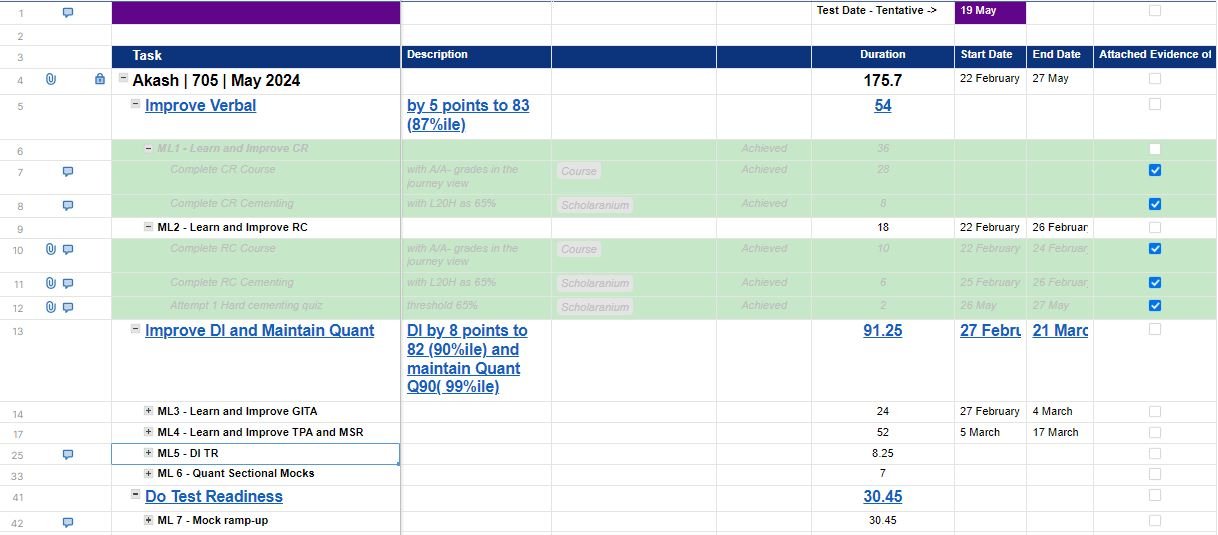
Regular feedback and mentoring sessions with Abha my mentor kept me on track and boosted my confidence.
Verbal
In Verbal, I started with a V77 (33rd percentile) and was suggested to complete the course. I began with the Master Comprehension course, which was fundamental in teaching me how to break down arguments—a crucial skill for CR and RC.
The pre-thinking approach in CR was a game-changer for me. Initially, it was tough to stick to this process, but with consistent practice, I saw significant improvements in both my timing and accuracy. Earlier, I did not have a specific approach to solving CR questions and relied more on intuition, but that changed after I was introduced to pre-thinking. My accuracies in specific blocks of Inference and Boldface saw a massive jump, which started reflecting in my quizzes as well.
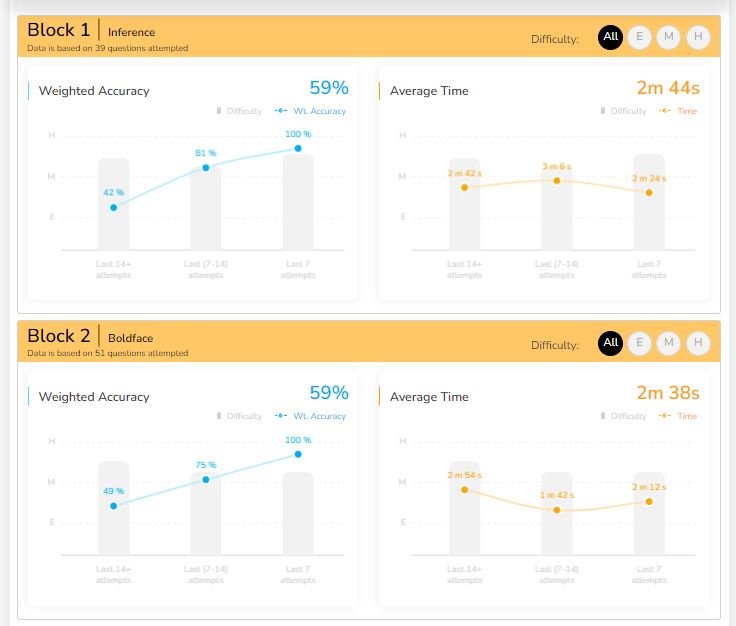
For RC, I focused on breaking down passages and understanding their structure, which helped me immensely. Following this approach—starting with basics and then moving to quizzes—increased my efficiency.
DI
The DI section was particularly challenging as it required a combination of verbal and quant skills. After completing my verbal modules, I found that these skills were beneficial in tackling DI questions. I followed a structured approach in DI, completing the GITA, TPA, DS, and MSR courses and trying to maintain A/A- grades throughout my journey for most of the files as directed by Abha.
Once I completed the course and the cementing stage for each subsection (for those unfamiliar with the cementing stage, it involves focused practice using e-GMAT's Scholaranium question bank, which contains numerous GMAT-style questions designed to build your ability after each section), I transitioned to the sectional tests, known as Test Readiness Quizzes, to validate my proficiency in DI. My goal was to consistently achieve 90% accuracy on medium-level questions and 65% accuracy on hard-level questions to meet my DI target.
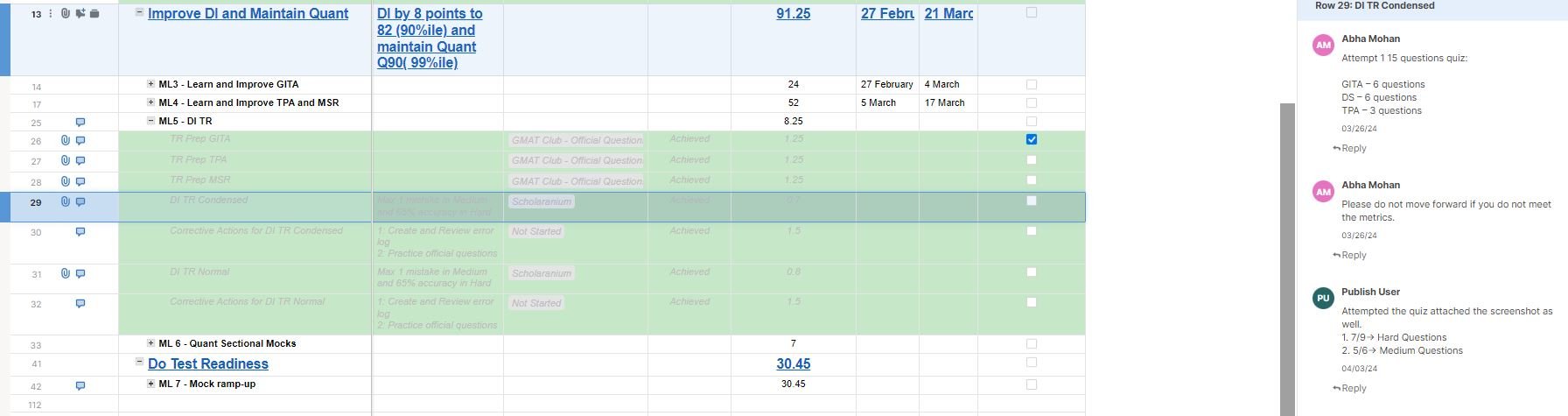
I maintained an error log to track my mistakes and identify patterns. This iterative process was crucial in improving my accuracy and timing and helped me improve from the 51 st percentile to the D83 – This was such a relief…
Quant:
When I began my GMAT preparation, I started with a higher ability in Quant. Given this advantage, I was suggested to take sectional tests once a week to maintain and further hone my skills. During these sectional tests, I consistently met the performance metrics. However, in my official mocks, my scores began to fluctuate, and I received Q86 and Q88. After a careful analysis with Abha, we discovered that my mistakes were often due to behavioural issues rather than conceptual gaps. I was rushing through questions, not following the process meticulously, and frequently missing constraints. Realizing this, I made a conscious effort to slow down and ensure I fully comprehended each question before attempting to solve it. Result – Q90!!!
Mock Phase:
Mocks were an essential part of my preparation, helping me gauge my progress and identify areas for improvement. I took several mocks, including Sigma-X Mocks (675 and 655) and OG Mocks (675, 685, and 675). Both mock algorithms and the types of questions closely mirrored the actual test.
In both the DI and Verbal sections, I initially struggled to finish on time. To tackle this, I was advised to take a few quizzes in a relaxed mode before switching back to standard timing. This strategy helped me get a hold of my pacing and approach, and it made a bigggg difference for the last mocks and on the actual test day.
Test Day Experience
I took the GMAT online, which had its advantages. By avoiding the hassle of traveling to a test center, I could focus better on the exam. I followed the sequence of Quant, Verbal, and DI, taking a break after Verbal. The online test experience was smooth.
During the test, I faced a tricky first question in the Quant section. Initially, I got it wrong, but
fortunately, I had some extra time at the end to revisit and correct it. This change played a crucial role in securing my perfect Q90. Although I felt I could have pushed a bit more in Verbal, my DI performance compensated for it, helping me achieve a 695.
Key Takeaways
1. Structured Approach: Stick to a structured study plan, focusing on foundational concepts, cementing knowledge, and then moving to quizzes.
2. Error Log: Maintain an error log to identify patterns in mistakes and work on them.
3. Mentorship and Support: Seek guidance and feedback to stay on track and boost confidence.
My journey from a 615 to a 695 was made possible by a structured approach, diligent practice, and continuous support from the e-GMAT team. To all GMAT aspirants, stay focused, and best of luck on your GMAT journey!
So here we go:
When I started my GMAT journey, my first mock score was 615. It was evident that my Verbal and DI sections needed a lot of work. I had timing and accuracy issues, and I wasn't sure where to begin. A friend recommended e-GMAT, and after reading reviews about it, I decided to give it a try.
As I started with a 615, I was onboarded into the Last Mile Push (LMP) program of e-GMAT. The LMP program provided structured metrics and personalized guidance, which were instrumental in my success. The program helped me set clear targets, such as Q90, DI82, and V83, with an overall goal of achieving a score of 695-705. My entire journey was broken down into 7 milestones, which included fine-tuning my skills in Verbal, DI, and Quant, followed by the test readiness phase. Each milestone had laid out steps that I had to follow, ensuring a systematic approach to my preparation.
Regular feedback and mentoring sessions with Abha my mentor kept me on track and boosted my confidence.
Verbal
In Verbal, I started with a V77 (33rd percentile) and was suggested to complete the course. I began with the Master Comprehension course, which was fundamental in teaching me how to break down arguments—a crucial skill for CR and RC.
The pre-thinking approach in CR was a game-changer for me. Initially, it was tough to stick to this process, but with consistent practice, I saw significant improvements in both my timing and accuracy. Earlier, I did not have a specific approach to solving CR questions and relied more on intuition, but that changed after I was introduced to pre-thinking. My accuracies in specific blocks of Inference and Boldface saw a massive jump, which started reflecting in my quizzes as well.
For RC, I focused on breaking down passages and understanding their structure, which helped me immensely. Following this approach—starting with basics and then moving to quizzes—increased my efficiency.
DI
The DI section was particularly challenging as it required a combination of verbal and quant skills. After completing my verbal modules, I found that these skills were beneficial in tackling DI questions. I followed a structured approach in DI, completing the GITA, TPA, DS, and MSR courses and trying to maintain A/A- grades throughout my journey for most of the files as directed by Abha.
Once I completed the course and the cementing stage for each subsection (for those unfamiliar with the cementing stage, it involves focused practice using e-GMAT's Scholaranium question bank, which contains numerous GMAT-style questions designed to build your ability after each section), I transitioned to the sectional tests, known as Test Readiness Quizzes, to validate my proficiency in DI. My goal was to consistently achieve 90% accuracy on medium-level questions and 65% accuracy on hard-level questions to meet my DI target.
I maintained an error log to track my mistakes and identify patterns. This iterative process was crucial in improving my accuracy and timing and helped me improve from the 51 st percentile to the D83 – This was such a relief…
Quant:
When I began my GMAT preparation, I started with a higher ability in Quant. Given this advantage, I was suggested to take sectional tests once a week to maintain and further hone my skills. During these sectional tests, I consistently met the performance metrics. However, in my official mocks, my scores began to fluctuate, and I received Q86 and Q88. After a careful analysis with Abha, we discovered that my mistakes were often due to behavioural issues rather than conceptual gaps. I was rushing through questions, not following the process meticulously, and frequently missing constraints. Realizing this, I made a conscious effort to slow down and ensure I fully comprehended each question before attempting to solve it. Result – Q90!!!
Mock Phase:
Mocks were an essential part of my preparation, helping me gauge my progress and identify areas for improvement. I took several mocks, including Sigma-X Mocks (675 and 655) and OG Mocks (675, 685, and 675). Both mock algorithms and the types of questions closely mirrored the actual test.
In both the DI and Verbal sections, I initially struggled to finish on time. To tackle this, I was advised to take a few quizzes in a relaxed mode before switching back to standard timing. This strategy helped me get a hold of my pacing and approach, and it made a bigggg difference for the last mocks and on the actual test day.
Test Day Experience
I took the GMAT online, which had its advantages. By avoiding the hassle of traveling to a test center, I could focus better on the exam. I followed the sequence of Quant, Verbal, and DI, taking a break after Verbal. The online test experience was smooth.
During the test, I faced a tricky first question in the Quant section. Initially, I got it wrong, but
fortunately, I had some extra time at the end to revisit and correct it. This change played a crucial role in securing my perfect Q90. Although I felt I could have pushed a bit more in Verbal, my DI performance compensated for it, helping me achieve a 695.
Key Takeaways
1. Structured Approach: Stick to a structured study plan, focusing on foundational concepts, cementing knowledge, and then moving to quizzes.
2. Error Log: Maintain an error log to identify patterns in mistakes and work on them.
3. Mentorship and Support: Seek guidance and feedback to stay on track and boost confidence.
My journey from a 615 to a 695 was made possible by a structured approach, diligent practice, and continuous support from the e-GMAT team. To all GMAT aspirants, stay focused, and best of luck on your GMAT journey!
Attachments
Image 3.JPG [ 89.51 KiB | Viewed 2169 times ]
Image 2.JPG [ 44.21 KiB | Viewed 2179 times ]
Image 1.JPG [ 90.99 KiB | Viewed 2171 times ]

 30 May 2024, 08:15
Kudos
Bookmarks
Congratulations for score.. all the best for applications
Posted from my mobile device
Posted from my mobile device








