Events & Promotions
|
|

GMAT Club Daily Prep
Thank you for using the timer - this advanced tool can estimate your performance and suggest more practice questions. We have subscribed you to Daily Prep Questions via email.
Customized
for You
Track
Your Progress
Practice
Pays
Not interested in getting valuable practice questions and articles delivered to your email? No problem, unsubscribe here.
 Aug 27
10:00 AM EDT
-11:00 AM EDT
We’ve worked incredibly hard to build TTP into the best test prep experience possible, and it would mean a lot to us to win Newsweek’s 2026 Readers’ Choice Award for Best Test Prep. If TTP has helped you, we’d be incredibly grateful for your vote. Sep 04
10:00 AM PDT
-11:00 AM PDT
What does test anxiety really look like on the GMAT? For many test takers, it does not look like a panic attack. Instead, it shows up as brain fog, rereading, negative comparisons, mental noise.... Sep 06
09:30 AM EDT
-12:30 PM EST
Top scores are possible when you enroll in a powerful EA course, taught live online + 6 months access to TTP OnDemand video courses included! Perfect class schedule and easy course access for working professionals. Class starts Sept. 6, 9:30am-12:30pm EST- Sep 09
07:00 AM PDT
-10:00 AM PDT
Meet AdComs and explore top Master’s programs - MiM, MiF, MSc, MSBA and more. - Application Fee Waivers - Free 1-Week of GMAT Club Tests: - Master's Application Toolkit - Grand Prize Giveaway  Sep 15
07:00 PM EDT
-09:00 PM EST
Elite scores are possible when you enroll in a powerful GMAT course, taught live online + 6 months access to TTP OnDemand video courses included! Class starts Tues/Thurs Sept. 15, 2026 - Nov. 15, 2027, 7:00pm-9:00pm EST Sep 21
08:00 PM EDT
-10:00 PM EDT
Elite scores are possible when you enroll in a powerful GMAT course, taught live online + 6 months access to TTP OnDemand video courses included! Class starts Tues/Thurs Oct. 13, 2026 - Jan. 7, 2027, 8:00pm-10:00pm EST


 27 Nov 2020, 12:11
Kudos
Bookmarks
In the 1920s and 1930s, many well-known chain restaurants—such as Horn & Hardart, Howard Johnson’s, A&W Root Beer, Bob’s Big Boy, Dairy Queen, White Castle, and Marriott Hot Shoppes—emerged in urban areas as walk-up lunch rooms, cafeterias, and hamburger stands. These early chains primarily served urban working populations. As suburban development and automobile travel increased by the mid-20th century, many chains adapted their layouts to include parking and drive-in service. Some new chains also appeared during this period, explicitly targeting automobile-based customers. These changes in design and audience contributed to a shift in how dining out was perceived, turning it from a work-related necessity into a form of entertainment.
In the 1950s, chain restaurant growth accelerated with the widespread use of the franchise model, originally developed by Howard Johnson in the 1930s. This model was successfully adopted by companies such as McDonald’s, Kentucky Fried Chicken, Domino’s, Long John Silver’s, Burger King, and Sonic. Unlike earlier centralized corporate chains, the franchise system allowed local owners to operate individual restaurants under contracts that standardized building design, menus, and service style. These agreements emphasized consistent quality and helped overcome the challenges of managing geographically dispersed locations.
In the 1950s, chain restaurant growth accelerated with the widespread use of the franchise model, originally developed by Howard Johnson in the 1930s. This model was successfully adopted by companies such as McDonald’s, Kentucky Fried Chicken, Domino’s, Long John Silver’s, Burger King, and Sonic. Unlike earlier centralized corporate chains, the franchise system allowed local owners to operate individual restaurants under contracts that standardized building design, menus, and service style. These agreements emphasized consistent quality and helped overcome the challenges of managing geographically dispersed locations.
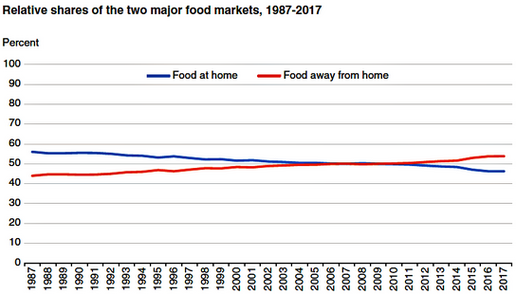
For each of the following statements, select Supported if it can be reasonably inferred from the information provided. Otherwise, select Not Supported.
| Supported | Not Supported | |
| Eating away from home increasingly came to be viewed as a recreational activity. | ||
| Some restaurant chains expanded their appeal beyond their original customer groups. | ||
| Vending machines increased their share of total FAFH expenditures between 1987 and 2017. |
ShowHide Answer
Official Answer
Eating away from home increasingly came to be viewed as a recreational activity.: Supported
Some restaurant chains expanded their appeal beyond their original customer groups.: Supported
Vending machines increased their share of total FAFH expenditures between 1987 and 2017.: Not Supported
27 Nov 2020, 12:11
Kudos
Bookmarks
Official Solution:
Eating away from home increasingly came to be viewed as a recreational activity.
• Tab 1 states that changes in restaurant design and audience contributed to a shift in how dining out was perceived, turning it from a work-related necessity into a form of entertainment. Therefore, this statement is supported. Supported.
Some restaurant chains expanded their appeal beyond their original customer groups.
• Tab 2 states that breakfast-focused chains initially catered to commuters and shift workers but later attracted broader audiences, including families and teenagers seeking leisure activities. Therefore, this statement is supported. Supported.
Vending machines increased their share of total FAFH expenditures between 1987 and 2017.
• Tab 3 states that vending machines were among the non-restaurant sectors whose share of total FAFH expenditures declined between 1987 and 2017. Therefore, this statement is not supported. Not Supported.
Correct answer:
Eating away from home increasingly came to be viewed as a recreational activity. "Supported"
Some restaurant chains expanded their appeal beyond their original customer groups. "Supported"
Vending machines increased their share of total FAFH expenditures between 1987 and 2017. "Not Supported"
Bunuel
Eating away from home increasingly came to be viewed as a recreational activity.
• Tab 1 states that changes in restaurant design and audience contributed to a shift in how dining out was perceived, turning it from a work-related necessity into a form of entertainment. Therefore, this statement is supported. Supported.
Some restaurant chains expanded their appeal beyond their original customer groups.
• Tab 2 states that breakfast-focused chains initially catered to commuters and shift workers but later attracted broader audiences, including families and teenagers seeking leisure activities. Therefore, this statement is supported. Supported.
Vending machines increased their share of total FAFH expenditures between 1987 and 2017.
• Tab 3 states that vending machines were among the non-restaurant sectors whose share of total FAFH expenditures declined between 1987 and 2017. Therefore, this statement is not supported. Not Supported.
Correct answer:
Eating away from home increasingly came to be viewed as a recreational activity. "Supported"
Some restaurant chains expanded their appeal beyond their original customer groups. "Supported"
Vending machines increased their share of total FAFH expenditures between 1987 and 2017. "Not Supported"





