Events & Promotions
|
|

GMAT Club Daily Prep
Thank you for using the timer - this advanced tool can estimate your performance and suggest more practice questions. We have subscribed you to Daily Prep Questions via email.
Customized
for You
Track
Your Progress
Practice
Pays
Not interested in getting valuable practice questions and articles delivered to your email? No problem, unsubscribe here.
 Sep 21
07:00 PM EDT
-10:00 PM EDT
Boost your GMAT score in less than one month in a live online class + 6 months access to TTP OnDemand video courses included!


 12 Nov 2024, 03:10
Kudos
Bookmarks
Dropdown 1: 1960-1990
Dropdown 2: 135 million
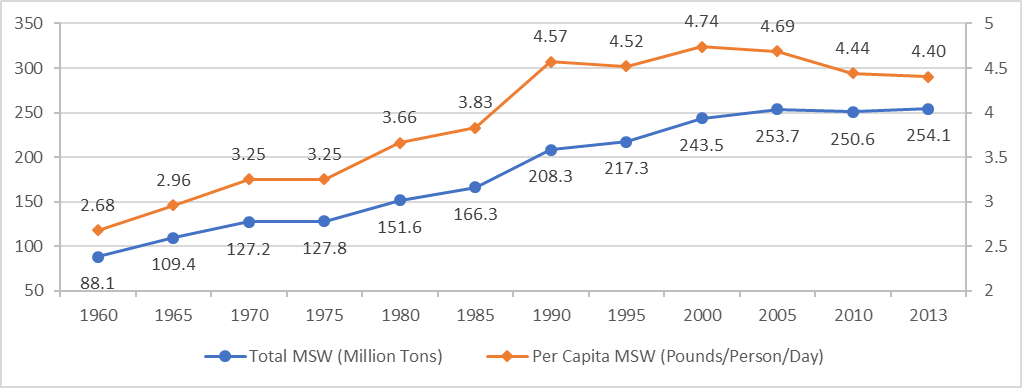
The graph shows the total municipal solid waste (MSW) generated in the United States from 1960 to 2013 (blue line) and the per capita MSW per day (orange line). Total MSW is measured in million tons, while per capita MSW per day is measured in pounds (1 ton = 2,000 pounds).
Select the most accurate option from each drop-down menu to complete the statements based on the information provided.
The greatest percentage change in total solid waste generation for any 30-year period during the study was between .
The municipal population of the United States increased by approximately people from 1960 to 2013.
ShowHide Answer
Official Answer
Dropdown 1: 1960-1990
Dropdown 2: 135 million
12 Nov 2024, 03:10
Kudos
Bookmarks
Official Solution:
Drop-down 1:
By examining the graph, we can estimate that the greatest percentage change, represented by the steepest increase, occurred between 1960 and 1990. During this period, total solid waste generation increased from approximately 90 to 210, an increase of about 2.3 times. For other listed 30-year periods, the increase was less than twofold.
Drop-down 2:
The total MSW generated in 1960 was approximately 90 million tons, or 180,000 million pounds (since 1 ton = 2,000 pounds). Per capita waste per year was 2.68 * 365 ≈ 1,000 pounds. Thus, the municipal population in 1960 was (180,000 million pounds) / (1,000 pounds) ≈ 180 million people.
The total MSW generated in 2013 was approximately 250 million tons, or 500,000 million pounds (since 1 ton = 2,000 pounds). Per capita waste per year was 4.40 * 365 ≈ 1,600 pounds. Thus, the municipal population in 2013 was (500,000 million pounds) / (1,600 pounds) ≈ 310 million people.
Therefore, the municipal population of the United States increased by approximately 310 - 180 = 130 million people.
Correct answer:
Dropdown 1: "1960-1990"
Dropdown 2: "135 million"
Bunuel
Drop-down 1:
By examining the graph, we can estimate that the greatest percentage change, represented by the steepest increase, occurred between 1960 and 1990. During this period, total solid waste generation increased from approximately 90 to 210, an increase of about 2.3 times. For other listed 30-year periods, the increase was less than twofold.
Drop-down 2:
The total MSW generated in 1960 was approximately 90 million tons, or 180,000 million pounds (since 1 ton = 2,000 pounds). Per capita waste per year was 2.68 * 365 ≈ 1,000 pounds. Thus, the municipal population in 1960 was (180,000 million pounds) / (1,000 pounds) ≈ 180 million people.
The total MSW generated in 2013 was approximately 250 million tons, or 500,000 million pounds (since 1 ton = 2,000 pounds). Per capita waste per year was 4.40 * 365 ≈ 1,600 pounds. Thus, the municipal population in 2013 was (500,000 million pounds) / (1,600 pounds) ≈ 310 million people.
Therefore, the municipal population of the United States increased by approximately 310 - 180 = 130 million people.
Correct answer:
Dropdown 1: "1960-1990"
Dropdown 2: "135 million"
29 Nov 2024, 03:41
Kudos
Bookmarks
I have revised the question, solution, and formatting by adding more details to enhance clarity.