Events & Promotions
|
|

GMAT Club Daily Prep
Thank you for using the timer - this advanced tool can estimate your performance and suggest more practice questions. We have subscribed you to Daily Prep Questions via email.
Customized
for You
Track
Your Progress
Practice
Pays
Not interested in getting valuable practice questions and articles delivered to your email? No problem, unsubscribe here.
 Sep 21
07:00 PM EDT
-10:00 PM EDT
Boost your GMAT score in less than one month in a live online class + 6 months access to TTP OnDemand video courses included!


 12 Nov 2024, 04:03
Kudos
Bookmarks
Dropdown 1: 20%
Dropdown 2: 40%
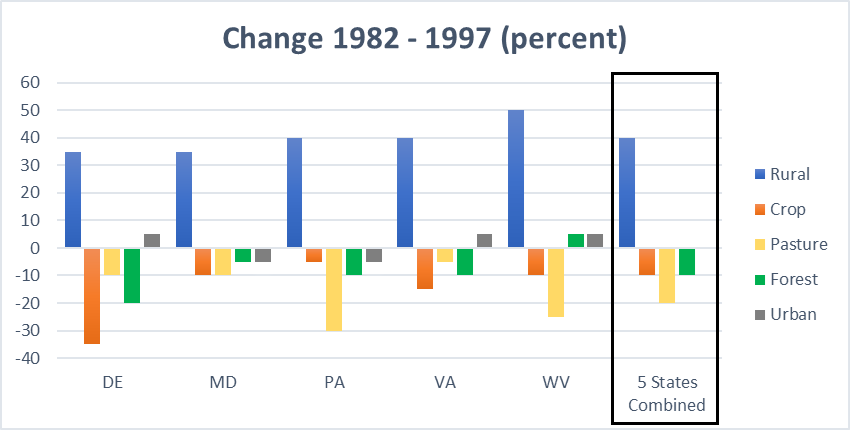
The graph shows the percent change in the area of different land cover types across five states (DE, MD, PA, VA, and WV) as well as for these five states combined, from 1982 to 1997.
Select from each drop-down menu the option that creates the most accurate statement based on the information provided.
If in 1997 Pennsylvania's (PA) rural land coverage equaled the average rural land coverage of the five states combined, then in 1982 Pennsylvania's rural land coverage was of the combined rural land coverage for all five states.
If Delaware (DE) and Maryland (MD) had similar acreage of land under crop in 1997, Delaware would have had approximately more acreage of cropland as compared to that in Maryland in 1982.
ShowHide Answer
Official Answer
Dropdown 1: 20%
Dropdown 2: 40%
12 Nov 2024, 04:03
Kudos
Bookmarks
Official Solution:
Drop-down 1:
Both Pennsylvania and the five states combined experienced a 40% increase in rural land coverage from 1982 to 1997. Thus, if in 1997 Pennsylvania's rural land coverage equaled the average for the five states combined, then in 1982 it also equaled the average, making Pennsylvania's rural land coverage 1/5, or 20%, of the total for the five states.
Drop-down 2:
Assuming Maryland's cropland acreage in 1982 was 100 acres, then after a 10% drop by 1997, it would have 90 acres. Since Delaware and Maryland had the same cropland acreage in 1997, Delaware also had 90 acres. Given that Delaware experienced a 35% drop from 1982 to 1997, its 1982 cropland acreage would be \(\frac{90}{0.65}\approx 140\) acres. Therefore, in 1982, Delaware (140 acres) had 40% more cropland acreage than Maryland (100 acres).
Correct answer:
Dropdown 1: "20%"
Dropdown 2: "40%"
Bunuel
Drop-down 1:
Both Pennsylvania and the five states combined experienced a 40% increase in rural land coverage from 1982 to 1997. Thus, if in 1997 Pennsylvania's rural land coverage equaled the average for the five states combined, then in 1982 it also equaled the average, making Pennsylvania's rural land coverage 1/5, or 20%, of the total for the five states.
Drop-down 2:
Assuming Maryland's cropland acreage in 1982 was 100 acres, then after a 10% drop by 1997, it would have 90 acres. Since Delaware and Maryland had the same cropland acreage in 1997, Delaware also had 90 acres. Given that Delaware experienced a 35% drop from 1982 to 1997, its 1982 cropland acreage would be \(\frac{90}{0.65}\approx 140\) acres. Therefore, in 1982, Delaware (140 acres) had 40% more cropland acreage than Maryland (100 acres).
Correct answer:
Dropdown 1: "20%"
Dropdown 2: "40%"
19 Nov 2024, 07:37
Kudos
Bookmarks
I have revised the question, solution, and formatting by adding more details to enhance clarity