Events & Promotions
|
|

GMAT Club Daily Prep
Thank you for using the timer - this advanced tool can estimate your performance and suggest more practice questions. We have subscribed you to Daily Prep Questions via email.
Customized
for You
Track
Your Progress
Practice
Pays
Not interested in getting valuable practice questions and articles delivered to your email? No problem, unsubscribe here.
 Sep 21
07:00 PM EDT
-10:00 PM EDT
Boost your GMAT score in less than one month in a live online class + 6 months access to TTP OnDemand video courses included! Sep 18
10:00 AM IST
-11:00 PM IST
Start your journey with a fully customized action plan and work with a dedicated mentor to achieve a 735+ score. Sep 26
01:00 PM EDT
-04:00 PM EDT
Top scores are possible when you enroll in a powerful GMAT course, taught live online + 6 months access to TTP OnDemand video courses included. Class starts Saturdays Sept. 26, 2026 - Dec. 19, 2026, 1:00pm-4:00pm ES


 13 Mar 2025, 01:29
Kudos
Bookmarks
In response to increasing environmental concerns and new government regulations, Woodchuck Timber Co. is implementing sustainable logging practices. This includes using lower-impact logging machinery and reserving additional land for reforestation efforts. These changes will improve our public image and align us with the Green Lumber Certification program, potentially opening us up for subsidies and grants from governmental environmental agencies. However, be aware that sustainable methods are more costly, both in terms of purchasing eco-friendly machinery and the additional space required for conservation. Despite these costs, I believe this is a crucial step for our future growth and approval rates with both the public and government.
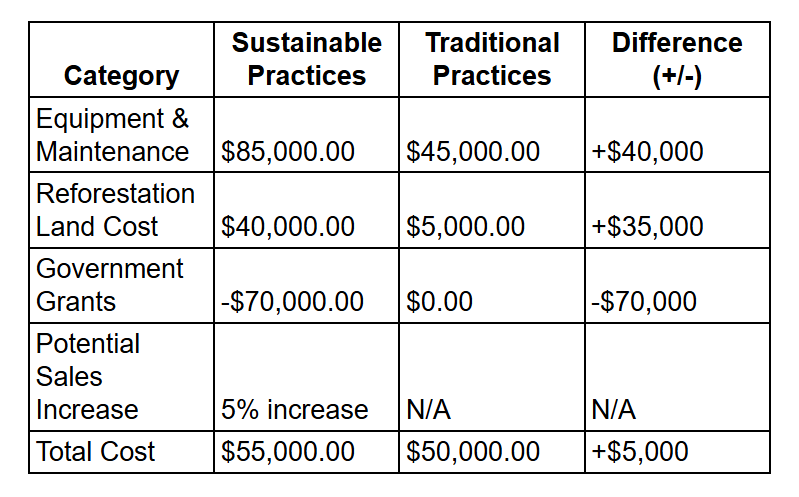
Which of the following statements best reflects the CEO’s stated rationale for adopting sustainable practices?
| The expected grants could offset most of the additional annual operating costs associated with sustainable practices. | |
| Sustainable practices could lead to reduced regulatory fines and penalties over time. | |
| There is a significant annual increase in operating costs due to eco-friendly equipment and conservation land. | |
| Traditional practices are less costly and require fewer resources than sustainable practices. | |
| Sustainable practices align the company with the Green Lumber Certification program, potentially improving its reputation. |
ShowHide Answer
Official Answer
Sustainable practices align the company with the Green Lumber Certification program, potentially improving its reputation.
13 Mar 2025, 01:29
Kudos
Bookmarks
Official Solution:
The question asks us to find which statement best reflects the CEO’s stated rationale for adopting sustainable practices.
- The expected grants could offset most of the additional annual operating costs associated with sustainable practices. This follows from the Finance Team’s analysis, but it does not reflect the CEO’s stated rationale. So, this statement doesn’t work.
- Sustainable practices could lead to reduced regulatory fines and penalties over time. This is a possible long-term benefit mentioned by the Finance Team, not part of the CEO’s stated rationale. So, this statement doesn’t work.
- There is a significant annual increase in operating costs due to eco-friendly equipment and conservation land. This describes a cost of adopting sustainable practices, not the CEO’s rationale for adopting them. So, this statement doesn’t work.
- Traditional practices are less costly and require fewer resources than sustainable practices. This is a disadvantage of sustainable practices, not the CEO’s rationale for adopting them. So, this statement doesn’t work.
- Sustainable practices align the company with the Green Lumber Certification program, potentially improving its reputation. In Email 1, the CEO says: “These changes will improve our public image and align us with the Green Lumber Certification program.” This directly reflects the CEO’s stated rationale. So, this statement works.
Correct answer:
Which of the following statements best reflects the CEO’s stated rationale for adopting sustainable practices? "Sustainable practices align the company with the Green Lumber Certification program, potentially improving its reputation."
Bunuel
The question asks us to find which statement best reflects the CEO’s stated rationale for adopting sustainable practices.
- The expected grants could offset most of the additional annual operating costs associated with sustainable practices. This follows from the Finance Team’s analysis, but it does not reflect the CEO’s stated rationale. So, this statement doesn’t work.
- Sustainable practices could lead to reduced regulatory fines and penalties over time. This is a possible long-term benefit mentioned by the Finance Team, not part of the CEO’s stated rationale. So, this statement doesn’t work.
- There is a significant annual increase in operating costs due to eco-friendly equipment and conservation land. This describes a cost of adopting sustainable practices, not the CEO’s rationale for adopting them. So, this statement doesn’t work.
- Traditional practices are less costly and require fewer resources than sustainable practices. This is a disadvantage of sustainable practices, not the CEO’s rationale for adopting them. So, this statement doesn’t work.
- Sustainable practices align the company with the Green Lumber Certification program, potentially improving its reputation. In Email 1, the CEO says: “These changes will improve our public image and align us with the Green Lumber Certification program.” This directly reflects the CEO’s stated rationale. So, this statement works.
Correct answer:
Which of the following statements best reflects the CEO’s stated rationale for adopting sustainable practices? "Sustainable practices align the company with the Green Lumber Certification program, potentially improving its reputation."
10 Aug 2026, 04:51
Kudos
Bookmarks
I have revised the question, solution, and formatting by adding more details to enhance clarity