Events & Promotions
|
|

GMAT Club Daily Prep
Thank you for using the timer - this advanced tool can estimate your performance and suggest more practice questions. We have subscribed you to Daily Prep Questions via email.
Customized
for You
Track
Your Progress
Practice
Pays
Not interested in getting valuable practice questions and articles delivered to your email? No problem, unsubscribe here.
 Aug 26
10:00 AM EDT
-11:59 PM EDT
Save up to $1,000 on select GMAT prep now. This Fall, achieve your most ambitious goals with millions of student success stories behind you. Aug 27
10:00 AM EDT
-11:00 AM EDT
We’ve worked incredibly hard to build TTP into the best test prep experience possible, and it would mean a lot to us to win Newsweek’s 2026 Readers’ Choice Award for Best Test Prep. If TTP has helped you, we’d be incredibly grateful for your vote. Sep 06
09:30 AM EDT
-12:30 PM EST
Top scores are possible when you enroll in a powerful EA course, taught live online + 6 months access to TTP OnDemand video courses included! Perfect class schedule and easy course access for working professionals. Class starts Sept. 6, 9:30am-12:30pm EST Sep 09
07:00 AM PDT
-10:00 AM PDT
Meet AdComs and explore top Master’s programs - MiM, MiF, MSc, MSBA and more. - Application Fee Waivers - Free 1-Week of GMAT Club Tests: - Master's Application Toolkit - Grand Prize Giveaway Sep 15
07:00 PM EDT
-09:00 PM EST
Elite scores are possible when you enroll in a powerful GMAT course, taught live online + 6 months access to TTP OnDemand video courses included! Class starts Tues/Thurs Sept. 15, 2026 - Nov. 15, 2027, 7:00pm-9:00pm EST Sep 21
08:00 PM EDT
-10:00 PM EDT
Elite scores are possible when you enroll in a powerful GMAT course, taught live online + 6 months access to TTP OnDemand video courses included! Class starts Tues/Thurs Oct. 13, 2026 - Jan. 7, 2027, 8:00pm-10:00pm EST


 16 Apr 2025, 07:35
Kudos
Bookmarks
Dropdown 1: Campaign A
Dropdown 2: 5.5
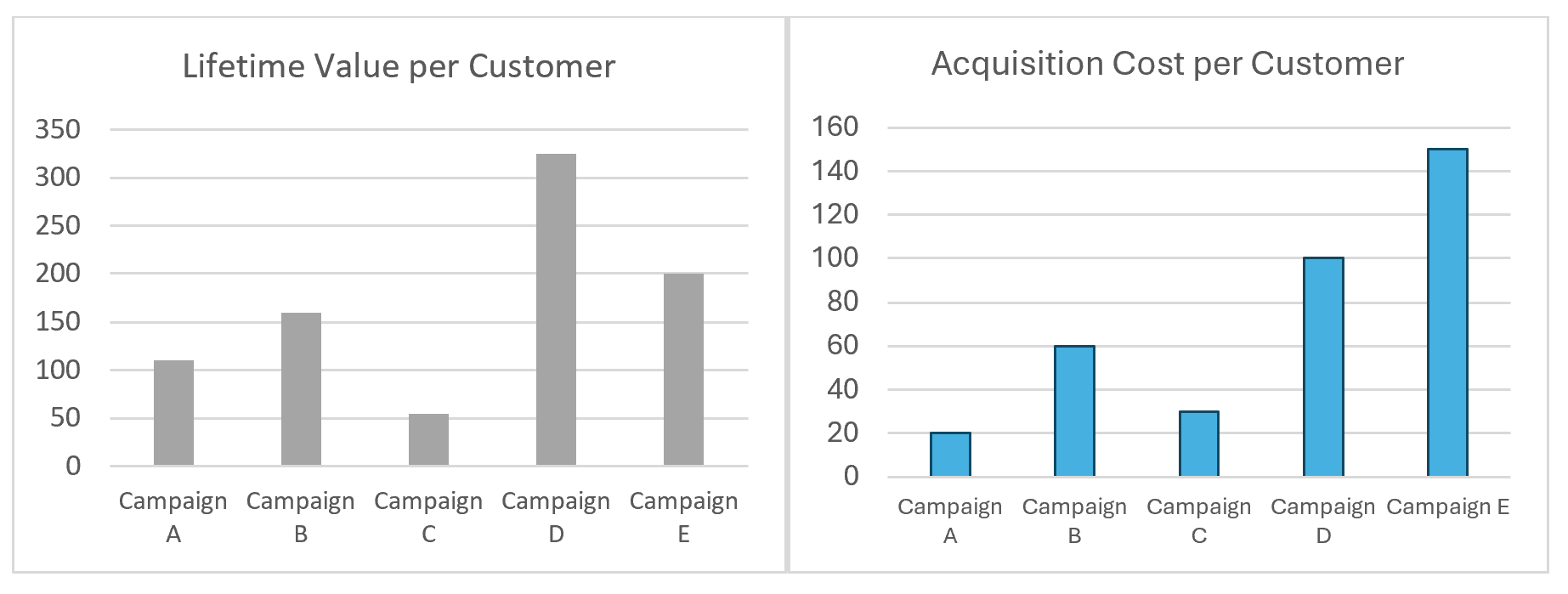
The two bar graphs show the results of five test advertising campaigns conducted by a marketing agency. The first graph displays the estimated Lifetime Value per customer (total revenue expected from a customer, in USD), and the second graph displays the Acquisition Cost per customer (cost to acquire one customer, in USD).
From each drop-down menu, select the option that creates the most accurate statement based on the information provided.
If each campaign acquired the same number of customers, the campaign with the highest ratio of Total Lifetime Value to Total Acquisition Cost is , with an approximate value of .
ShowHide Answer
Official Answer
Dropdown 1: Campaign A
Dropdown 2: 5.5
16 Apr 2025, 07:35
Kudos
Bookmarks
Official Solution:
Since each campaign acquired the same number of customers, the ratio of total Lifetime Value to total Acquisition Cost will be the same as the ratio per customer. So, we can compare the per-customer values directly to find the highest overall ratio.
Campaign A:
Lifetime Value ≈ 110 USD, Acquisition Cost ≈ 20 USD
Ratio = 110 / 20 = 5.5
Campaign B:
Lifetime Value ≈ 160 USD, Acquisition Cost ≈ 60 USD
Ratio = 160 / 60 ≈ 2.7
Campaign C:
Lifetime Value ≈ 50 USD, Acquisition Cost ≈ 30 USD
Ratio = 50 / 30 ≈ 1.7
Campaign D:
Lifetime Value ≈ 325 USD, Acquisition Cost ≈ 100 USD
Ratio = 325 / 100 ≈ 3.3
Campaign E:
Lifetime Value ≈ 200 USD, Acquisition Cost ≈ 150 USD
Ratio = 200 / 150 ≈ 1.3
The campaign with the highest ratio is Campaign A, with an approximate value of 5.5.
Correct answer:
Dropdown 1: "Campaign A"
Dropdown 2: "5.5"
Bunuel
Since each campaign acquired the same number of customers, the ratio of total Lifetime Value to total Acquisition Cost will be the same as the ratio per customer. So, we can compare the per-customer values directly to find the highest overall ratio.
Campaign A:
Lifetime Value ≈ 110 USD, Acquisition Cost ≈ 20 USD
Ratio = 110 / 20 = 5.5
Campaign B:
Lifetime Value ≈ 160 USD, Acquisition Cost ≈ 60 USD
Ratio = 160 / 60 ≈ 2.7
Campaign C:
Lifetime Value ≈ 50 USD, Acquisition Cost ≈ 30 USD
Ratio = 50 / 30 ≈ 1.7
Campaign D:
Lifetime Value ≈ 325 USD, Acquisition Cost ≈ 100 USD
Ratio = 325 / 100 ≈ 3.3
Campaign E:
Lifetime Value ≈ 200 USD, Acquisition Cost ≈ 150 USD
Ratio = 200 / 150 ≈ 1.3
The campaign with the highest ratio is Campaign A, with an approximate value of 5.5.
Correct answer:
Dropdown 1: "Campaign A"
Dropdown 2: "5.5"





