Events & Promotions
|
|

GMAT Club Daily Prep
Thank you for using the timer - this advanced tool can estimate your performance and suggest more practice questions. We have subscribed you to Daily Prep Questions via email.
Customized
for You
Track
Your Progress
Practice
Pays
Not interested in getting valuable practice questions and articles delivered to your email? No problem, unsubscribe here.
 Sep 02
12:30 AM EDT
-01:30 AM EDT
Thought your job leaves no time for GMAT prep? After multiple GMAT attempts and a demanding consulting job, Kshitij improved to 695 in under 2 months. Learn the mindset shifts, study strategy, and execution changes that made the breakthrough possible. Aug 27
10:00 AM EDT
-11:00 AM EDT
We’ve worked incredibly hard to build TTP into the best test prep experience possible, and it would mean a lot to us to win Newsweek’s 2026 Readers’ Choice Award for Best Test Prep. If TTP has helped you, we’d be incredibly grateful for your vote. Sep 02
08:00 PM PDT
-09:00 PM PDT
Video explanations + diagnosis of 10 weakest areas + 150+ short videos + study plan! Sep 03
01:30 AM EDT
-02:30 AM EDT
At one point, she believed GMAT wasn’t for her. After scoring 595, self-doubt crept in and she questioned her potential. But instead of quitting, she made the right strategic changes. The result? A remarkable comeback to 695. Check out how Saakshi did it. Sep 04
10:00 AM PDT
-11:00 AM PDT
What does test anxiety really look like on the GMAT? For many test takers, it does not look like a panic attack. Instead, it shows up as brain fog, rereading, negative comparisons, mental noise.... Sep 06
09:30 AM EDT
-12:30 PM EST
Top scores are possible when you enroll in a powerful EA course, taught live online + 6 months access to TTP OnDemand video courses included! Perfect class schedule and easy course access for working professionals. Class starts Sept. 6, 9:30am-12:30pm EST- Sep 09
07:00 AM PDT
-10:00 AM PDT
Meet AdComs and explore top Master’s programs - MiM, MiF, MSc, MSBA and more. - Application Fee Waivers - Free 1-Week of GMAT Club Tests: - Master's Application Toolkit - Grand Prize Giveaway  Sep 15
07:00 PM EDT
-09:00 PM EST
Elite scores are possible when you enroll in a powerful GMAT course, taught live online + 6 months access to TTP OnDemand video courses included! Class starts Tues/Thurs Sept. 15, 2026 - Nov. 15, 2027, 7:00pm-9:00pm EST Sep 21
08:00 PM EDT
-10:00 PM EDT
Elite scores are possible when you enroll in a powerful GMAT course, taught live online + 6 months access to TTP OnDemand video courses included! Class starts Tues/Thurs Oct. 13, 2026 - Jan. 7, 2027, 8:00pm-10:00pm EST


 12 Mar 2026, 07:00
Kudos
Bookmarks
Dropdown 1: 5
Dropdown 2: 1 empty lipstick
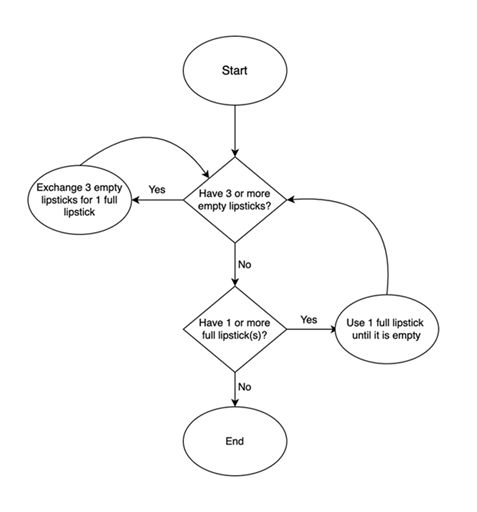
A drugstore chain can return empty lipsticks that it originally sold to the supplier for recycling. To encourage customers to return their empty lipsticks to its stores rather than throw them in the trash, the drugstore chain has instituted a new policy allowing customers to bring empty lipsticks to a store and exchange them for a new, full lipstick, as shown in the diagram.
Select from each drop-down menu the option that creates the most accurate statement based on the information provided.
Dara has 11 empty lipsticks originally purchased from this drugstore chain. If Dara exchanges these for new lipsticks under the store policy, wears the new lipsticks until they run out, and then repeats these actions (with the lipsticks that are now empty) to the fullest extent possible—without acquiring any additional lipsticks outside of the exchange program—then Dara will be able to acquire and wear new lipsticks, and will have upon reaching “End”.
ShowHide Answer
Official Answer
Dropdown 1: 5
Dropdown 2: 1 empty lipstick
12 Mar 2026, 07:00
Kudos
Bookmarks
Official Solution:
The store’s program allows Dara to trade 3 empty lipsticks for 1 new full one, as shown by the “Yes” path at the first question. With 11 empty lipsticks to begin with, Dara will be able to make this exchange three times (following the “Yes” arrow and then looping back, three times each). In so doing, Dara will trade 9 empty lipsticks for 3 full ones—and thus will have 3 full and 2 empty lipsticks.
At this point, Dara will not be able to make another exchange. So Dara wears one of the new lipsticks until it runs out, at which point Dara will have 2 full and 3 empty lipsticks, and will have worn 1.
Dara can now trade those 3 empty lipsticks for an additional full one—ending up with 3 full lipsticks (and no empties).
At this point, Dara will wear all three of these lipsticks one by one. After wearing all three, Dara will have just the 3 empty lipsticks, and will now have worn 4 lipsticks total.
Dara can then trade those 3 empties for one last full lipstick, and then wear that lipstick—the fifth and final one that Dara can wear. Dara will then reach “End” with the empty container of this one last lipstick. So, Dara acquires and wears 5 lipsticks total, and reaches “End” wih 1 empty lipstick.
Correct answer:
Dropdown 1: "5"
Dropdown 2: "1 empty lipstick"
Bunuel
The store’s program allows Dara to trade 3 empty lipsticks for 1 new full one, as shown by the “Yes” path at the first question. With 11 empty lipsticks to begin with, Dara will be able to make this exchange three times (following the “Yes” arrow and then looping back, three times each). In so doing, Dara will trade 9 empty lipsticks for 3 full ones—and thus will have 3 full and 2 empty lipsticks.
At this point, Dara will not be able to make another exchange. So Dara wears one of the new lipsticks until it runs out, at which point Dara will have 2 full and 3 empty lipsticks, and will have worn 1.
Dara can now trade those 3 empty lipsticks for an additional full one—ending up with 3 full lipsticks (and no empties).
At this point, Dara will wear all three of these lipsticks one by one. After wearing all three, Dara will have just the 3 empty lipsticks, and will now have worn 4 lipsticks total.
Dara can then trade those 3 empties for one last full lipstick, and then wear that lipstick—the fifth and final one that Dara can wear. Dara will then reach “End” with the empty container of this one last lipstick. So, Dara acquires and wears 5 lipsticks total, and reaches “End” wih 1 empty lipstick.
Correct answer:
Dropdown 1: "5"
Dropdown 2: "1 empty lipstick"
 19 Apr 2026, 05:55
Kudos
Bookmarks
Hi Bunuel,
can we use following shortcut to answer this question
When:
Each new lipstick consumes (k − 1) empties permanently.
Why?
Apply to This Problem
Given
Step 1: Maximum new lipsticks possible
Max new lipsticks=⌊Starting empties/(k−1)⌋=⌊11/2⌋=5
✅ Dara can acquire and wear 5 new lipsticks
Step 2: Final empties left
Final empties=11−(5×2)=1
✅ 1 empty lipstick remains
✅ Final Answer (using shortcut)
can we use following shortcut to answer this question
When:
- k empty items → 1 full item
- And every full item eventually becomes empty
- And nothing is added from outside
Each new lipstick consumes (k − 1) empties permanently.
Why?
- To get 1 full lipstick: you give k empties
- After using it, you get 1 empty back
- Net loss = k − 1 empties
Apply to This Problem
Given
- Exchange rate = 3 empty → 1 full
- Net loss per new lipstick = 3 − 1 = 2 empties
- Starting empties = 11
Step 1: Maximum new lipsticks possible
Max new lipsticks=⌊Starting empties/(k−1)⌋=⌊11/2⌋=5
✅ Dara can acquire and wear 5 new lipsticks
Step 2: Final empties left
Final empties=11−(5×2)=1
✅ 1 empty lipstick remains
✅ Final Answer (using shortcut)
- New lipsticks acquired and worn: 5
- Empty lipsticks at End: 1
Bunuel





