Events & Promotions
|
|

GMAT Club Daily Prep
Thank you for using the timer - this advanced tool can estimate your performance and suggest more practice questions. We have subscribed you to Daily Prep Questions via email.
Customized
for You
Track
Your Progress
Practice
Pays
Not interested in getting valuable practice questions and articles delivered to your email? No problem, unsubscribe here.
 Sep 24
01:30 AM EDT
-01:30 AM EDT
Tejas studied hard but kept repeating the same mistakes. After 3 attempts at 645, a focused 4-week strategy helped him identify and fix what was holding him back—leading to a 695 with just 12–15 hours of study per week. Sep 24
08:00 AM EDT
-08:30 AM EDT
Meet Tuck at an informal student or staff-hosted coffee chat in a city near you! Sep 26
12:30 AM EDT
-01:30 AM EDT
Struggling to find the right strategies to score a 99 %ile on GMAT Focus? Riya (GMAT 715) boosted her score by 100-points in just 15 days! Discover how the right mentorship, tailored strategies, and an unwavering mindset can transform your GMAT prep. Sep 26
01:00 PM EDT
-04:00 PM EDT
Top scores are possible when you enroll in a powerful GMAT course, taught live online + 6 months access to TTP OnDemand video courses included. Class starts Saturdays Sept. 26, 2026 - Dec. 19, 2026, 1:00pm-4:00pm ES Sep 26
06:00 PM PDT
-07:00 PM PDT
Free- full-length test + 15 concept videos + 150+ short videos + study plan! Sep 29
11:00 AM EDT
-01:00 PM EDT
" Description: Top scores are possible when you enroll in a powerful GMAT course, taught live online + 6 months access to TTP OnDemand video courses included! Class starts Tues/Thur Sept. 29, 2026 - Dec. 3, 2026, 11:00am-1:00pm EST Oct 01
07:00 AM BST
-08:00 AM GMT
Welcome to the GMAT Club's Free Interview Prep Event for Top MBA Programs! Buy tickets - Virtual series that’s all set to equip you to -excel in your MBA interviews.


 15 Feb 2024, 09:33
Kudos
Bookmarks


Dropdown 1: 4
Dropdown 2: 42
Be sure to select an answer first to save it in the Error Log before revealing the correct answer (OA)!
Difficulty:
 65%
(hard)
65%
(hard)
Question Stats:
72% (02:45) correct 28%
(02:44)
wrong
based on 1521
sessions
28%
(02:44)
wrong
based on 1521
sessions
History
Date
Time
Result
Not Attempted Yet
If N = 5 is the starting value, then after the process "N =N/2" is completed for the second time, the output is
Like N= 10,N = is a number that passes only once through the process "N = 3N + 1" before it reaches "stop."
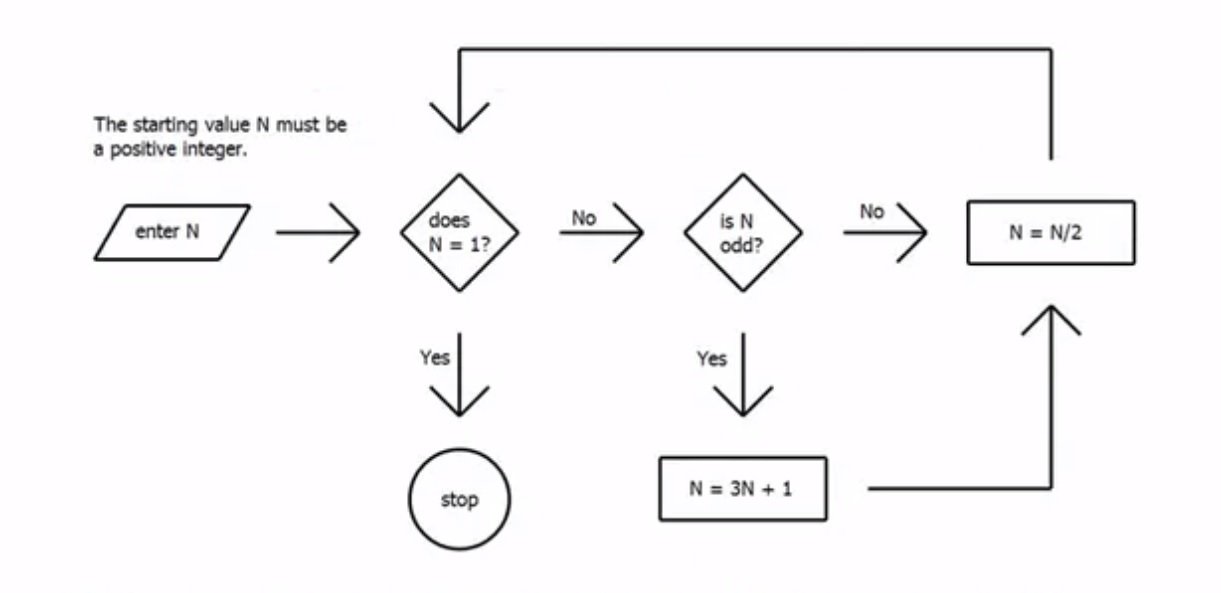
7.jpg [ 52.04 KiB | Viewed 10229 times ]
Attachment:
7.jpg [ 52.04 KiB | Viewed 10229 times ]
ShowHide Answer
Official Answer
Dropdown 1: 4
Dropdown 2: 42
 16 Feb 2024, 01:35
Kudos
Bookmarks
IMO 4 & 42
Logic-
For Statement 1,
If N = 5 is the starting value, then after the process "N =N/2" is completed for the second time, the output is
Is N = 1? No ---> Is N Odd? Yes ---> N=3N+1 i.e. N=3*5+1=16--->N=N/2 i.e. N=16/2=8. 1st Cycle is complete.
With N=8, Is N = 1? No ---> Is N Odd? No ---> N=N/2 i.e. N=8/2=4. 2nd Cycle is complete and 4 should be our answer.
For Statement 2,
With Trial and error we can find that N=42 is a number that passes only once through the process "N = 3N + 1" before it reaches "stop."
Logic-
For Statement 1,
If N = 5 is the starting value, then after the process "N =N/2" is completed for the second time, the output is
Is N = 1? No ---> Is N Odd? Yes ---> N=3N+1 i.e. N=3*5+1=16--->N=N/2 i.e. N=16/2=8. 1st Cycle is complete.
With N=8, Is N = 1? No ---> Is N Odd? No ---> N=N/2 i.e. N=8/2=4. 2nd Cycle is complete and 4 should be our answer.
For Statement 2,
With Trial and error we can find that N=42 is a number that passes only once through the process "N = 3N + 1" before it reaches "stop."

 30 Mar 2024, 22:07
Kudos
Bookmarks
1. If N = 5 is the starting value, then after the process "N =N/2" is completed for the second time, the output is [4]
n=5
=> \(n\neq{1}\)
=> n ood
=> n = 3 * 5 + 1 = 16
=> n = \(\frac{16}{2}\) = 8 (1st time)
=> \(n\neq{1}\)
=> n not odd
=> n = \(\frac{8}{2}\) = 4 (2nd time)
Answer: 4
2. Like N= 10,N =[42] is a number that passes only once through the process "N = 3N + 1" before it reaches "stop."
n = 10
=> \(n\neq{1}\)
=> n not odd
=> n = 5
... (like above)
=> n = 8 (n = \(\frac{n}{2}\) for the 1st time)
...
=> n = 4 (n = n/2 for the 1st time)
=> \(n\neq{1}\)
=> n not odd
=> n = 2
... (one more time divided by 2)
=> n = 1
=> The patterns seems that after the 1st time going thru "n=3n+1", the results must be something \(2^x\) to keep dividing by 2 without going thru "n=3n+1" again
Likely to choose an even to start trying (because the first N must go thru the "odd-even" test first)
42
=> n = \(\frac{42}{2}\) = 21
=> n = 21*3+1 = 64 = 2^6
Answer: 42
n=5
=> \(n\neq{1}\)
=> n ood
=> n = 3 * 5 + 1 = 16
=> n = \(\frac{16}{2}\) = 8 (1st time)
=> \(n\neq{1}\)
=> n not odd
=> n = \(\frac{8}{2}\) = 4 (2nd time)
Answer: 4
2. Like N= 10,N =[42] is a number that passes only once through the process "N = 3N + 1" before it reaches "stop."
n = 10
=> \(n\neq{1}\)
=> n not odd
=> n = 5
... (like above)
=> n = 8 (n = \(\frac{n}{2}\) for the 1st time)
...
=> n = 4 (n = n/2 for the 1st time)
=> \(n\neq{1}\)
=> n not odd
=> n = 2
... (one more time divided by 2)
=> n = 1
=> The patterns seems that after the 1st time going thru "n=3n+1", the results must be something \(2^x\) to keep dividing by 2 without going thru "n=3n+1" again
Likely to choose an even to start trying (because the first N must go thru the "odd-even" test first)
42
=> n = \(\frac{42}{2}\) = 21
=> n = 21*3+1 = 64 = 2^6
Answer: 42






