Events & Promotions
|
|

GMAT Club Daily Prep
Thank you for using the timer - this advanced tool can estimate your performance and suggest more practice questions. We have subscribed you to Daily Prep Questions via email.
Customized
for You
Track
Your Progress
Practice
Pays
Not interested in getting valuable practice questions and articles delivered to your email? No problem, unsubscribe here.
 Sep 28
07:00 PM EDT
-10:00 PM EDT
Boost your GMAT score in less than one month in a live online class + 6 months access to TTP OnDemand video courses included! Class starts Mon, Tues, Wed, Thur, Fri Sept. 28, 2026 - Oct. 16, 2027, 7:00pm-10:00pm EST Sep 29
11:00 AM EDT
-01:00 PM EDT
" Description: Top scores are possible when you enroll in a powerful GMAT course, taught live online + 6 months access to TTP OnDemand video courses included! Class starts Tues/Thur Sept. 29, 2026 - Dec. 3, 2026, 11:00am-1:00pm EST Oct 01
07:00 AM BST
-08:00 AM GMT
Welcome to the GMAT Club's Free Interview Prep Event for Top MBA Programs! Buy tickets - Virtual series that’s all set to equip you to -excel in your MBA interviews. Oct 03
01:00 PM EDT
-04:00 PM EDT
Top scores are possible when you enroll in a powerful GMAT course, taught live online + 6 months access to TTP OnDemand video courses included! Class starts Saturdays Oct. 3, 2026 - Dec. 26, 2026, 1:00pm-4:00pm EST

 11 Mar 2024, 10:05
Kudos
Bookmarks
Question 1


A
Be sure to select an answer first to save it in the Error Log before revealing the correct answer (OA)!
Difficulty:
 75%
(hard)
75%
(hard)
Question Stats:
46% (03:13) correct 54%
(03:12) wrong
based on 995
sessions
54%
(03:12) wrong
based on 995
sessions
History
Date
Time
Result
Not Attempted Yet
Question 2
E
Be sure to select an answer first to save it in the Error Log before revealing the correct answer (OA)!
Difficulty:
65%
(hard)
Question Stats:
54% (01:33) correct 46%
(01:44) wrong
based on 1064
sessions
History
Date
Time
Result
Not Attempted Yet
Question 3
C
Be sure to select an answer first to save it in the Error Log before revealing the correct answer (OA)!
Difficulty:
55%
(hard)
Question Stats:
50% (00:56) correct 50%
(01:03) wrong
based on 990
sessions
History
Date
Time
Result
Not Attempted Yet
GMAT-Club-Forum-v8ahjzmg.png [ 124.77 KiB | Viewed 5028 times ]
GMAT-Club-Forum-9kwktzbr.png [ 38.26 KiB | Viewed 5036 times ]
GMAT-Club-Forum-ltopnhxp.png [ 76.88 KiB | Viewed 5028 times ]
GMAT-Club-Forum-2gqhdoos.png [ 78.57 KiB | Viewed 5045 times ]
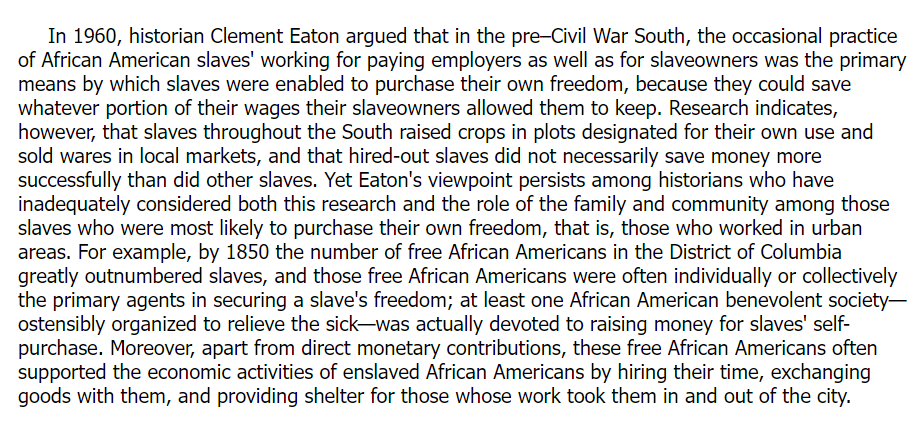
In 1960, historian Clement Eaton argued that in the pre-Civil War South, the occasional practice of African American slaves’ working for paying employers as well as for slaveowners was the primary means by which slaves were enabled to purchase their own freedom, because they could save whatever portion of their wages their slaveowners allowed them to keep. Research indicates, however, that slaves throughout the South raised crops in plots designated for their own use and sold wares in local markets, and that hired-out slaves did not necessarily save money more successfully than did other slaves. Yet Eaton’s viewpoint persists among historians who have inadequately considered both this research and the role of the family and community among those slaves who were most likely to purchase their own freedom, that is, those who worked in urban areas. For example, by 1850 the number of free African Americans in the District of Columbia greatly outnumbered slaves, and those free African Americans were often individually or collectively the primary agents in securing a slave’s freedom; at least one African American benevolent society— ostensibly organized to relieve the sick—was actually devoted to raising money for slaves’ self- purchase. Moreover, apart from direct monetary contributions, these free African Americans often supported the economic activities of enslaved African Americans by hiring their time, exchanging goods with them, and providing shelter for those whose work took them in and out of the city.
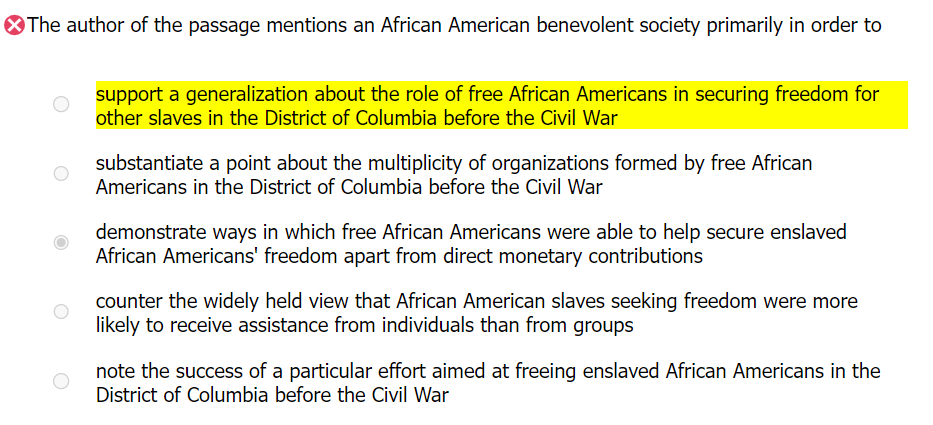
1. The author of the passage mentions an African American benevolent society primarily in order to
A. support a generalization about the role of free African Americans in securing freedom for other slaves in the District of Columbia before the Civil War
B. substantiate a point about the multiplicity of organizations formed by free African Americans in the District of Columbia before the Civil War
C. demonstrate ways in which free African Americans were able to help secure enslaved African Americans’ freedom apart from direct monetary contributions
D. counter the widely held view that African American slaves seeking freedom were more likely to receive assistance from individuals than from groups
E. note the success of a particular effort aimed at freeing enslaved African Americans in the District of Columbia before the Civil War
A. support a generalization about the role of free African Americans in securing freedom for other slaves in the District of Columbia before the Civil War
B. substantiate a point about the multiplicity of organizations formed by free African Americans in the District of Columbia before the Civil War
C. demonstrate ways in which free African Americans were able to help secure enslaved African Americans’ freedom apart from direct monetary contributions
D. counter the widely held view that African American slaves seeking freedom were more likely to receive assistance from individuals than from groups
E. note the success of a particular effort aimed at freeing enslaved African Americans in the District of Columbia before the Civil War
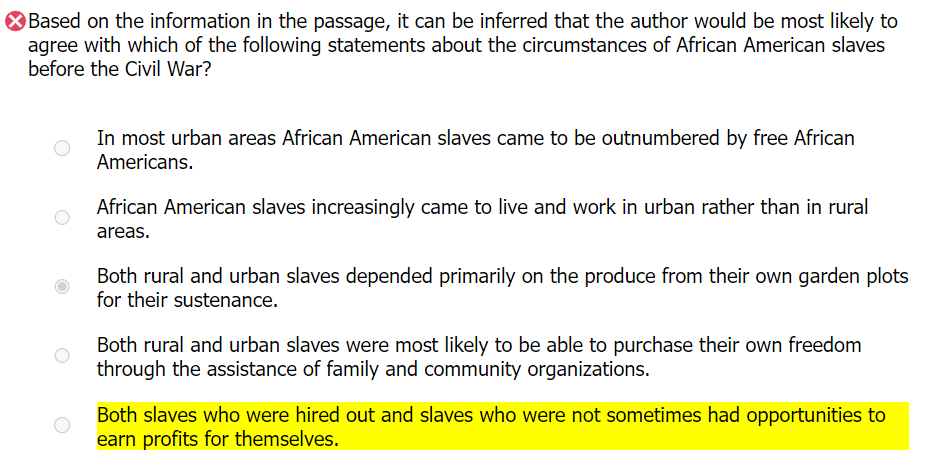
2. Based on the information in the passage, it can be inferred that the author would be most likely to agree with which of the following statements about the circumstances of African American slaves before the Civil War?
A. In most urban areas African American slaves came to be outnumbered by free African Americans.
B. African American slaves increasingly came to live and work in urban rather than in rural areas.
C. Both rural and urban slaves depended primarily on the produce from their own garden plots for their sustenance.
D. Both rural and urban slaves were most likely to be able to purchase their own freedom through the assistance of family and community organizations.
E. Both slaves who were hired out and slaves who were not sometimes had opportunities to earn profits for themselves.
A. In most urban areas African American slaves came to be outnumbered by free African Americans.
B. African American slaves increasingly came to live and work in urban rather than in rural areas.
C. Both rural and urban slaves depended primarily on the produce from their own garden plots for their sustenance.
D. Both rural and urban slaves were most likely to be able to purchase their own freedom through the assistance of family and community organizations.
E. Both slaves who were hired out and slaves who were not sometimes had opportunities to earn profits for themselves.
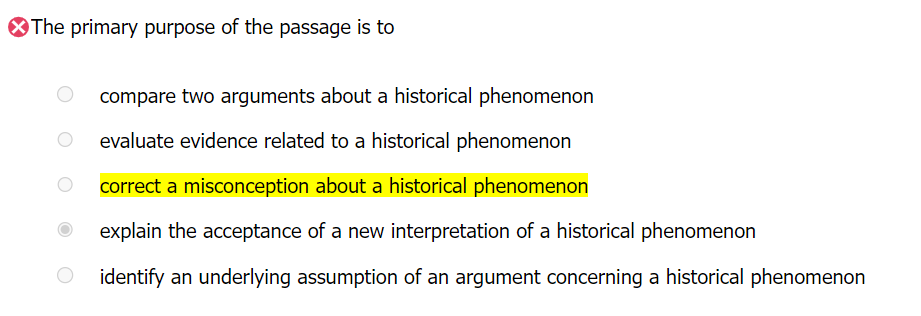
3. The primary purpose of the passage is to
A. compare two arguments about a historical phenomenon
B. evaluate evidence related to a historical phenomenon
C. correct a misconception about a historical phenomenon
D. explain the acceptance of a new interpretation of a historical phenomenon
E. identify an underlying assumption of an argument concerning a historical phenomenon
A. compare two arguments about a historical phenomenon
B. evaluate evidence related to a historical phenomenon
C. correct a misconception about a historical phenomenon
D. explain the acceptance of a new interpretation of a historical phenomenon
E. identify an underlying assumption of an argument concerning a historical phenomenon
Attachment:
GMAT-Club-Forum-v8ahjzmg.png [ 124.77 KiB | Viewed 5028 times ]
Attachment:
GMAT-Club-Forum-9kwktzbr.png [ 38.26 KiB | Viewed 5036 times ]
Attachment:
GMAT-Club-Forum-ltopnhxp.png [ 76.88 KiB | Viewed 5028 times ]
Attachment:
GMAT-Club-Forum-2gqhdoos.png [ 78.57 KiB | Viewed 5045 times ]
Question exposed a gap?
Take sectional Adaptive Quant, Verbal, or DI tests on GMAT Club and review the detailed score report.
Get started →
 23 Mar 2024, 23:41
Kudos
Bookmarks
1. The author of the passage mentions an African American benevolent society primarily in order to
A. support a generalization about the role of free African Americans in securing freedom for other slaves in the District of Columbia before the Civil War- correct answer
B. substantiate a point about the multiplicity of organizations formed by free African Americans in the District of Columbia before the Civil War- we are not talking about "multiplicity of organizations formed by free African Americans" anywhere in the passage.
C. demonstrate ways in which free African Americans were able to help secure enslaved African Americans’ freedom apart from direct monetary contributions- Great trap answer because of the words that are matching with what we have in the passage, but we are not talking about the "ways " they secured freedom, passage only talks about the role of African Americans in securing freedom.
D. counter the widely held view that African American slaves seeking freedom were more likely to receive assistance from individuals than from groups- mention of African American benevolent society only to support the role of African Americans in securing freedom not to counter anything.
E. note the success of a particular effort aimed at c in the District of Columbia before the Civil War-, True that society aimed at freeing the enslaved African Americans, but we don't have any clues in the passage about the success or failure of that effort.
A. support a generalization about the role of free African Americans in securing freedom for other slaves in the District of Columbia before the Civil War- correct answer
B. substantiate a point about the multiplicity of organizations formed by free African Americans in the District of Columbia before the Civil War- we are not talking about "multiplicity of organizations formed by free African Americans" anywhere in the passage.
C. demonstrate ways in which free African Americans were able to help secure enslaved African Americans’ freedom apart from direct monetary contributions- Great trap answer because of the words that are matching with what we have in the passage, but we are not talking about the "ways " they secured freedom, passage only talks about the role of African Americans in securing freedom.
D. counter the widely held view that African American slaves seeking freedom were more likely to receive assistance from individuals than from groups- mention of African American benevolent society only to support the role of African Americans in securing freedom not to counter anything.
E. note the success of a particular effort aimed at c in the District of Columbia before the Civil War-, True that society aimed at freeing the enslaved African Americans, but we don't have any clues in the passage about the success or failure of that effort.
 16 Apr 2024, 08:30
Kudos
Bookmarks