Events & Promotions
|
|

GMAT Club Daily Prep
Thank you for using the timer - this advanced tool can estimate your performance and suggest more practice questions. We have subscribed you to Daily Prep Questions via email.
Customized
for You
Track
Your Progress
Practice
Pays
Not interested in getting valuable practice questions and articles delivered to your email? No problem, unsubscribe here.
 Sep 15
07:00 PM EDT
-09:00 PM EST
Elite scores are possible when you enroll in a powerful GMAT course, taught live online + 6 months access to TTP OnDemand video courses included! Class starts Tues/Thurs Sept. 15, 2026 - Nov. 15, 2027, 7:00pm-9:00pm EST Sep 21
07:00 PM EDT
-10:00 PM EDT
Boost your GMAT score in less than one month in a live online class + 6 months access to TTP OnDemand video courses included! Class starts Mon, Tues, Wed, Thur, Fri Sept. 21, 2026 - Oct. 9, 2027, 7:00pm-10:00pm EST

 27 Jan 2022, 07:20
Kudos
Bookmarks
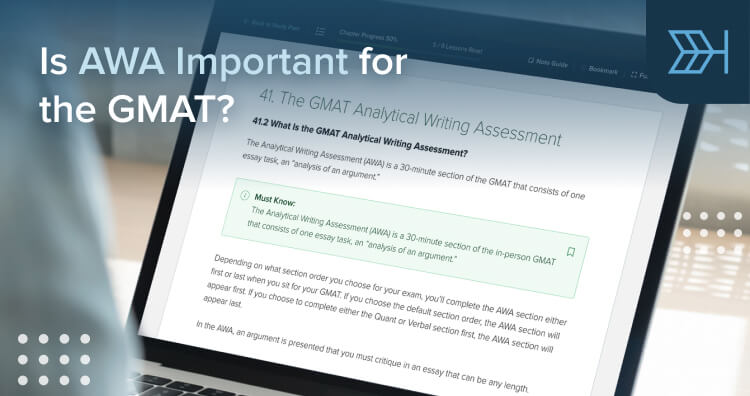
Is AWA Important for the GMAT?
With so much to learn for the GMAT, many students wonder how important it is to perform well on the Analytical Writing Assessment (AWA). After all, the Analytical Writing Assessment section is not factored into your total GMAT score. Furthermore, your AWA score isn’t included in the unofficial GMAT score report you see on test day. Does the AWA score affect admissions to MBA programs, or do business schools not really care about GMAT writing scores?It’s natural to ask these questions, but before you decide that preparing for the AWA section “isn’t worth it” or that “no one cares” about the GMAT AWA, there are some important facts to consider.
In this article, we’ll answer some common questions about what the GMAT AWA section is and why it matters. To start, let’s review what exactly the AWA section is.
What Is the Analytical Writing Assessment Section?
The Analytical Writing Assessment (AWA) is a 30-minute section of the GMAT exam that consists of one essay task called an Analysis of an Argument. In the AWA section, an argument is presented to you in a short essay prompt. In an essay of any length, you must write a critique of that argument. So, you’ll do things such as:
- analyze the argument’s line of reasoning
- point out any flaws or assumptions in the argument
- discuss what evidence might strengthen or refute the argument’s conclusion
- provide alternative explanations for what the argument says
And of course, you’ll need to organize your ideas logically and communicate them clearly.
Let’s now take a look at what AWA essays are generally about.
AWA Essay Prompts
AWA essay topics are typically business-related or “general interest.” Essay prompts are often presented in the form of an excerpt from a hypothetical newspaper or magazine article, organization memo or company report, corporate or organization newsletter, or business plan, to name a few examples. So, for example, an AWA question might present a short paragraph that is an excerpt of a memo issued by XYZ Corp’s manufacturing department. The excerpt explains why the department supports a proposal to shut down one-third of XYZ’s manufacturing plants. Your job is to find and critique any flaws in the department’s reasoning. Additionally, you would point out any further information that would be useful in assessing the validity of the department’s reasoning.
One good thing about AWA essays is that you don’t need any specialized knowledge to write them. You don’t even have to give your personal views on the subject matter. You just have to create a clear, well-reasoned response to the given argument.
Now that we have a basic understanding of what the AWA is and what AWA essays are about, let’s discuss some common questions GMAT test-takers have related to the importance of the AWA.
Does AWA Go Toward Your GMAT Score?
Only the Quant and Verbal sections of the GMAT are factored into your GMAT total score. So, neither the Integrated Reasoning (IR) score nor the AWA score affect your total score. For that reason, both of those sections are generally less emphasized by MBA admissions committees than the Quant and Verbal sections. However, “generally less emphasized” is not the same as “totally disregarded” or “not important.” A low score in any section of the GMAT has the potential to stick out like a sore thumb on your applications. So, the fact that the AWA score does not affect your total score is not a reason to slack off on the AWA.
Why Don’t You See Your AWA Score on Test Day?
Some GMAT test-takers make the mistake of thinking that, because the unofficial score report they see after they complete the GMAT exam includes only the Quant, Verbal, IR, and Total Score, the AWA is some “secondary” thing they don’t need to worry about.However, there is a good reason why you don’t see your GMAT Analytical Writing score on test day. GMAT AWA grading is done by both a computer and a person. All of the other section scores (and the total score) are calculated by a computer alone. Since AWA essays must be reviewed by a person — who will obviously not be at the test center with you — AWA scores take longer to generate than computer-generated scores. (Read more about how the AWA section is scored here.)
So, the fact that you receive your GMAT AWA score after test day rather than right after you finish your exam is not an indication that the AWA is unimportant or an afterthought.
To read the full article, view my full article on Target Test Prep’s blog.

Moderator:






